
Justice for the Green of Greenland! A Seasons by the Lake Talk with Naja Lund Aparico

Seasons. They’re a whole thing.
If you’re a children’s librarian or a teacher, that is.
I think you all know what I’m talking about. Whether you have to do a program out of the blue, a book display that will have enough books (this is why none of us do St. Patrick’s Day displays anymore, people), or a presentation of titles that have something to do with the time of year, season-related children’s books are a godsend. And so expansive! Who amongst us hasn’t given thanks to the Lois Elhlert title Leaf Man at least once in our lives when all the other autumn and fall books have been checked out?
But (and there is a but) they can get a bit samey, right? Here are the seasons of the year, here’s what we appreciate about them, and so on and so forth. You might begin to want for something more. So what if I were to tell you that there’s a new seasons book out, but the seasons? They don’t look ANYTHING like what you’d find in North America.
ADVERTISEMENT
ADVERTISEMENT
Seasons by the Lake: Adventures in Greenland (out now) by Naja Lund Aparico (Greenlandic Inuk) explores the idea of the seasons in a typical Greenland year. Or, as the publisher puts it:
“Brothers Minik and Nuka have a whole year of adventures ahead in Greenland, including finding ice shards from glaciers in the spring to picking crowberries during the summer when the sun barely sets.
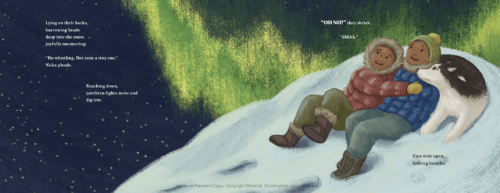
The darkness of winter reveals Arsarnerit, or the Aurora Borealis, above as the two whisper about the Inuit myth behind the lights.
Greenlandic Inuk author Naja Lund Aparico combines a sweet sibling story with an exploration of the seasons in the Arctic featuring stunning illustrations by German and Choctaw illustrator Alex Nees that captures the sweeping landscape.”
One does not get a chance to discuss seasons in such disparate areas of the world every day. As such, I was delighted to get the chance to ask Naja Lund Aparico some very specific questions:
Betsy Bird: Naja! Thank you so much for taking the time to answer some of my questions today. One of the things that really struck me about your book is how well it fits with some of the other alternate spring titles I’ve seen this season in children’s book publishing. On the outset, your book is a seasons book like any other. But the bulk of “seasons” in picture books (at least in the American publishing market) tend to follow a specific pre-ordained pattern. By placing your book in Greenland you’re able to show that seasons vary by climate and nation. Where did you initially get the idea for this book?

photo credit: Emil Lund Aparico
Naja Lund Aparico: Thank you so much for having me on your blog, Betsy! I am so thrilled to answer your questions.
I love this question. And I am happy you have noticed this specific perspective, because it was an intentional choice. When I first drafted the story, I had an outdoor/playtime concept in mind, but I did not think I had framed the story in a way that was easy for the reader outside of Greenland to relate to. For example, the storms, ice cold weather, long periods of darkness, or even the Midnight Sun were not anchored in the reader’s world view. So, structuring the story in a familiar way made it easier to compare with childhood fun in other parts of the world. In essence, I have applied a universal concept about the changing seasons to bring a cultural story to the reader. What inspired me to tell the story about outdoor adventures is that I really wanted to share how the weather and the time of the day/year in Greenland are not a hindrance to playing outdoors. Kids still play outside in the dark of the Winter, because during the long Winter the daytime is mostly dark. Conversely, during the Summer, it is still light enough during nighttime to play outdoors. After many (what feels like hundreds!) iterations, I landed on a structure that categorized playtime into ‘seasons’, because I think most readers can relate to that concept while trying not to be too didactic.
Betsy Bird: Honestly, the part where the kids are playing in broad daylight at midnight really stuck with me. And you do such an excellent job of not simply informing but also correcting some myths that people might have about the region. For example, I was always taught that Greenland was icy and Iceland was green. You have a bit of backmatter that discusses this as well as all kinds of other Greenland information. How did you decide what to highlight and explain and what to leave out?
Naja: Of course. The topic about the ‘greenness’ in Greenland is always fun to talk about. What I chose to highlight in the backmatter was not just the facts that the story shares, but also based on the questions that people ask me when I meet them. In fact, my book exemplifies – through Alex Nees’s illustrations – that Greenland is green during the Summer. And I am very proud to come from Southern Greenland, considered to be the greenest part of Greenland.
In choosing what to include in the backmatter generally, I try to put myself in the shoes of kids imagining Greenland without seeing any images. In that regard, I can understand if Greenland and the Arctic sounds like a place that is mono-seasonal: Ice and cold. But I think this is what my story combined with Alex Nees’s illustrations shows so well, that Greenland has distinct seasons – not just a variety of icy Winter to warmer Winter. For example, the Spring — when the ground begins to melt and the daylight stays longer — is really a relief. Just like where I live now in the Pacific Northwest, when Spring arrives, and I begin to tend to the garden. It is like a renewal and promise of great adventures to come. The same with the arrival of Summer, then there is great excitement about going into the fjords and going fishing. Another part of choosing backmatter is that I wanted to share some cultural aspects to show some folktales and myths as wells as local cultural traditions, like celebrating a child’s ‘firsts’.

In terms of deciding which facts to leave out, it comes down to whether I wanted the story to be solely a book of non-fiction or informational fiction. My choice was to lean into the fictional story as a way to connect with a reader on the level of a child, as opposed to being a non-fiction story about Greenland, which I consider would be at the level of a teacher. In addition, a non-fiction story about Greenland would have responsibility to include a broader variety of facts, which was not the purpose of SEASONS BY THE LAKE. Our story is about the joys of playing outdoors in Greenland.
BB: You’ve touched a little bit on this, but with all that in mind, how much of the book would you say is autobiographical? Have you experienced everything that the characters in the book have experienced or were there a couple things you added along the way?
Naja: I spent a large part of my childhood with my brothers, cousins and friends exploring nature on our own. We had the freedom to roam outdoors. Mind you that the wild outdoors in Greenland is pretty much outside a house. And I am very fortunate that I had these childhood adventures depicted in Seasons By The Lake: From collecting ice shards, fishing for Arctic char, Grandma throwing ‘paggaa’, and picking crowberries, camping under the Midnight Sun, sledding, whistling at Arsarnerit – as kids we were truly petrified of whistling at Northern Lights, because they always seemed like they moved faster and closer when you whistled at them! The thrill and excitement were real – and ice skating on a lake. If you have never ice skated on a lake, it is a recommended adventure. Especially on a large lake, where you can go in any direction without smashing into people, try laying splayed on top of the ice and just look through to the bottom of the lake. That alone can stir so much of a child’s imagination, anything from seeing lake monsters or just like for Minik and Nuka in this story, seeing all the way through the Earth’s center to the South Pole.
BB: I’m still entranced by the idea of whistling at the Northern Lights and seeing them get closer. So what would you most like kids (and the grown-ups who read to them) to take away from this book? What would you like them to know?
Naja: Naturally, my biggest hope is that the reader enjoys the story about outdoor adventures in Greenland. Secondly, if the takeaway from the story is that there are people living in Greenland, and they learn that the people in Greenland are Indigenous. Also, I hope the reader gets an understanding that Greenland does have distinct seasons, and that kids can play outdoors even through snowstorms. I think the book has done more than a wonderful job of portraying that.
ADVERTISEMENT
ADVERTISEMENT
BB: Absolutely. No question about it. Now you were paired with illustrator Alex Nees on this project. How do you feel about the final product? What does Alex bring to this book?
Naja: Alex Nees brings the story to another level, which I did not even think was possible. I admire the book every single day. There is a dreamy like air and texture to her motifs, which bring out the magical angle of the adventures combined with figments of my memories. The spread with Minik and Nuka bringing their catch home to Aanaa, with those colors and the airy ambience, is like a snapshot from my memory. The first time I saw that image, I teared up. It is very special and sometimes surreal to have an illustrator bringing the images in your head to life.
BB: Finally, will you be doing any other books for kids? Can we hope for more from you in the future?
Naja: Yes, I am very excited for two more picture books about Greenland to come out the next two years. One book that comes in 2027, and another planned for 2028.

Naturally, I’ve nothing but thanks for Naja for bringing all this to my attention and for taking so much care and attention in answering my questions. Seasons by the Lake: Adventures in Greenland is out now, so you’ve every reason to seek it out. Thanks too to Hannah Sheridan and the team at Penguin Young Readers for helping to put this all together.
Filed under: Interviews
About Betsy Bird
Betsy Bird is currently the Collection Development Manager of the Evanston Public Library system and a former Materials Specialist for New York Public Library. She has served on Newbery, written for Kirkus, and has done other lovely little things that she'd love to tell you about but that she's sure you'd find more interesting to hear of in person. Her opinions are her own and do not reflect those of EPL, SLJ, or any of the other acronyms you might be able to name. Follow her on BlueSky at: @fuse8.bsky.social
ADVERTISEMENT
ADVERTISEMENT
SLJ Blog Network
2026 Books from Asian/Pacific American Award Winners
Clock Hands | This Week’s Comics
From Policy Ask to Public Voice: Five Layers of Writing to Advance School Library Policy
The Choice is Yours, a guest post by Amanda McCrina
Dan Santat Talks Sashimi
ADVERTISEMENT