
Shouldn’t Work. Does. Brilliantly. We Discuss Charts for Babies with Michelle Rial

Nope.
No no no. Sorry, but no.
Y’all, I’m a book snob. I don’t mind saying it. Frankly, if you’ve got yourself some title trying to teach a baby the three-body problem, I ain’t intrigued. Folks, you know me. You know I don’t get swayed by that stuff. As such, what the heck am I doing looking a book called Charts for Babies (out as of April 7th), for crying out loud?!? That title sounds way suspicious, right? Like it’s just going to be a bunch of Excel spreadsheets on thick cardboard pages or something.
My friends… be prepared for a treat.
The fact of the matter is that Michelle Rial (a.k.a. the new funny person you need to add to your roster) has not only created what might be the most amusing for toddlers AND parents book of the year, she’s gone above and beyond the call of duty to answer some interview questions with me today… IN CHART FORM!!!
ADVERTISEMENT
ADVERTISEMENT
I am very very excited.
Betsy Bird: Michelle! Thank you so much for answering some of my questions today. CHARTS FOR BABIES is one of those titles that works exceedingly well on the page (and has never really been done in this way before for the ankle biter set). Please, give us the rundown on where precisely this book came from in the first place.
Michelle Rial: I started off trying to work on some kind of charts-for-parents version of my first adult book, Am I Overthinking This? which is a collection of life questions that I attempt to answer with charts. Something like “overthinking new parenthood” or “worrying for two” was the idea. I had a few ideas half-sketched in a notebook, but as a new mom I hadn’t had enough uninterrupted time to really get to anything good.
So one Mother’s Day weekend I asked my husband and my mom: Can you give me the entire weekend? I want to WRITE. And they are great, and so they did. So I went and sat at the coffee shop with my little notebook sketching more half-ideas, took a little walk, got a Topo Chico, sat in the park, and drew some silly thoughts about new parenthood. It was glorious! Problem was, I didn’t really want to think about being a parent all that much. I wanted to make something for my kid.
I had known in the back of my mind that I wanted to write a children’s book using charts, inspired by the sneaky ways my dad taught me math as a young child. And parents were often sending me photos of their kids engrossed in Am I Overthinking This?, so I often thought about making a kids’ version. I’d pitched a terrible board book idea in 2022, but this time I had a child that I actually wanted to write something for. I flipped to the back of the notebook and started sketching what would become Charts for Babies.

BB: Love that you still have the notebook. So you just mentioned your geophysicist dad. Tell us a bit about his influence on you and your appreciation for math, as well as how all that affected the creation of this book.
Michelle: Yes, he was a geophysicist: a researcher and a professor, so I had the privilege of being his youngest student. He loved sharing details of the world with me through a math and science lens, for as long as I can remember. He was also a painter, and when I was a baby, he loved to take me to museums and galleries, facing out in the baby carrier so I could see the art up close.
He had the immigrant parent compulsion of constantly pushing me to be better and better at math, but there was a poetry to the way he shared each concept. He had an ability to capture the magnificence of science in simple terms. He often pointed out fractals in nature, drew me simple equations and graphs, and shared math related riddles like this one:

He passed away in 2019, and I often wish I could remember and pass on all the knowledge he had to offer. And that’s a bit of what I wanted to do with this book.

BB: I think what I like best about this book is the simple fact that it will actually be interesting to young readers. People sometimes have this sense that if they pour facts and concepts into children’s books, it won’t matter that they’re boring. Never mind that kids get VERY strong opinions on the books that they prefer pretty early on. Your book, in contrast, lets parents quack like ducks, point, wave, and do any number of interactive things as they read. This indicates to me that you actually know the book business. How important was it to you to actually make the book interesting to kids?
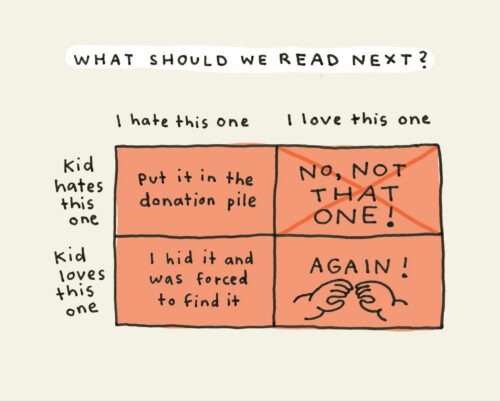
Michelle: Thank you for saying that!I wanted it to be interesting in general, and I wanted my baby (now almost-three-year-old) to like it. The ideal is something the kid loves, and the parent can enjoy too. There’s a graph somewhere in there… OK, here it is:
I wanted it to be engaging, and I now had an idea of what was engaging for my kid and my friends’ kids. I had learned the tricks. I can see now why that first children’s book I pitched was so bad—I wasn’t talking to kids, I wasn’t reading to kids, and I wasn’t reading any children’s books. Now? I read 1300 books *per night.* I just tell myself it’s research.

BB: Since your book isn’t really like any others out there, I’ll tweak this next question a bit. Are there any board books or picture books (or, really, any books at all) that you admire and that served as a kind of guide for CHARTS FOR BABIES?
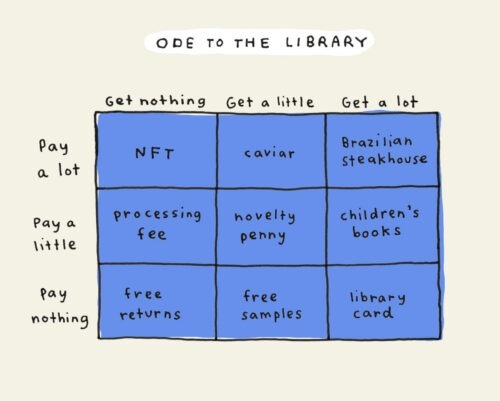
Michelle: As a creative person that is such a lovely thing to hear! More generally, I can say that trips to the library are definitely part of how the book came together. I love taking my son to our local library, where there are a bajillion books to peruse, and when he was smaller, while he browsed (aggressively unshelved) the books in the early learning section, I got to read (and re-shelve!) them too. I looked through a lot of opposites, colors, shapes, numbers, and letters books, and realized that charts cover all of these subjects in some way.
But more specifically, in the very young baby phase I was drawn to Press Here by Hervé Tullet and the Touch Think Learn series by Xavier Deneux. French and design-y is apparently my taste. Which also makes me think of Paris vs. New York by Vahram Muratyan—not a children’s book, but maybe it could be. I haven’t looked at it in probably over ten years, but it’s in there in my subconscious somewhere. I love clever, minimalistic art that can be understood with few words (or none).
I also have to say that during the time I sketched the first draft of the book, I had two board books stuck on repeat in my head: You Are New, by Lucy Knisely, and I Love You to the Moon and Back by Amelia Hepworth, so I’m sure that they influenced the cadence.
My picture book taste has definitely changed with time. I get Margaret Wise Brown now, and am not as annoyed by the made-up words in Dr. Seuss books. I really appreciate strangeness and unexpected whimsy, and wish I’d had even more in Charts for Babies. On the subject of weird, here are a few spreads, cover ideas, and rhymes that didn’t get past the draft stage:
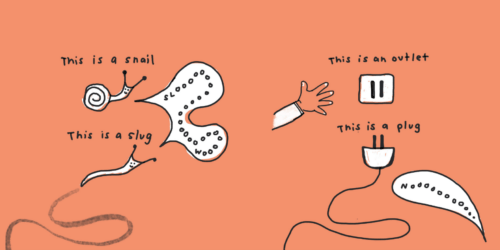


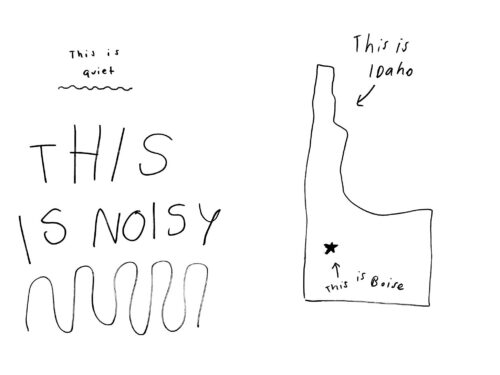

No slant rhymes!!
BB: Damn right. Now unlike other subjects, math often has an uphill battle to climb when it comes to children’s books. Parents and gatekeepers often fear it, while at the same time desperately wishing for their children to have a good grasp on the subject. What does this book do to alleviate some of that anxiety?
Michelle: It doesn’t take itself too seriously, and doesn’t try to go crazy with details. I have been thinking about it as sneaky STEM, a way to incept the subconscious with a new language that can stay with you for life, the way my dad did for me. After all, they say math is a universal language, and the earlier you start, the more likely it’ll stick.
I also like that when it’s read aloud, it turns math into movement. And it rhymes! I wanted to bring in little life moments that remind both the adult and child that math can be engaging, satisfying, and can help you see the world in a whole new way.
And since math is full of aha moments, I tried to add in some haha moments.
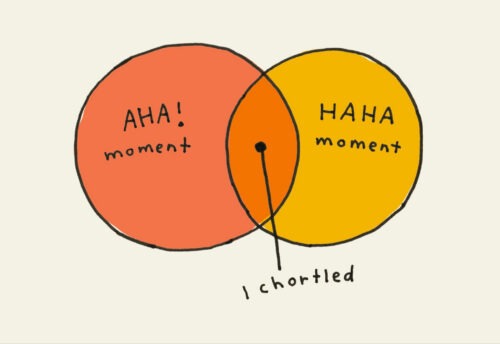
[Also pictured: the ahahaha moment]
BB: Talk to us a bit about how you worked out the images for this title. Did it all come naturally? Did you have to workshop some of these spreads? And which one, looking back, is your favorite overall?
Michelle: My process is a bit chaotic: I move from paper sketch to Procreate to Docs to Sheets, back to Procreate, back to paper, then a mix of Procreate and Photoshop for final editing. Each step has its own way of giving me a new way to see and change the work. Like the way you spot all your typos after you’ve already sent the email.
The first few pages came very quickly, and they were very shapes and opposites heavy. So I brainstormed more opposites, shapes, colors, and numbers to see how things could rhyme. I tried two on a page and one on a page. Simple charts don’t need to be huge, so two on each page worked and the rhymes flowed more smoothly.
The spreadsheet step helps me organize the book, the flow, and any details I’m wavering on, such as whether something feels “meh.”
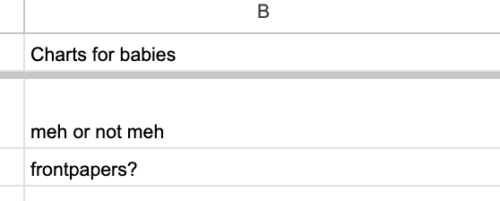
I made columns with all the rhymes and moved them around that way for a while, dragging each row to easily shift things around. I then made a column for the type of chart, which early learning concepts it covers, and what the fun square could say on this page (this is after I begrudgingly agreed to a character—more on that later). This helped spread out each chart style, and helped with tying the background color of each page to the endpapers so that they could function like a color-coded table of contents and index.
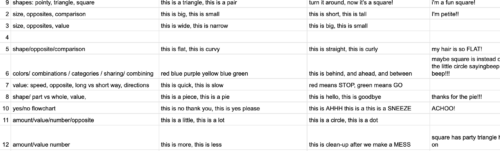
There was a whole lot of workshopping on my own, and then a lot of editing and back-and-forth with my editor, Meredith Mundy, and the art team, Heather Kelly and Azalea Afendi, who all enormously helped shape the book.
And on the workshopping, here are some files I found with the workshopping right on the page!
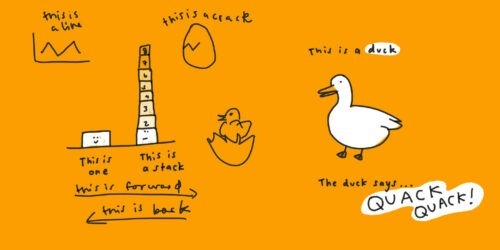
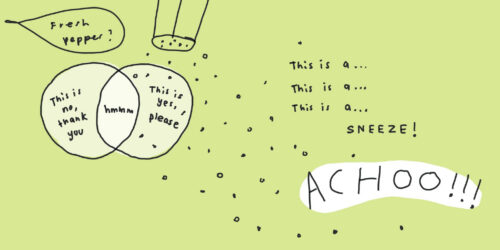
And a process video that is a lot of spreads that either didn’t make it, or have changed a lot since:
Here are some versions of the cover that didn’t make it. One “encouraged violence against books,” so the pulled out piece eventually became “share it,” which is sweet and does not involve book blasphemy. The challenge was making a chart that parents and kids would like that also related to the inside of the book.

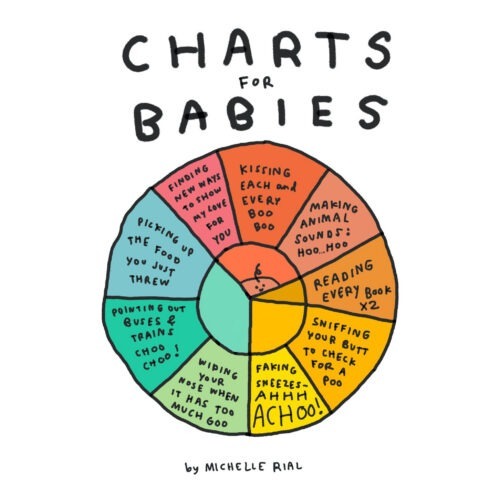
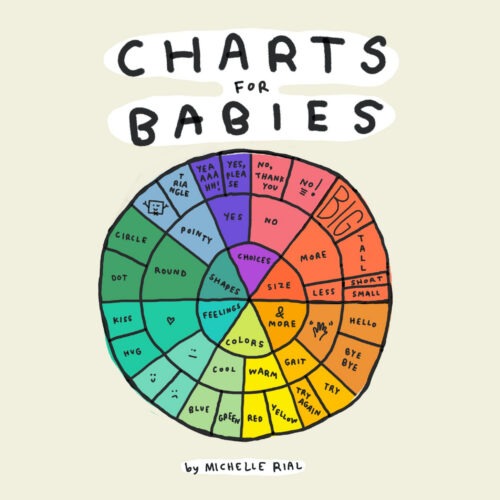
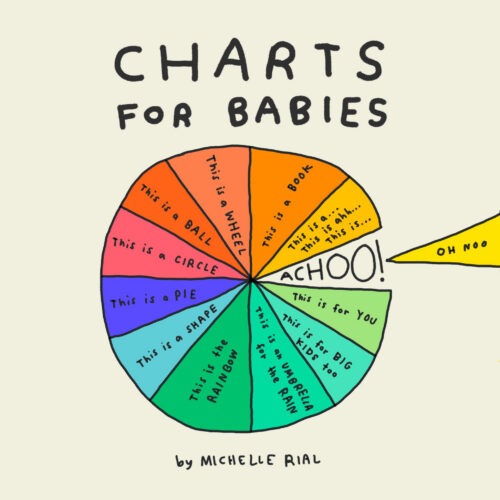
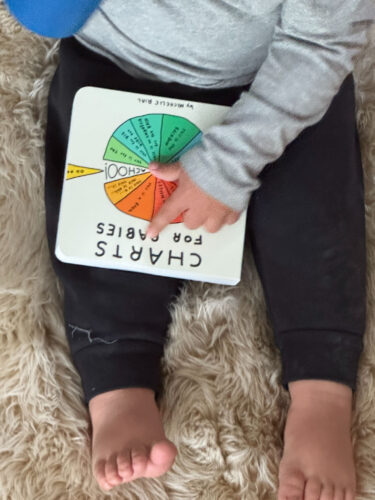
I drew and printed a few versions to see how they’d look on the tiny baby shelf, and with tiny baby hands:


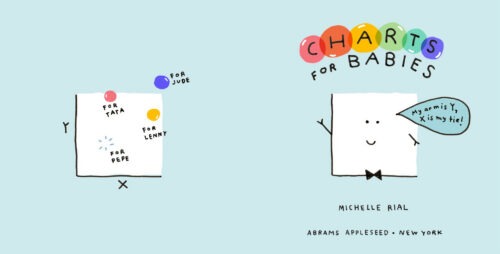
Favorite spread: I love the title page even though I skip it when I read the book aloud. It contains the satisfying aha moment that the square is actually a chart, and it honors my mom, husband, son, and dad (the popped bubble) as they all either inspired the book or gave me the time and space to write it.
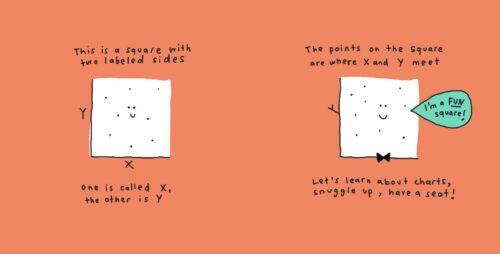
I chose to allude to the square as a chart here because it was too clunky when I tried to introduce it as “fun square” in the first spread. I wanted it to come more naturally, and wanted the quicker rhymes to start right away. Here is a first spread that was explored:
BB: I love all of this. Can we hope for more books like this in the future? And what else are you working on these days?
Michelle: I am so excited to say that, YES, if all goes according to plan, there will be another Charts for Babies book next year! Abrams offered an additional book in their deal, something like “untitled chart for babies book 2” and while I was waiting for edits and a contract on Charts for Babies (at the time, Charts for Baby), I immediately went to work on two options: feelings and sharing. Feelings filled out better and faster, and became Charts for Babies: All the Feelings. It is in the final art stages and my editor says everyone likes it even more than the first Charts for Babies, which feels great. That one has evolved a ton, and editing conveniently took place over the course of my son’s toddlerhood. Lots of feelings, lots of material.
Here’s a work-in-progress spread from Charts for Babies: All the Feelings

Once All the Feelings is fully done, I hope to go back to exploring more Charts for Babies ideas, and I am in the middle of pitching a book about an owl with “allergies,” which was a tangent from one of my favorite Charts for Babies covers in which the pie chart has a big sneeze. It probably doesn’t make sense to veer from the chart theme right as it’s started but I kept coming back to the idea, so I went with it. There are zero charts, and I’m working with an artist I love to make it flowery, quirky, funny, and a little bit strange.
I have also started sketches for a potential book that formed in my mind while washi-taping the entire alphabet on the floors of our home in three different rooms.
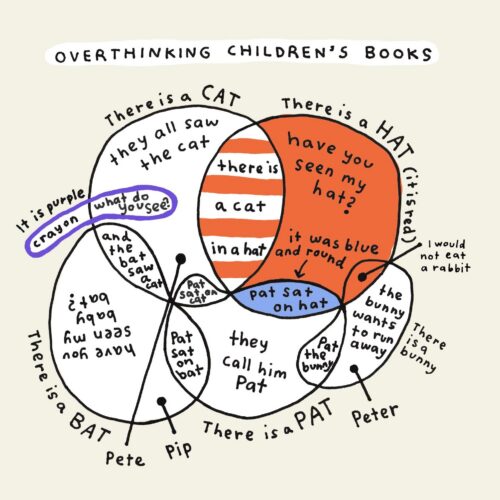
Oh! and I got back to work on those initial charts for parents that prompted this whole kids’ book exploration. I’ve pitched a few to publications as part of Charts for Babies promo, and am using them as preorder prints as a little gift for the parents. I thought I’d want to get back to making even more charts for that potential “overthinking new parenthood” book, but right now I’m having too much fun overthinking children’s books.
Overthinking children’s books:
Oh. My. God.
Just when I think we can’t raise the bar on interviews, we get something like this. Don’t know about you, but if Michelle were to turn pretty much ANY of these images into tshirts or bags, I would be first in line screaming, “TAKE MY MONEY!!”

Huge thanks to Michelle for all the hard work she poured into this interview. Charts for Babies is, as I mentioned before, on shelves now so you don’t have to do any of that pesky waiting around for it. Thanks too to Tracey Daniels for setting this whole thing up.
Filed under: Best Books, Best Books of 2026, Interviews
About Betsy Bird
Betsy Bird is currently the Collection Development Manager of the Evanston Public Library system and a former Materials Specialist for New York Public Library. She has served on Newbery, written for Kirkus, and has done other lovely little things that she'd love to tell you about but that she's sure you'd find more interesting to hear of in person. Her opinions are her own and do not reflect those of EPL, SLJ, or any of the other acronyms you might be able to name. Follow her on BlueSky at: @fuse8.bsky.social
ADVERTISEMENT
ADVERTISEMENT
SLJ Blog Network
Cover Re-Reveal: 1000 HORSES FOR THE KING by Gracey Zhang and Me
Exclusive: New Middle-Grade Fantasy from Nakama Press | News
From Policy Ask to Public Voice: Five Layers of Writing to Advance School Library Policy
ADVERTISEMENT
Completely new and engaging – can’t wait to get a copy!
Wow. THAT was an incredible interview. Thank you both! (Can’t wait to get my hands on a copy.)