
Secret Agent Men (and Women!): A Double Crossed Q&A with Rebecca E.F. Barone

There is great reason to feel good about the young generations reading books today. The material they have access to, for instance, is more variegated, diverse, and nuanced than a lot of what was around when I was growing up. You know what else is significantly better? Informational books for kids. Particularly those of the narrative nonfiction variety. Oh, sure, we had some when I was younger, but if we’re going to be honest, it couldn’t hold a candle to the stuff our children can read today. And of the nonfiction writers that are out there, one of the best of the best is Rebecca E.F. Barone. Let me tell you, her Mountain of Fire, about the Mount St. Helens eruption, may be one of the best booktalk books I’ve encountered in years. “And then they were riding logs to get away, and this one guy’s leg kept getting slammed into the other logs, over and over…”
You know what else is going to booktalk well? Barone’s latest. In a way, it has absolutely everything. Double agents. Chicken farmers with ambition. Even a reluctant hero who may have single-handedly secured the D-Day invasion… and paid the ultimate price. Double Crossed: The WWII Spies Who Saved D-Day (out April 28th) has it all. Or, put another way (by the publisher):
ADVERTISEMENT
ADVERTISEMENT
“In the fall of 1943, German troops controlled nearly all of continental Europe. The one chance the Allies had of punching through the German front meant keeping the enemy distracted and in the dark. They had to take the Germans by surprise on “D-Day.”
The mission: trick the Germans into believing the Allies would strike anywhere but their true target, the beaches of Normandy. Featuring historical photos and breathtaking true accounts, Double Crossed tells the exhilarating story of Operation Bodyguard, the mind-boggling effort to lay a false trail for the Germans using fake armies, decoy landings, and the covert work of double agents and spies who risked their lives. With millions of lives hanging in the balance, victory—or defeat—in World War II depended on the Nazis being caught unaware.”
Look, when you can get a blurb from Steve Sheinkin where he says that the book, “Throws you right into the action—real spies playing for the highest possible stakes!” then you know you’re doing something right.
Today, I talk to Rebecca E.F. Barone herself about her latest and all that it entails:
Betsy Bird: Rebecca! Such a pleasure to get a chance to speak with you today. I was a huge fan of your book MOUNTAIN OF FIRE about Mount St. Helens when it was released. This latest book, however, seems to bear a little more in common with your other WWII book UNBREAKABLE: THE SPIES WHO CRACKED THE NAZIS’ SECRET CODE. Did you come up with the idea of this book while researching that one, or did you come across this story in an entirely different way?

Rebecca E.F. Barone: Hi, Betsy! It’s wonderful to be chatting with you! I’ve long been in awe of the way you support and promote books for children. It’s so good to be here!
I’ve always been fascinated by spies. Their world seems so different, so separate from my ordinary one that it almost seems like fantasy. I’m always on the lookout for a good spy story, and I was thrilled when Brian Geffen, my editor, asked if there was another story to tell after UNBREAKABLE. In fact, early versions of DOUBLE CROSSED had a lot more emphasis on how the spies used information from Enigma (the German code that my earlier WWII book is about). Enigma was such a big part of early drafts that my working title for this book was actually “Broken,” in reference to breaking the Enigma code. While I discovered the double cross spy story after I wrote UNBREAKABLE, it jumped out at me because of the work I had done with Enigma.
BB: Ah! Makes Since. Now, since MI5 agent Thomas Argyll Robertson created a network of somewhere around 35 double agents, all tasked with deceiving the Abwehr, why did you land on focusing on the four key spies that you did?
Rebecca: It ended up being very natural to choose these four. I wanted to show agents who directly had an impact on the war, and above all, I knew I needed people who had left behind enough information for me to write an engaging story. I had to have journals or memoirs that recorded not only what happened, but how the agents felt and how they changed throughout the war.
These four agents have such a breadth of backgrounds and reasons for wanting to become spies. I love showing their range of motivations. They each risked their lives for different reasons, and it was important to me to show that there are many ways to have courage and be brave.
It’s also important to me, whenever I possibly can, to highlight the contributions of women. Lily, the main female spy in this book, overcame hurdles that the male spies did not. While women today certainly still face many obstacles, it is crucial for to show how far we’ve come and to celebrate the work done by previous generations.
BB: I’ll admit that I kept peeking at the Epilogue as I read to see what happened to everyone. I am NOT good with tension. So tell us a bit about how you conducted your research. Where did you go? Did you interview anyone who had firsthand knowledge (though I admit that would probably be unlikely considering how long ago these events took place).
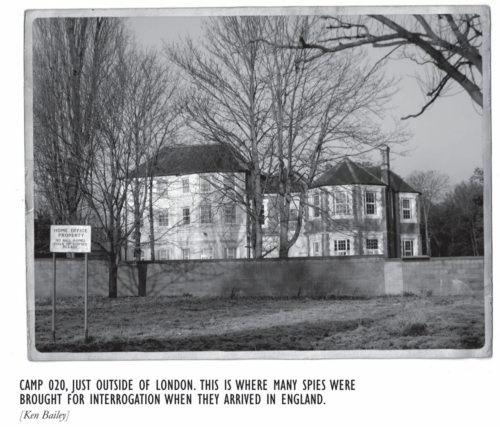
Rebecca: It was very different than researching MOUNTAIN OF FIRE, for sure! It was hard to switch from a book based largely on interviews to one based almost entirely on written works. All of the “characters” from this book have long since passed away. But, three of the four spies and several of the handlers published memoirs or journals after the war. Having their thoughts and feelings in their own words was key in writing this story.
There’s a lot more to D-Day and the deception campaign than just the spies, however, and I’m grateful there are experts who could walk me through a lot of this information! Talking with Dr. Robert Citino, a military historian with the National WWII Museum, was especially important for me in understanding German troop movements and the success of the double cross program.
BB: What proved most challenging when putting this book together? Were there elements of the story that you really wanted to include and simply couldn’t, for one reason or another?
Rebecca: I’m an engineer by training, and I’m constantly pulling myself back from going into more detail than necessary about how things work. I would love to spend page after page explaining details of Mulberry Harbors or how the triggering mechanisms are set up on pintails and paragons. I ended up cutting at least two paragraphs that were nothing but how to make a Morse code clicker out of kitchen supplies. There’s so much about nitty-gritty of how to be a spy that I think is incredibly interesting, but it ends up slowing down the story. In the end, this information isn’t crucial to the plot, but it’s always a bit gut-wrenching to leave it out! Sticking to the story, and not the mechanics of spying, was challenging for me!
And then are always elements of the story that are so juicy and interesting that they’d be fascinating to include, but I just can’t find a way to make them fit. There were so many layers to deception campaigns during WWII. Did you know that British intelligence tried to circulate a rumor that they had imported 200 man-eating sharks from Australia and let them loose in the English Channel? True story! They wanted to scare the Germans into thinking the sharks would eat any downed pilots! Such a cool anecdote, but it didn’t make it into the final book.
BB: Okay, but now I really REALLY want to see someone write about this sometime. WWII + Sharks = Gold. You know, books like DOUBLE CROSSED serve as such a great bridge between narrative nonfiction texts like the Who Was series and longer nonfiction tales that kids may enjoy as teens or adults some day. Are you yourself a nonfiction reader? And do you have thoughts on how we can better get kids to discover the form?
Rebecca: I’ll read anything that’s a good story! We use stories as a way of making sense of and understanding the world around us, and I’d argue that’s as much the point of fiction as it is of nonfiction. If a story’s being told well – fiction or nonfiction – then I’m there.
And I think that’s where nonfiction gets a bad rap. For readers who are adults now, we didn’t grow up with great nonfiction stories. In fact, I can’t remember a single middle grade nonfiction book outside of textbooks from when I was growing up. We didn’t have access to engaging nonfiction as kids, and we bring this baggage with us as adults to our own reading journeys.
The problem here, is that adults are the gatekeepers for children. And if the adults are biased against nonfiction because of their own history with it, then we expose children to it less.
I don’t know of any child who inherently discriminates against nonfiction. The real hurdle seems to be the adults who do – or more likely do not – offer nonfiction to kids. Again, I get it! We just didn’t have great nonfiction when we were growing up. There’s a reason for our gut reaction to the genre! But there’s been such a huge change in children’s nonfiction in the past few decades. Today there’s narrative nonfiction, graphic nonfiction, nonfiction in verse and more told in a wide variety of voices and styles.
The solution for kids to discover the form is for the adults around them – teachers, librarians, parents – to discover it first and then offer it with as much enthusiasm as they do fiction.

BB: Yes! Exactly! Well put! And in your acknowledgements you thank Brian Geffen, noting that this is the fourth book you’ve worked on with him. Tell us a bit about your working relationship. What does Brian do to help you bring each one of these books together into a cohesive whole?
Rebecca: I’m so glad you asked this question! My books would be entirely different without Brian. I can’t say enough about how a great editor – and Brian certainly is one! – can help an author utterly transform a book.
Brian sees my work in such a raw state, and he has the vision to suggest ways to bring it to a much higher level. Sometimes it’s pulling back areas that have gotten too technical, and sometimes it’s suggesting areas that need more explanation. Sometimes it’s highlighting what is going well and making that a more substantial part of the story. It’s different in every project, but I’m constantly amazed by how he sees the potential in a story and can guide it along.
Knowing how he can transform a book, and the patient, kind way in which he does so, leads to so much trust. I can take chances as a writer and go for reach topics, because I know that Brian and I will have these ongoing conversations to get the story to where it needs to be. My next nonfiction is about Wernher von Braun and the American space program, and I would never think about touching such a difficult topic that requires such nuance without absolute confidence in working with Brian.
BB: Finally, what are you working on next? What’s the next subject to intrigue you?
ADVERTISEMENT
ADVERTISEMENT
Rebecca: I’m thrilled to have two books coming out next year! Even though one is fiction and the other is nonfiction, they’re both about little-known episodes that had a big impact on us as a country.
I mentioned my next middle grade nonfiction earlier: LIFTOFF: THE MERCURY SEVEN ASTRONAUTS AND THE NAZI OFFICER WHO TOOK THEM TO SPACE. This book is about Wernher von Braun and Operation Paperclip, the American program that recruited Nazi officers to come to the States after WWII. Not many people know that our first American space rockets were direct descendants of rockets created for Hitler. It’s such an important story that examines the lengths we’re willing to go to ensure success and victory over other countries.
MIND NOT THE TIMID, my YA novel coming out in March, 2027, is about a teenager – Lily – who is thrown into the fight for women’s right to vote. I was floored when I found out about the Night of Terror and how suffragists were beaten and tortured while protesting for the right to vote. How did I never learn about this in school?! Lily also moves through the story while receiving letters from her brother who is fighting in France during WWI. I’ve loved getting to contrast the two storylines of suffrage and WWI, each of which show courage of people fighting for what’s right.
Betsy, thank you for these questions! It’s been wonderful to talk with you about books, research, writing, and editing!


Huge thanks to Rebecca for taking so much time and care and attention with her answers today. Double Crossed: The WWII Spies Who Saved D-Day is, as I mentioned before, out April 28th. And thanks too to Kelsey Marrujo and the team at Macmillan Children’s Publishing Group for helping me put this all together!
Filed under: Best Books, Best Books of 2026, Interviews
About Betsy Bird
Betsy Bird is currently the Collection Development Manager of the Evanston Public Library system and a former Materials Specialist for New York Public Library. She has served on Newbery, written for Kirkus, and has done other lovely little things that she'd love to tell you about but that she's sure you'd find more interesting to hear of in person. Her opinions are her own and do not reflect those of EPL, SLJ, or any of the other acronyms you might be able to name. Follow her on BlueSky at: @fuse8.bsky.social
ADVERTISEMENT
ADVERTISEMENT
SLJ Blog Network
One Star Review, Guess Who? (#231)
Walt Disney’s Mickey Mouse Versus the Mouseton Society of Evil | Review
Bring on the JUNE Mock Newbery suggestions!
From Policy Ask to Public Voice: Five Layers of Writing to Advance School Library Policy
ADVERTISEMENT