
Liminal: An Every Space (Conversation) Between Naseem Hrab and John Martz

Maybe I’m just a lazy soul at heart, but every once in a while I like it when I don’t have to do as much work on a Q&A post. I mean, do I even have to technically enter into the equation? Why don’t the authors and illustrators talk amongst themselves? They know the material better than anyone and they’d probably be willing to bring up points that no interviewer, no matter how well-intentioned, even could come up with.
When the folks at Groundwood Books proposed to me a post where author Naseem Hrab and illustrator John Martz talk about their latest picture book, Every Space Between (out today, as luck would have it), I was intrigued. It’s an interesting book to begin with, concentrating as it does on those liminal spaces betwixt and between. Or, as the publisher puts it:
ADVERTISEMENT
ADVERTISEMENT
You can find in-betweens everywhere! Some are as overlooked as the space between an itch and a scratch. Others are as thrilling as the pause between making a wish and blowing out your birthday candles. How you feel about an in-between really does depend on your perspective … and each one is full of potential.
Once you spot the spaces in-between, everything changes. Instead of rushing from one thing to the next, you can pause to collect and reflect. Is this something you really want to do? How much longer can you wait? Maybe it’s time to say … sorry?
Sparkling with the signature wit of Naseem Hrab (author of How to Party Like a Snail) and the cracking comedic timing of John Martz (illustrator of How to Give Your Cat a Bath: In Five Easy Steps), Every Space Between is an unexpected invitation to a world of possibilities!
Here then is a talk delving into some questions I would have thought to ask and a slew I wouldn’t:
Naseem Hrab: We originally were catching up over brunch when I pitched you Every Space Between among others. It was the only idea that seemed to appeal to you. Ha! Do you remember why?
John Martz: I honestly don’t remember any of the other stories you may have pitched! I hope this speaks to how much I felt drawn to this one over the others.
I think what I liked about it was how spare and poetic the text was … I’ve turned down other book projects when the text didn’t leave me, as the illustrator, any room to play around, or to contribute anything beyond illustrating the text literally. Your manuscript did not present an immediate narrative thread between all the examples of in-betweens, which made it a creative challenge ripe with opportunity, and it forced me to flex my muscles a bit.
In the true spirit of celebrating in-between moments, the space between having read the manuscript and having finally cracked the story open (with the help of our editor, Karen Li), was an exciting place to be as an illustrator. I couldn’t yet see what the book was going to be, but I knew it could be something fun, and that was interesting to me.
John: Okay, my turn. Was there an impetus for this manuscript? Did you know what it was going to be when you started writing? Was it inspired by a specific in-between moment? Or did it simply reveal itself in the process of writing?

Naseem: Or maybe it speaks to how forgettable my other ideas were! Hahaha.
As for the inspiration, I was on a date at the Art Gallery of Ontario back in 2021, and we came across the word “gloaming” in an exhibit. Neither of us had heard it before, so we looked it up: dusk. My date said, “You should put that in a book.” I have to admit, I initially bristled. No one tells me what to write. Hahaha. But seconds later, I thought, Wow, that’s a great idea.
At home, I explored the word more and was struck by how poetic some of the definitions felt to me — gloaming as something liminal and whole at the same time, expansive and contained. I didn’t know what the manuscript would be when I started, only that this word had unlocked ideas for other fleeting, overlooked moments, all whole in their own right.
We can all pause to appreciate how beautiful dusk is as a threshold, but what if we paused to take in other in-betweens? For example, what happens in the space between when your father leans in and when his kiss reaches your forehead? Between the day you were born and today? Between the first page of a book and the last?

The piece revealed itself as I wrote, taking the form of a poem that collects a variety of in-betweens and how they might make the reader feel. When I shared it with our editor, Karen, she was intrigued by it but encouraged me to find even more fun and ground it more firmly in a child’s perspective. She suggested I turn to Shinsuke Yoshitake’s work for inspiration, as we’re both huge fans, but I realized I’m no Yoshitake (I wish!). The final manuscript became my own, a sometimes absurd, often playful, and sweetly philosophical take. As Karen said, “It’s not what I asked for — but it’s totally what I wanted!”
Even though the word “gloaming” never made it into the book, the journey from day to night does. And I, of course, dedicated it to the person who inspired it, with heartfelt thanks. It truly wouldn’t exist without him.
Naseem: Back to you: Karen and I knew early on that this manuscript needed an illustrator who could bring its humor, beauty and emotion to life. Independently, we both landed on you! How do you take something that might feel a bit heavy or philosophical and bring it fully alive through a child’s perspective, playful, dynamic and full of heart?
John: Well, it’s very nice to think my drawings may have achieved all that!
As a kid I learned to draw by copying the comic strips in the newspaper, so my sensibilities and visual vocabulary are really informed by things like Peanuts and Calvin and Hobbes. Both of those strips dealt with philosophical themes filtered through the eyes of children, and I think the secret of why those strips were so effective is because neither Charles Schulz nor Bill Watterson treated the reader as anything but a sophisticated, clever person who was on their same intellectual level — and these strips, of course, were enjoyed by both children and adults.
The form of the comic strip is in my blood, too, I suppose. In a newspaper comic strip, you’ve got three or four small panels in which a joke or an idea needs to be communicated efficiently, and the images and action need to be readable and reproducible at a small size. Those constraints inform how the drawings look and how the drawings need to work — they need to be simple and clear, almost like diagrams.
It’s a bit like making visual haiku — in as few lines or in as few shapes and as simply as possible, figure out how to communicate the essence of an idea, but in such a way that it has some rhythm and life to it.
I don’t think it would take a team of forensic scientists to dissect the images from this book to find these inspirations in their DNA.

John: In the preparations for launching this book and talking about it, you and I have discussed the challenges of describing the book with a brief “elevator pitch.” As someone who works in both sides of publishing, do you think about a potential project in terms of saleability or how easy it might be to pitch it to a salesperson or a customer when you are writing? I’m curious if you have any favorite picture books that might similarly defy categorization or blurbability.
Naseem: Oof and ooh! What a question! It feels like audiences seem to have less patience or even tolerance for complexity. Think of Hollywood’s “X meets Y” pitch, which I hate on behalf of all storytellers, and the recent reports that Netflix has asked that writers repeat the plot three to four times in movie dialogue because everyone is casually watching while on their phones. We demand originality but still want instant reference points, which leaves little room for work that does something new. Too often, art that isn’t immediately understood is labeled a failure rather than simply unfamiliar or different. (I feel I should add that I’ve never thought I’m doing anything particularly original — I just write what I write and hope for the best.) I’m shaking my fists at many adults right now: they’re gatekeeping kids’ books more than ever, even philosophical ones, by assuming children can’t grasp deep, conceptual ideas.
So, to answer your question, do I think about a potential project in terms of saleability? No. Thankfully, since we still can’t predict what will truly resonate in the hearts and minds of readers, I can just focus on what pulls me creatively … and wistfully hope the readers will find and enjoy it!
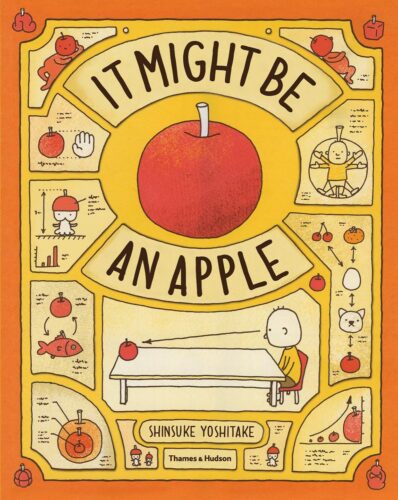
For me, the books that most defy categorization often tend to be international titles, where experimentation, ambiguity and rawness are celebrated. Some favorites include It Might Be an Apple by Yoshitake Shinsuke, Things That Go Away by Beatrice Alemagna, We Are Lions! written by Jens Mattsson and illustrated by Jenny Lucander and Every Color of Light by Hiroshi Osada and Ryōji Arai. All of these books do something exciting in my opinion.
Naseem: I want to return to your last answer. You spoke thoughtfully about philosophical themes and composition, but what about the emotional side of your work? I’d love to hear more about how you uncovered emotion in Every Space Between through the illustrations, how that process affected you, and how a certain tenderness emerged. And what are some of your favorite picture books that really make you feel the feelings? We’ve known each other for over twenty years, and I can already tell this will be your favorite question!
John: Haha, you’re not suggesting I am some sort of crusty, hardened cynic with a severe earnestness allergy, are you?
Well, you know my first draft of the book was much different. Many of the scenarios were the same, but there were different characters on every spread. It was not a book that focused on this one small family, but was more of a series of unrelated vignettes. It was our editor Karen who urged me to put more heart into it, suggesting I put more focus into the sibling relationship. I pushed back at first, because I worry that sweetness can easily become schmaltz, and I was initially more interested in the philosophical parts of the text, and how to solve the visual puzzle of it all.
But I’m grateful to have been pushed into a direction outside of my comfort zone because as I played around with the idea, a story emerged — characters and a thread that could connect the otherwise disparate scenarios. I saw rather quickly that it became a tighter, more satisfying book with this relationship at its core.
I could put these characters into new scenarios and they’d react interestingly to me because the more scenes they inhabited, the more their personalities emerged — they became real people in my mind. And if you’re thinking of a character as a real person, then by trying to understand them, you need to have empathy for them. And if you have empathy for someone — even a fictional character — then I think you can’t help but want to portray them honestly and with a little tenderness.
Some favorite picture books that have made my cold, black heart feel a little something:
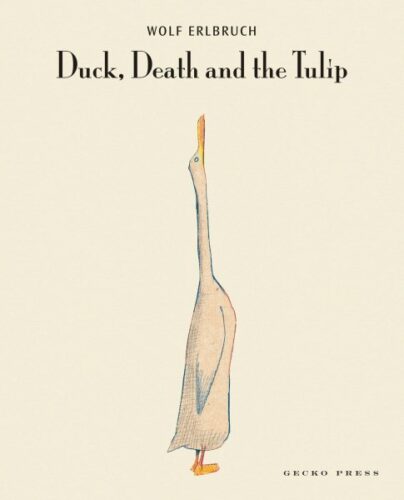
– Duck, Death and the Tulip by Wolf Erlbruch
– The Man by Raymond Briggs
– T is for Terrible by Peter McCarty
– The Longest Letsgoboy by Derick Wilder, illustrated by Cátia Chien
– Broken by X. Fang
John: Do you have a favorite part of the book, or something you hope people will take away from it?
Naseem: Hahaha. I was actually going to say to you that I truly think of you as a feeling, expressive human! Though I believe our respective crustiness is what has made our bond stronger.
May I answer both questions? I’ll be quick!
I loved getting to make this book: the origin, the writing, the collaboration. My favorite scene is when the family peers at all the ice cream flavors, because of the anticipation and sweetness of the moment. And because ice cream is one of my favorite things on earth!
I also love the scene showing the space between making a wish and it coming true. I love thinking about a kid somewhere whose wishes haven’t come true yet, but who can still believe they might someday. Instead of seeing them as over or impossible, the child can remember they’re still in the middle of their wish and hold onto that possibility indefinitely.

We tend to focus on beginnings and endings because they feel more promising or more concrete, but they’re illusory — life is mostly lived in the in-betweens. I hope the book helps readers slow down and pause to take in the middles, whether they’re sure or uncertain, full of hope or full of struggle. All middles have meaning.
Naseem: Let me know if you need anything for that allergy. Same questions — back at you!
John: My favorite part of the manuscript when I first read it was that first surprise page turn — CABBAGE! But I think my favorite part of the book, now that it’s complete, is the final page, which (I hope successfully) ties everything together and gives some meaning to the in-betweens that precede it.
My hope for the book is simply that it finds its audience — a reader (or two or three …) that’s willing to spend some time with it to find what might be hidden in between the pages.
Thank you, Naseem, this was fun!
Naseem: Thank you! … And just let me know when you’re ready for me to pitch you my next idea.

If ever there were an argument for picture book collaboration, it would have to be this talk. Many thanks to Naseem and John giving us a peek into their thoughts and process. Thanks too to Kirsten Brassard and the whole team at Groundwood Books for putting this together. As I mentioned before Every Space Between is out today, so you won’t even have to wait to see it firsthand. It’s out there for the taking!
Filed under: Guest Posts, Interviews
About Betsy Bird
Betsy Bird is currently the Collection Development Manager of the Evanston Public Library system and a former Materials Specialist for New York Public Library. She has served on Newbery, written for Kirkus, and has done other lovely little things that she'd love to tell you about but that she's sure you'd find more interesting to hear of in person. Her opinions are her own and do not reflect those of EPL, SLJ, or any of the other acronyms you might be able to name. Follow her on BlueSky at: @fuse8.bsky.social
ADVERTISEMENT
ADVERTISEMENT
SLJ Blog Network
Books to Celebrate National Poetry Month 2026
Born in the USA | Review
From Policy Ask to Public Voice: Five Layers of Writing to Advance School Library Policy
Different Kinds of Funny: Character Humor for Middle Grade Readers, a guest post by Laurie Morrison
Sara Pennypacker visits The Yarn
ADVERTISEMENT
What an amazing mind meld these two had to have -and the result so satisfying!