
A Nicholas Day/Corey Tabor Cover Reveal and Q&A? It’s Gotta Be a Look at A Riddle of Eels
Eels.
Now that I have your attention, let us discuss them.
I mean, not you and me. How much do you know about eels? How much do I? These were probably not the questions you expected to be asked today, but once you see the nonfiction picture book A Riddle of Eels by Nicholas Day, illustrated by Corey Tabor, all will be clear. This is one of those books that just makes you delighted to be alive to see such books for children in this day and age.
The publisher describes it in this way:
You’d think that a book about eels would tell you everything you need to know about eels: where they’re born, how they grow, where they live, where they die.
You’d think, anyway.
But the more we study eels, the more they slip away.
If a book about eels doesn’t tell you about eels, then what does it tell you about?
Here is a celebration of curiosity and wonder by a Sibert Medalist and a Caldecott Honoree—an awe-inspiring story of how much we have yet to know.
I will be showing you the cover (it’s very slithy, as Lewis Carroll might say) but first, one must never pass up the chance to interview Nicholas Day and Corey Tabor:
ADVERTISEMENT
ADVERTISEMENT
Betsy Bird: Nicholas! Someday someone somewhere will write a long article or book on you, and they’ll examine with great interest the topics that you have chosen for your nonfiction picture books. The line from John Cage’s 4’33” to eels is not direct, but it does speak to the possibility that you’ve a penchant for topics that no one else has touched. Let’s focus on the eels in this case. When did you first learn about them in such a way where you realized they’d be ideal for a book?
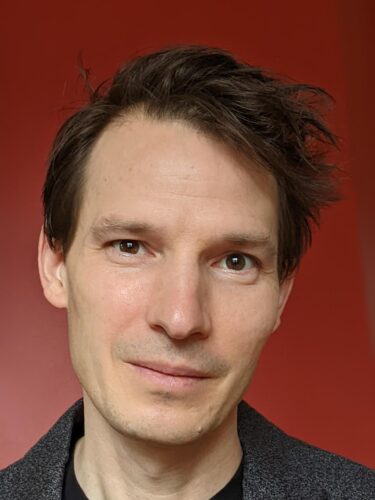
Nicholas Day: Betsy! It’s wonderful to be back here. When did I realize that eels would be an ideal subject for a book? Not to be excessively eel-like here, but I think the best way to answer this is to wiggle out of the clutches of this fine question, vanish in a cloud of mud, and…
BB: (what the…) Uh, okay. So you are not writing a book about things that we know. You are writing a book about one very specific thing that we do not know. And, granted, you surround that central question with things that we know on practically every page. Still, this unknowing is interesting to me. There are scant few informational books for kids that acknowledge freely that sometimes we, the humans, don’t know something. So I put it to you the very question this book brings up multiple times: “If a book of eels doesn’t tell you about eels, then what does it tell you about?” Because all these other books the kids are reading are seemingly saying something very different.
Nicholas: …reappear over here. Because this is at the heart of A Riddle of Eels. You’ve nailed it. It’s ultimately not about what we know. It’s about what we don’t know. For a while now, I’ve wanted to write a book on this subject, if it counts as a subject. I’d thought of it, half-seriously, as an informational book in which there’s a gap where the information part should be. An irony of having so many excellent nonfiction books for children is that it can appear that we already know everything: that our world is all mapped, archived, indexed, sorted. That’s not true, of course. But it can feel that way.
Then the problem is: How do you write a book about an absence? Writing about eels was a way in. We now know a lot about eels, and so there’s information there to build a narrative around. But the study of eels is ultimately the study of us failing to know things. We kept getting eels wrong, and not just wrong, but wildly wrong. And even today, when we know so much more, the eel has remained elusive. It keeps—very appropriately—slipping away. It’s a potent, poignant reminder of how much we don’t know, of how large and mysterious our world still is.
BB: Well articulated, sir. Or, rather, slithered. Let’s have a word or two with your partner-in-crime then. Corey! What a delight to see you doing straight up nonfiction! You’ve often done picture books that are nonfiction adjacent, but this feels like the first time you’ve gone all in on a fully informational text. What appealed to you about Nicholas’s project? Did you have a previous love of eels before now?
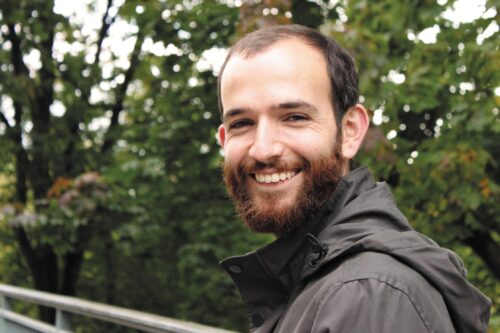
Corey Tabor: It was a delight to get to do nonfiction! Like you said, I’ve dipped my toes into nonfiction before, but this was my first time really diving all the way in. Honestly, I don’t think I’d ever really thought about eels before doing this book though. When I was sent this manuscript I had recently read and loved Nicholas’s The Mona Lisa Vanishes. I loved his voice, his sense of humor, and the way he looks at the world. I’d only read a few sentences of the Eels manuscript when I decided I had to do the book. I think Nicholas could write a book on just about anything and I’d want to illustrate it. But I’ve since become a member of the eel fan club too!
BB: How could you not be? And by the way, Nicholas, you get 500 extra points for including Pliny the Elder in a book for kids. I am consistently shocked at how few Pliny the Elder references children’s literature contains and if someone *cough* wanted to do a book for kids on him *cough cough* it would be a great idea. Now I know it is obvious to some, but you have a LOT of historical theories in this book of where eels come from. Can we assume that every theory you included was actually proposed by someone at some point?
Nicholas: Pliny the Elder biography: noted. But yes, I wanted to show how many theories there were out there, and there so many because eels were a source of such fascination. These theories—that eels came from the hairs of horses’ tails, for example—are so ludicrous that it might seem like I’m exaggerating for effect. But they only seem ludicrous to us today. At the time, they were all proposed with absolute earnestness.
BB: Speaking of ludicrious, I did not have on my Bingo Card for 2026 “Corey R. Tabor illustrates what Sigmund Freud and Rachel Carson would look like as eels”. That’s on me. I feel like I should have seen this coming in some way. The sequence, though, highlights how comfortable you are, Corey, mixing humor into the art of this book (often when Nicholas sets such things up in the text). How did you balance the lighter elements of the visual storytelling alongside the more serious informational sections?

Corey: Ha, that wasn’t on my bingo card either, but it’s one of the things I love about this job: you never know what project might be coming around the corner. I’m not sure that I was consciously trying to balance funny and serious in the illustrations. It was more that when I had a funny idea I’d throw it in and see what stuck (the spaghetti method). Since this was nonfiction, though, I did do a lot of research and tried to make sure that even when I was drawing silly things I was drawing those silly things accurately.
BB: Accuracy is key. That brings us to the research for this book. Nicholas, I don’t know what kind of a researcher you are, but I have to assume that if you were learning about eels and reading up on eels then it might be difficult to pull yourself out of the eel rabbit holes (how’s THAT for a mixed metaphor?) you discover. That’s why I’m going to give you an opportunity to tell us a couple amazing facts about eels that didn’t, for whatever reason, make it into your book but that are still incredibly fascinating. Go!
Nicholas: How about this: In the water, an eel’s sense of smell is as finely tuned as a dog’s. Or this: We still don’t know how long eels can live for. Decades, yes. But over a century? Possibly. Or: the Larousse Gastronomique once had 45 recipes for eel. Or: in medieval England, rent and taxes were often paid with dried eel. Or: the black market trade in eels today has been called “the largest wildlife crime by value on Earth.” Or: the young Sigmund Freud once spent a spring in the city of Trieste with his hands buried in eel guts, trying to locate its reproductive organs. Or…
BB: Stop! Stop! You’re going to make us all want an eel sequel! Whew! You know, there is a note at the end of the book about the decline in eels worldwide. How dire is the state of the eel today? You mention scientists tagging them, but is anything else being done to protect them in any systematic way?
Nicholas: There is, but it isn’t easy. We can put limits on the number of eels caught each year; we can make it easier for eels to migrate by removing obstacles we’ve placed in their way; we can crack down on the massive illegal trade in eels. These are good things to do, and they have a real impact. But eels are also difficult to protect because they live for a long time and in so many different places and in so many different ecosystems. They’re an umbrella species. We can’t just keep a river clean; we can’t just remove a dam; we can’t just stop flushing pollutants into our waters. We can’t just protect the Sargasso Sea itself. We have to do all those things. And then there’s climate change, which is altering the very currents that the eel floats on.

BB: Well, and then how do you illustrate any of that? Corey, I thought you’d set yourself up for a challenge when you had to write the chrysalis section of Papilio last year (you managed to make goo exciting). But now I see that you had to illustrate a LOT of eels for this book. Like, a slew. I have to assume that there would be a danger of making things a bit samey over time. Your endpapers, though, are one way you kept things interesting eel-wise. What else could you possibly do to pep things up on the page and not bore yourself with infinite eeldom?
Corey: It’s true, I drew a lot of eels for this book. But I also got to draw plenty of other fun (and strange) things—dinosaurs, a giant squid, baby eels being born from the tail of a horse, for a few examples. And something else I like to do to keep things interesting when I’m illustrating is to play with different art mediums. In this book I did a lot of paper marbling (I also used this technique in Ursula Upside Down). What you do is fill a little tub with water, drip in different colors of art resin, swirl it around, then dip your paper. It’s a watery, kind of slimy, sticky process, which felt very appropriate for the subject matter (and is also very fun to do). I used these marbled papers for some of the backgrounds throughout the book, including the endpapers.
BB: Was there anything you tried to do visually with this book that just didn’t work? Were there ideas that seemed like they might pan out but that ultimately had to be discarded along the way? Or did you have a pretty clear cut sense from the start of where you wanted to take this?
Corey: I think overall I had a pretty clear idea from the start of how I wanted to illustrate the book, but there were definitely a few ideas that were cut or changed during the editing process. And there’s this one spread near the end where the eels are emerging from the gutter of the book. I originally had some ambitious ideas about doing physical cutouts with the eels peeking through. But I could never figure out how to make it work. And then I realized that the gutter of the book was maybe a more elegant, simple way to illustrate the same idea.
BB: Nicholas, let’s talk about being paired with Corey Tabor for this book. Corey has, of course, done many picture books featuring creatures from the natural world. For any artist to be paired with your text, they would have to be comfortable drawing hundreds and hundreds of eels in the course of your storytelling. Did you have any sense of the style of art that would suit this book best? And how do you feel Corey did with the material.
Nicholas: Corey Tabor! You’ve seen this book. How do you convey the genius of what he’s done here? He’s brought the text to life in ways I’d never imagined. It’s not just the beauty of his line. It’s not just how moving his work is here. It’s also his sense of humor, the wit he brings to each page. (Rar! Glub!) At every point, he’s brought out the playfulness of the text. And his colors! It’s a stunning achievement.

ADVERTISEMENT
ADVERTISEMENT
BB: Speaking of colors, Corey, I just wanted to tell you that I absolutely love your endpapers. There isn’t a question here. I just really liked them.
Corey: Thanks! I wanted to do something a little more abstract with the endpapers. I’ve never really tried my hand at anything abstract like this before (I was a little scared to try it, to be honest) so I’m glad to hear that you like it.
BB: Finally, what else are you both working on these days? What’s next for you?
Nicholas: My next narrative nonfiction title will be out in the spring of 2027, which suddenly seems right around the corner. It’s called Get Rich Quick and it tells the story of Charles Ponzi, the original Ponzi schemer, and the confidence game in American life and history. Cons! Schemes! Frauds! It’ll be illustrated by the incomparable Brett Helquist.
Corey: Right now I’m working on a new Fox early reader called Fox Flies. And I have two books coming out in March, Fox Catches a Wave, and Wally Mammoth: Hide-and-Seek which was illustrated by my good friend Dalton Webb. And I also have a picture book coming out in May called Bear For A Day.
Love every aspect of these answers. How could I not? And you folks have been so very patient. Here, then, is the cover:


I want to thank Ann Kelley and the whole team at Random House Studio for helping to put this together today. Thanks too to Nicholas and Corey for taking such time and care to answer my questions. A Riddle of Eels is out September 8th, so you’ll have to wait until then to see it firsthand. Believe me. It’s worth the wait.
Filed under: Best Books, Best Books of 2026, Cover Reveal, Interviews
About Betsy Bird
Betsy Bird is currently the Collection Development Manager of the Evanston Public Library system and a former Materials Specialist for New York Public Library. She has served on Newbery, written for Kirkus, and has done other lovely little things that she'd love to tell you about but that she's sure you'd find more interesting to hear of in person. Her opinions are her own and do not reflect those of EPL, SLJ, or any of the other acronyms you might be able to name. Follow her on BlueSky at: @fuse8.bsky.social
ADVERTISEMENT
ADVERTISEMENT
SLJ Blog Network
Books on Film: Jeff Kinney on TODAY
Papercutz to Publish ‘Midnight Island’ | News and Preview
From Policy Ask to Public Voice: Five Layers of Writing to Advance School Library Policy
Taking Risks On The Page, a guest post by Jennifer Dickinson
Dan Santat Talks Sashimi
ADVERTISEMENT