
Milkwood: Spaces, Retreats, and Their Place in Children’s Literary History

I’ve been thinking a bit about legacies lately. What we leave for future generations. The choices we make now that will affect the future of children’s literature as a whole, however it happens to turn out. This is probably less because I’ve grand, all-encompassing thoughts and more because I’m middle aged and there’s a bit of memento mori floating about in the brain. Or maybe it’s also because I recently attended Sophie Blackall’s Milkwood retreat and it got me to thinking all kinds of great, grand thoughts.
In the United States, at this time, there are several places that I would deem children’s literature meccas. They are, and in no particular order:
- The Rabbit Hole in Kansas City, MS
- The Eric Carle Museum in Amerherst, MA
- The Milkwood Retreat in the Catskills
- Books of Wonder in New York City
- The Kerlan Collection at the University of Minnesota
- The statues of Abilene, Texas (Storybook Capital of America)
- The Highlight Foundation Retreat Center in Milanvile, PA
- The Writing Barn Retreat Center in Austin, TX
- The de Grummond Children’s Literature Collection of Hattiesburg, MS
Naturally, there are plenty of others, but that’s a pretty good starting list. Feel free to add your own suggestions in the comments.
I haven’t been to all these locations yet, but six out of nine ain’t too shabby. Milkwood was the one I visited most recently, and it’s the place that’s been most on my mind ever since.
ADVERTISEMENT
ADVERTISEMENT
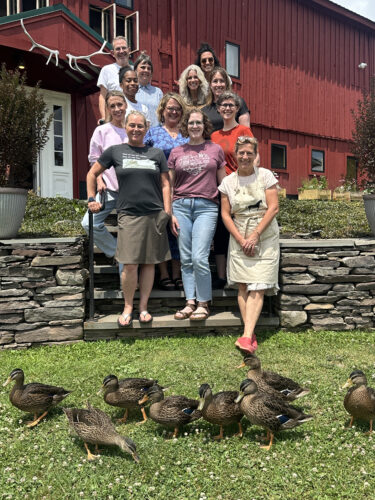
Described as “A Creative Retreat for the Children’s Literature Community”, Milkwood is the brainchild of multi-Caldecott Award winning creator Sophie Blackall. Started in 2022 (as recorded in this Publishers Weekly piece), Sophie renovated an abandoned barn into a truly beautiful space for all kinds of people who love children’s literature. Her husband, the playwright Ed Schmidt, works closely alongside her, making it an experience like no other. How do you attend? Each year Milkwood opens up applications for the season and hundreds of people apply. If you are lucky enough to be selected, you work with them to figure out travel and timing. Then, once you are there, the days are relatively unscheduled. You know when the meals are. There are snacks if you need them. Outside there are trails and mountains to look at. And ducks, of course. Copious ducks. Sophie raises them each year and by the end of the season they fly away for adventures unknown.
This year I was lucky enough to be chosen. I attended a retreat intended for librarians and educators. While there, I found I was particularly taken with Milkwood’s library. Each group of people who come to Milkwood are asked to bring a book to add to the collection. I did so, keeping a close eye on the academic children’s literature section. I don’t usually have time to indulge in scholarly works on children’s books, but Milkwood gave me the time and space that I needed.

It also led me to think about Milkwood within the pantheon of children’s literature spaces in the history of America. There were plenty of writing retreats out there already, of course. The most famous of these is probably Kindling Words, a professional retreat for the children’s literature world, with locations in the East and West. Actually, if you’re at all interested, I did a round-up of Children’s Literature Retreats about ten years ago that covers a whole slew of them (and should probably be updated). But Milkwood isn’t really that kind of retreat. Not in the sense that it has only one purpose (writing). Its goals align a little more closely to the Highlights Foundation, where regular speakers come to talk about different aspects of children’s literature. Still, that’s not quite what Milkwood strives for either.
Maybe the best way to sum up Milkwood is to look at it in terms of connection and collaboration. Long ago, Sophie Blackall and a slew of Brooklyn artists joined together to create a mutual studio together not far from the Gowanus Canal. As she puts it, the job of an illustrator is a fairly solo affair. It can be very isolating and lonely at times. With this studio, she and her friends had space for their work, but also connection if they wanted it. Milkwood, in that light, is much the same thing. Here, Sophie’s able to bring together an eclectic mix of people. New editors and editors that have been in the business a long time meet up. Librarians and teachers from across the country, discussing what they’re going through and dealing with in the current state of the world. Illustrators who may not know one another. Members of the kidlit queer community, meeting together in numbers they may not have experienced before. BIPOC kids book creators. Even poets and scientists! Milkwood then serves as a gathering place, in this sense.
That, then, will probably be Milkwood’s legacy. I’m a librarian with a penchant for history, so I think a lot about legacies these days. Considering the fact that we live in a time when book banning has reached an egregious high, spaces like these serve to ensure a continual stream of connection and creativity.

When I was at Milkwood, my group was shown thirteen large blank books (there are probably fourteen by now). Each gathering at Milkwood is encouraged to sign one of these books and to draw a horse. Yep. Draw an actual horse. Folks get awful creative when you give them as broad an instruction as that. I think a lot about those books. Naturally, I read through all of them before adding my own horse (and a little something extra that was on brand). Since Milkwood essentially boils down to being a two-person team, it’s impossible to say how long it will continue. Those books though… they’ll serve as its physical legacy long after we’re all gone. The influence of Milkwood is different. That will linger in ways we cannot even hope to predict. All we know is that it’s a undeniable force for good.
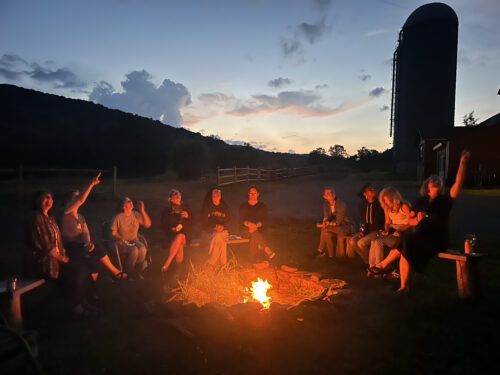
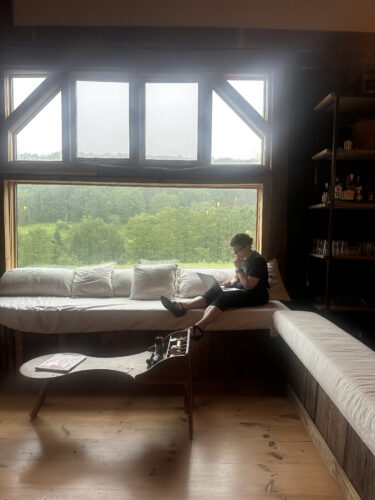
Some photos from my time (with thanks to Ed and Sophie for some of these):






Filed under: Uncategorized
About Betsy Bird
Betsy Bird is currently the Collection Development Manager of the Evanston Public Library system and a former Materials Specialist for New York Public Library. She has served on Newbery, written for Kirkus, and has done other lovely little things that she'd love to tell you about but that she's sure you'd find more interesting to hear of in person. Her opinions are her own and do not reflect those of EPL, SLJ, or any of the other acronyms you might be able to name. Follow her on BlueSky at: @fuse8.bsky.social
ADVERTISEMENT
ADVERTISEMENT
SLJ Blog Network
Name That LEGO Book Cover! (#75)
The Delinquent and the Transfer Student, vol. 1 | Review
From Policy Ask to Public Voice: Five Layers of Writing to Advance School Library Policy
Fast Five Interview: Shreya Davies and Vanessa Wong
ADVERTISEMENT
Thank you for sharing this incredibly special visit. Love the eggs!
It’s hard to capture the joys of Milkwood in a single article, but you’ve done a fine job. All the same, I have things to add. One thing about Milkwood is that everything, everywhere, has been considered and made beautiful. There are fresh wildflowers in sconces in the halls. The hand soap is delicious. There is a whole wall mural made of antique tools, so exquisitely patterned and arranged that looking at it is like listening to Mozart. Every corner contains another delicious detail–playful or chosen for the guests’ comfort, or wabi-sabi. And at the same time, Milkwood offers space: large, airy rooms, halls with whitewashed beams overhead; the space is so wide and filled with light that you want to dance.
One memory that I cherish at Milkwood is of a cold, rainy day. I had bought an old friend with me–a copy of THE THREE MUSKETEERS, which I hadn’t read since my teenage years. I was walking down the hall when I saw that there was a small wood stove that had been lit; there was also a big basket of sumptuous wool and cotton throws. Of course there was. I made myself a nest before the stove and opened THE THREE MUSKETEERS; I was doing exactly what I wanted to do, because Milkwood is like that; it encourages you to rejoice in life. Ed passed me in the hall and smiled at me and said, “I knew I’d lit that stove for someone,” and I felt like a beloved child.
And something about all that beauty, that spaciousness, the carefree feeling of being taken care of, makes writing very possible. The usual obstacles are swept away. It’s like nowhere else on earth, and it was built by twin forces of artistry and generosity.
And that, my dears, is why you invite writers to such a space.
Agree on all counts! What a labor of love, in every single aspect!
Sidenote: that little salamander!! (I realize that’s a weird thing to shout out, but squee!) I didn’t see any of those, but we did get a rainbow, which felt like another kind of awesome omen.
Great job capturing so much of what made it awesome. And also, big yes to all the little spaces one could find to settle into – anything. I found so many little spots to sit and read. But the caretaking I felt was next level – and that is such a gift. I’m sipping coffee from Milkwood mug as I write this. Well, not like literally, because drinking and typing at the same time just doesn’t work for me. That collection of horse drawings is such a treasure.
Sophie and Ed are exactly as delightful as you’ve painted them to be! I haven’t yet made a pilgrimage to Milkwood, but I was excited to hear their visions for it when Sophie visited the National Center for Children’s Illustrated Literature in ’22 (another Abilene-based entry for your Children’s Literature Mecca list — though I may be biased as someone who works there). Milkwood seems like such a special little pocket of sanctuary, creativity, and community. Thanks for sharing your experiences!
I went in June. We all need a club. Thank you for capturing the magic.