

Moms Ride: A Q&A with Ishita Jain on Midnight Motorbike
I’ve noticed something. It’s not a huge something, but it’s something just the same. Have you ever happened to notice how many picture books are about daughters traveling with their dads on motorcycles, or on horses, or in cars? Ever wondered where all the vehicular mamas have been hiding themselves? I hadn’t. Not really. It’s not one of those things I really paid attention to until the publication of Maureen Shay Tajsa and Ishita Jain’s Midnight Motorbike. Deep and lovely, with a star from Kirkus to boot, this book is best described by its publisher this way:
Imagine Goodnight, Goodnight Construction Site set in the jungle. On a night too hot to sleep, Amma takes her daughter on a magical, moonlit motorbike ride through South India.
In this lush mother-daughter nighttime adventure through the jungles of southern India, debut author Maureen Shay Tajsar enchants the reader with all five senses, offering smells of spicy tea and warm hay, tastes of warm potato dosa, and wind washing over sandaled feet. Debut illustrator Ishita Jain immerses the reader in the deepest blue, the darkest night, and the coziest love, in a book that feels at once like a hug and an adventure.
There’s no better way to be lulled to sleep than tucked against Amma on her motorbike, and a Midnight Motorbike read-aloud is the next best thing. Drawing on the childhood memories of both author and illustrator, this sumptuous treasure is sure to be a new family favorite.
Today we’re talking with debut illustrator Ishita Jain herself about the book, genderless motorcycles, authenticity over moralizing, and how (as Ishita puts it) “Thrill and adventure are not just for dads!”
ADVERTISEMENT
ADVERTISEMENT
Betsy Bird: Ishita! Thanks so much for joining me here today! Midnight Motorbike is this lovely, lulling, but also bonding, book between a mother and daughter as they zoom through different landscapes in South India. I know that you’re from Delhi yourself. Tell us a little bit about how you got connected to this book. What drew you to this particular story?

photo credit: Naomi Kundu
Ishita Jain: When I was fresh out of undergrad, I felt dissonance with the industry work I was doing—it didn’t align with the people-centered design principles I’d studied. I had always been curious about Auroville, an experimental township in Tamil Nadu. I found a short course there and eventually left my job and went.
Auroville introduced to me a way of life, and people, who built every aspect of their daily lives around principles that they value most- be it beauty, generosity or gratitude. The weeks that followed were as much an exploration of the external environment as they were of my internal self. So when Midnight Motorbike came to me, I instantly recognized the setting, even though it’s not named. Taylor and Maureen knew nothing of my own personal love for this place and it felt like a cosmic reminder to reconnect with this place that shaped me deeply.
BB: So we see all sorts of picture books about girls and their fathers taking various forms of transportation. Books like My Papi Has a Motorcycle and My Daddy Is a Cowboy. But seeing a girl and her mother bond in a similar way (and on something as badass as a motorcycle) is incredibly rare. What, to your mind, is the significance of a story where a mother and child bond in this matter? And why don’t we see more mother/daughter tales of this kind?
Ishita: That’s a great observation! Growing up in New Delhi, gender roles were in my face every single day. How I dressed, moved through public spaces, especially at night, was starkly shaped by gender. Motorcycles are typically represented in media as symbols of speed, risk, freedom and by extension, masculinity.

However, in Pondicherry, Tamil Nadu, this mode of transportation felt genderless. It is so normal to see women enrobed in saris with braids studded with jasmines just going about their daily lives on cycles, scooters and bikes.
Maureen wrote this story after her mother’s passing and in memory of all the love they shared. Thrill and adventure are not just for dads! Amma and daughter are a complete, whole unit enveloped in love and together, the world is a playground.
BB: That is BEAUTIFULLY put. Now this being America, we’ve a particular focus on bike safety. Your characters don’t wear helmets (and, indeed, would not). Was there any discussion of this particular aspect? Have you heard anything from readers about it?
Ishita: We talked about this early on and made the explicit decision to show things as they are. Legally, helmets are required in Tamil Nadu, but in reality, many people don’t wear them. It’s common to see entire families—babies, parents, even an extra adult, balanced on a single bike. As the saying goes, ‘It happens only in India’ or ‘India is not for beginners,’ haha.
I would personally recommend wearing a helmet, especially in a big city, but for this story, we chose authenticity over moralizing.
BB: You’ve an ability to switch up your style depending on whatever book or project you happen to be working on. Could you tell us a little bit about some of the choices you made with this book specifically? Why did you settle on the style, palette, medium, etc. that you did?
Ishita: I draw outdoors regularly, and each landscape calls out differently. Initially, I thought I’d use watercolor for this book, but when I started painting the hot, humid night, it called for something richer and thicker. There are many elements that gleam out and sparkle at night and gouache and crayon let me build layers, paint over, scratch and reveal in ways watercolor couldn’t.

I’d never done a full book in gouache, but I had used it in location sketchbooks by laying down a flat color and layering with pencil or crayon. I revisited those sketches, then went to an art store and stared at some tubes of gouache. I found myself drawn to ultramarine blue, marigold yellow, and bougainvillea pink. The palette unfolded from there, and I was also probably influenced by the jewel-toned Kanjivaram saris of Tamil Nadu.
ADVERTISEMENT
ADVERTISEMENT
BB: I hear from illustrators regularly that the only thing more difficult to draw than a horse is a bicycle. With that in mind, how hard is it to paint a motorbike? And what kind of references did you look to to get it right?
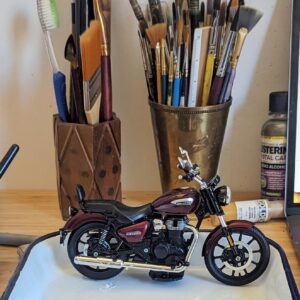
Ishita: I still cannot paint a motorbike from memory. My favorite way to paint is from life and so, I hunted for a model of a Royal Enfield motorbike and used it to paint all the bikes in the book!
BB: I love that. Finally, what’s next for you? What else do you have coming out these days?
Ishita: I am wrapping up final art for a book about a rogue banyan taking over a building, written by Stephanie Ellen Sy (Kokila), hosting summer sketch jams with Riverside Park in NYC and very excitedly, I am chasing the rain and writing a picture book about my favorite season of all time- the Indian Monsoon (Neal Porter Books).
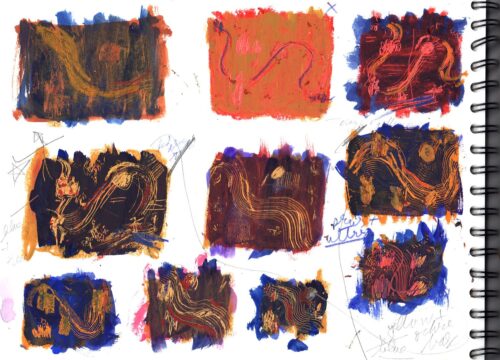

A thank you to Ishita Jain for being so kind as to answer my questions and send me these cool pictures as well. Midnight Motorbike is out now so don’t hesitate to find it and read it for yourself.
Filed under: Interviews

About Betsy Bird
Betsy Bird is currently the Collection Development Manager of the Evanston Public Library system and a former Materials Specialist for New York Public Library. She has served on Newbery, written for Kirkus, and has done other lovely little things that she'd love to tell you about but that she's sure you'd find more interesting to hear of in person. Her opinions are her own and do not reflect those of EPL, SLJ, or any of the other acronyms you might be able to name. Follow her on BlueSky at: @fuse8.bsky.social
ADVERTISEMENT
ADVERTISEMENT
SLJ Blog Network
Off to ALA Annual 2026
Cooking with Monsters: Best Served Cold | Preview and Trailer
From Policy Ask to Public Voice: Five Layers of Writing to Advance School Library Policy
Book Mail: Magical cupboards, fake dating, a romantasy anthology, a witch hunt, and more!
ADVERTISEMENT