
Happy Juneteeth! Celebrate in Style with SO MANY YEARS and a Discussion with Anne Wynter and Jerome Pumphrey
‘
What is the best Juneteenth picture book ever made?
Even as recently as 10 years ago this question would have led to a relatively short conversation. As Juneteenth has grown in national recognition over the years, children’s book publishers have been scrambling to fill the gap. Ten, or even five, years ago there weren’t a slew of books to choose between. Today? I’d wager it’s the fastest growing holiday in our libraries’ Holiday Book sections (talking about the last popular holidays is a separate conversation).
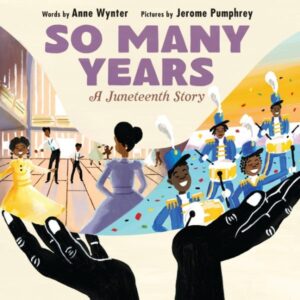
But… can I tell you a secret? I know this isn’t a good thing, but I didn’t actually have a favorite favorite Juneteenth book before. I mean, probably my top pick was Free At Last: A Juneteenth Story due to sheer gorgeousness in the art. That book? Class act. But that book came out back in 2022. Today, please meet my newest favorite. So Many Years: A Juneteenth Story is such a perfect example of how to pack an emotional punch with a spare text and exquisite art. Author Anne Wynter wrote the Eztra Jack Keats Award winning Nell Plants a Tree a number of years ago, which I adore. Now add in the art of Jerome Pumphrey and we’re talking HIT!
ADVERTISEMENT
ADVERTISEMENT
Here’s the description:
The celebrated author of Ezra Jack Keats Award winner Nell Plants a Tree and a Caldecott Honor artist come together for a poetic picture book introduction to Juneteenth and its origin.
Oh, how you would dance! How you would sing! How you would celebrate!
With lyrical text from Anne Wynter and radiant artwork from Jerome Pumphrey, this poetic picture book explains the history behind Juneteenth celebrations. So Many Years simultaneously acknowledges the history of slavery in the US as well as the astonishing Black resilience that has led to an enduring legacy of Black joy.
Now, you lucky ducks, we get to hear from the creators themselves about how this book (three stars and climbing) came to be:
Betsy Bird: Anne! Thank you so much for answering my questions today. SO MANY YEARS is the kind of book talking about Juneteenth that I feel like we’ve been waiting years for. But where did it come from? Can you give us a run down on the origins of the book itself?

Anne Wynter: Thank you for the kind words! It started with an email from my original editor Donna Bray asking if I might like to write a Juneteenth book. I responded with a “yes” but honestly, I had my doubts about pulling it off. Back in school, I loved every subject . . . except history. Sometimes I would be so lost in my history classes that I’d burst out laughing at the fact that everyone else was nodding and answering questions, meanwhile I couldn’t remember which country we were discussing (apologies to my teachers).
Anyway, it felt like we were always learning about what happened, when it happened, where it happened . . . but I wanted to know why things happened. I was much more curious about the human emotions behind the dates and locations. So with this book, I thought – if I’m going to write about history, I’d like to do it in a way that would resonate with my younger self.
I also knew that there were so already many brilliant Juneteenth picture books on shelves, so my goal was to approach the subject from a fresh angle.
BB: I’d say you succeeded tenfold. And Jerome! Thank you so much for talking with us about this book today too! Tell us a little bit about how you came to discover So Many Years and what drew you to the project.
Jerome Pumphrey: Thank you for having us, Betsy. I’m excited to talk about this. The journey began back in spring 2021. I received an email from my agent about the opportunity, and all I really knew about Anne at the time was that she was the kind author who had brought her kids to the launch event for The Old Truck. Her debut book hadn’t come out yet.

But from reading the manuscript, I thought immediately that she had a brilliant approach to introducing Juneteenth to young readers. It was poetic, and it invited readers to reflect on the holiday’s meaning and why it’s commemorated.
BB: Oh! Well, that leads nicely into my next question. Anne, you were paired with Jerome, who has the singular skill of managing to capture both the fun of Juneteenth and the seriousness of its origins. Were you aware of his work before this book? How do you feel about the final product?
Anne: I’ve been a big fan of Jerome’s since The Old Truck, and I was thrilled when he agreed to make this book with me!
If you look at the text alone, it doesn’t exactly have a clear narrative, so I always knew this manuscript was going to be a huge challenge for the illustrator. I was blown away by how Jerome layered the book with not just one narrative, but multiple narratives. He brought so much depth and care to this book and I’m still amazed every time I open the pages.
BB: Let’s talk a bit about that. Jerome, I’d like to focus in a little on your unique ability to display the seriousness of the past in this book, the sheer joy after emancipation, and then the present—which is rich in color and celebration. Tonally, I feel like this book had to present a unique challenge for you. How did you navigate these three states of being?
Jerome: You’re absolutely right—the tone was a real challenge. At its heart, this is a book about reflection and celebration, but we’re necessarily dealing with a heavy subject. And handling something as serious as slavery in a picture book for young children requires a lot of thought and care.
I was aiming for balance. I wanted to be honest about the history without being too graphic or overwhelming for young readers. But I also didn’t want to soften the truth to the point that it was misleading or incomplete. That tightrope—between being age-appropriate and being truthful—was something I gave a lot of thought to.
That thinking informed my decision to treat the time periods differently. I decided early on to use visual shifts—changes in palette and style—to help distinguish between the era of enslavement and the later periods of freedom and celebration. As the story moves forward, the color palette grows and blooms into something brighter, culminating in the full celebratory scenes.
I also have to acknowledge the helpful notes and thought partnership I got from Kate O’Sullivan (editor) and Dana Fritts (art director) as I was making final decisions on palette and style. In the end, I think we achieved the balance I was trying to achieve.
BB: I want to follow up on that. Tell us a little bit about the style you chose for the enslavement sections. It’s different from the rest of the book but feels as if there were distinct influences at work. Did you have a visual sense of how you would portray this section from the start, or was there a lot of trial and error?
Jerome: Thanks for noticing that. Very early on, when I was working out visual concepts for lines like “…after so many years of working through waves of pain?” I knew I needed to treat those scenes differently.
I wanted a visual language that could communicate the gravity of that period without being too literal or traumatic. A mural-inspired or more graphic style felt right—something symbolic, expressive, and dignified. I was especially influenced by Aaron Douglas, the Harlem Renaissance painter and designer known for his use of silhouetted figures and geometric forms. His work often dealt with themes of slavery and liberation, and it helped guide my approach to those scenes.

BB: Anne, Another part of what I love so much about the title is how simple it is. And writing simple picture book texts that aren’t overly verbose or wordy can often be the most difficult kinds of picture books to write. How much does the final version of this book resemble its first draft? Did you have to pare down the writing in any way or does this pretty much resemble your initial conception?
Anne: My writing tends to be succinct. That tendency works against me whenever I have to hit a certain word count or page count – but it really comes in handy for writing picture books!
Looking back at documents on my computer, I’m realizing I did all my drafting on paper, which is unusual for me. It was back in late 2019 and early 2020, so I’m having a hard time remembering the process. But I did find a document where I wrote out the lyrics of His Eye is On the Sparrow and Suddenly, Seymour. I remember listening to these songs on repeat because they’re simultaneously tragic, joyful and soulful. If you look at the lyrics of those songs, His Eye Is on the Sparrow begins with questions and Suddenly, Seymour begins in the 2nd person – it’s interesting to look back and see how clearly they influenced So Many Years.
BB: Oh! Well the Suddenly Seymour makes sense since you’ve a degree in theater. You know, I’m often intrigued by how a person’s writing is influenced by their primary area of study. Do you feel that SO MANY YEARS, or really any of your picture books, owe their creation at all to your natural understanding of how to engage and enthrall a young audience?
Anne: Most of my plays were for adult audiences, but keeping them engaged is still so important. Actually, after I had kids, I had a hard time staying awake during theater performances. So in my own playwriting, I started to pay close attention to pacing. If there’s even a moment where I feel myself getting bored, I try to switch things up, throw in a plot turn, add some interesting language, or introduce an unusual prop. I’m sure that has translated to my picture book writing as well.
BB: Jerome, I think there remains a certain level of mystery surrounding whether, on a project, you work with your brother or whether you two go it alone. What guides your separate projects vs. the ones you work on together?

Jerome: It’s a bit of a mystery to me too! But really, it comes down to whether we’re approached as a duo or individually. On the few projects I’ve illustrated solo—such as So Many Years or Elbert in the Air—those opportunities came directly to me.
When that happens, I take on the illustration work while Jarrett focuses on our longer-form projects, like our Link & Hud series, for which he handles all the writing. So even when we’re not working on the same book, we’re still very much working in tandem. I’ll also add that Jarrett was the first person to see any sketches for these solo projects, and he’s helped me think through different parts of them.
BB: On a more personal note, what does Juneteenth mean to the two of you specifically?
Anne: I don’t remember a time when I didn’t know about Juneteenth. It took me a while to understand that it wasn’t as well-known as – say – Valentine’s Day. My mom is from Galveston and we visit often, which I’m sure is part of the reason this particular piece of history has always felt closer and more relatable than other historical events.
Doing research for this book strengthened that feeling. There are dozens of fascinating personal accounts I came across that might never make it into any book – but they’ve stuck with me, and probably always will.
Jerome: Even though my family has deep roots in Texas (where the holiday was first celebrated) and I grew up in Houston, I have to admit—I wasn’t fully aware of Juneteenth as a kid. I would hear about it here and there, but I didn’t understand what was being celebrated or the significance of the day. It wasn’t taught widely in schools at the time.
The first time I actually participated in a Juneteenth celebration was in the early 2000s when I was in my 20s—and surprisingly, it wasn’t in Texas. I was in New York and volunteering with a literacy outreach program that had a booth at a local Juneteenth festival. That’s where I first really learned about the holiday’s history.
What struck me was how little I’d known about this important piece of Texas history, even though I’d grown up right where it all began. This was before Juneteenth was as widely recognized as it is today, and there wasn’t as much information available online. I remember turning to an encyclopedia to read about it. It felt like uncovering a part of Texas history that had been hidden in plain sight. I even remember thinking back then that it would be amazing to have a picture book about it.
And the more I’ve learned since then, the more meaningful it’s become. While researching for the artwork in So Many Years, I discovered that I have family ties to early Black community organizing in Galveston—the very place where Juneteenth originated. That connection made the project feel even more personal.
It’s been incredible to see how much has changed since my childhood—from the books now available to the broader awareness of the holiday. And I feel fortunate that I was able to help bring a book into the world that can introduce Juneteenth to young readers.

BB: Finally, what else do you two have coming out these days? What’s next for you?
Anne: My next title is a picture book called While We’re Here, gorgeously illustrated by Micha Archer. It comes out in spring 2026 and it’s all about slowing down and appreciating the beauty around you.
Jerome: Link & Hud: Sharks & Minnows, the second book in our middle grade chapter book/graphic novel hybrid, comes out in July 2025.
And The Old Sleigh—which you were kind enough to reveal the cover for—will be out in October 2025. Thanks again for that!
Huge thanks to both Anne and Jerome for taking so much time out of their days to answer all my questions. And look, I know you can choose any Juneteenth book you want, but I think we can all agree that this book? This book is unparalleled. I wouldn’t be discussing it with you here today if it wasn’t. It’s also out right now, so run to your independent bookstore/library and snag a copy to read with some kids today.

Final thanks to Anna Ravenelle and the team at Harper Collins Children’s Books for helping to put this talk together!
Filed under: Best Books, Best Books of 2025, Interviews

About Betsy Bird
Betsy Bird is currently the Collection Development Manager of the Evanston Public Library system and a former Materials Specialist for New York Public Library. She has served on Newbery, written for Kirkus, and has done other lovely little things that she'd love to tell you about but that she's sure you'd find more interesting to hear of in person. Her opinions are her own and do not reflect those of EPL, SLJ, or any of the other acronyms you might be able to name. Follow her on BlueSky at: @fuse8.bsky.social
ADVERTISEMENT
ADVERTISEMENT
SLJ Blog Network
Cover Re-Reveal: 1000 HORSES FOR THE KING by Gracey Zhang and Me
Spider-Man Mighty Mayhem | This Week’s Comics
From Policy Ask to Public Voice: Five Layers of Writing to Advance School Library Policy
ADVERTISEMENT