

The Rodari Conversation: Talking Classic Italian Children’s Literature with the Esteemed Antony Shugaar, Claudia Zoe Bedrick, Jack Zipes, and Matthew Forsythe
I don’t want to overhype this post, but I’m having a hard time containing my excitement. So as I type this, people all over the world are preparing to embark on planes, trains, and who-knows-what-all to get to the Bologna Children’s Book Fair. It’s an international rights fair of children’s literature, and a true delight if ever you should find yourself there. It’s the kind of place that reminds you that as often as we speak about American children’s books, there’s an entire world out there beyond our borders (and doesn’t that sound lovely right now?).
It also means that each country has its own children’s literature superstars. In Sweden, for example, you might have Astrid Lindgren. In New Zealand you have Margaret Mahy. And in Italy, the man every good schoolchild would be able to name is none other than Gianni Rodari.
ADVERTISEMENT
ADVERTISEMENT
In America, Rodari isn’t exactly a household name, but that hasn’t stopped Claudia Zoe Bedrick and the incredible Enchanted Lion Books from bringing his works to our shores. Thanks to their efforts, in the past few years we’ve seen books like The Book of Whys, A Daydreamy Child Takes a Walk, Telling Stories Wrong, Telephone Tales, and more. It is no coincidence that each of these titles has been published by the small, independent Brooklyn publisher Enchanted Lion Press, and almost all were translated by the illustrious Antony Shugaar.

This year, two additional Rodari titles join this list, and neither could be called particularly dull. The first is a delightful novel called Lamberto, Lamberto, Lamberto. You may have recently read the Kirkus review which said of it, “Supremely sophisticated bedtime fare, Rodari’s mildly muddled hoot revels in its own peculiar humor.”
The other book is quite different: The Grammar of Fantasy: An Introduction to the Art of Inventing Stories. This book (not out until May 13th), is described by Enchanted Lion as, “A collection of essays about fairy tales, folk tales, and their great advantages in teaching creative storytelling.” Jack Zipes, the incredible scholar of fairy tales as well as the very history of children’s literature, provides the translation. Matthew Forsythe, an illustrator responsible for such incredible picture books as Pokko and the Drum and, way back in the day, the art for My Name Is Elizabeth, provides the accompanying art.
But today? Today I’m gonna talk to these people. Zipes! Forsythe! Bedrick! I’m going to ask each and every one of them questions about Rodari, and specifically The Grammar of Fantasy.
Historically when I interview folks, I tend to merge their answers together. That technique is not going to work for today’s post since some of what they have written are essays. As such, please enjoy each of these incredible people as they pay homage to an Italian who has an awful lot to say about the state of the world today.
We begin with a small essay from Antony Shugaar. Claudia Zoe Bedrick is commenting throughout. Due to the limitations of this blog, I wasn’t able to color her comments, but she did initial them and I’ve made them italicized for your convenience.
A Note from Antony Shugaar and Claudia Zoe Bedrick

It is both a truth universally acknowledged and a not entirely complete truth that Gianni Rodari was largely ignored by the children’s publishing industry until Claudia Bedrick came along and published Telephone Tales in an eye-popping version illustrated by Valerio Vidali. There’s an old saying: “Even if it isn’t true, it ought to be.”
The truth is, people were aware of Rodari in the English-speaking world. In June of 1950, a few months after Joe McCarthy started his anti-Communist campaign, the International Herald Tribune ran this short piece:
ROME — The newspaper “Unita” explained the difference between conk, pow, stack, splosh, splock, ploop, bonk, stonk and gulp. In a three-column article written by Gianni Rodari, the newspaper said this was the language “which children on six continents now know well through American comic strips.” Mr. Rodari said he heard his son “mumbling these strange sounds.” Although the dialogue in American comics printed here is translated into Italian, the whamboos, sockos and whizzes are left “in English.”
Okay, quotes from L’Unità may have become much rarer in the years that followed, and the International Herald Tribune by its nature enjoyed a sort of off-shore immunity, but I know that Cricket magazine was publishing Rodari at the time. In fact, when Telephone Tales came out, if I’m remembering right, I got a letter from a retired editor of that magazine recalling the number of short Rodari pieces they had run. (This is correct, we got that Cricket letter. – czb)
Jack Zipes himself recalls finding a Rodari story, from Telephone Tales as it happens, in an issue of Cricket. Though I’m sure you’re aware of this piece by Zipes, I’ll include a bit of it, and the url.
My first “meeting” with Rodari was about 1981, the year after he had died. I was in the midst of collecting different versions of Little Red Riding Hood for my book The Trials and Tribulations of Little Red Riding Hood. I was scouring libraries, flea markets, bookstores, archives, and collectible shows for interesting versions of this tale to explain why readers from the eighteenth century to the present were fascinated by it, and at one point I came across a version that begins like this:
Once upon a time there was a little girl called Little Yellow Riding Hood.
“No! Red Riding Hood!”
“Oh yes, of course, Red Riding Hood. Well, one day her mother called and said: ‘Little Green Riding Hood—’”
“Red!”
“Sorry! Red. ‘Now, my child, go to aunt Mary and take her these potatoes.’”
“No! It doesn’t go like that! ‘Go to Grandma and take her these cakes.’”
“All right. So the little girl went off and in the wood she met a giraffe.”
“What a mess you’re making of it! It was a wolf!”
“And the wolf said: ‘What’s six times eight?’”
“No! No! The wolf asked her where she was going.”
“So he did. And little Black Riding Hood replied—”
“Red! Red! Red!!!”
[ … ]
This remarkable Rodari story was first published in English in the children’s magazine Cricket in 1973, and I had come across it in 1981 when I knew next to nothing about Rodari. I did not know Italian, and I did not know how Rodari’s tale fit into his pedagogical theory. For me, his story was appealing because it played with the traditional fairy-tale motifs and challenged standard forms and notions of storytelling. It was simply charming, deceiving in its simplicity, and one year later, in 1982, I realized just how much more there was to the tale than I realized.
Around the same time, Dent published “Mr. Cat in Business” by Rodari, with illustrations by Jan Brychta (1975).
(In the 1970s, a few of Rodari’s works were published in English in the UK by Dent, but they never crossed the pond, and some were truncated versions, but there was clearly an Editor at Dent who was aiming to get the Brits reading Rodari, but it didn’t quite come off as hoped. – czb)
Certainly, in the same years, Rodari was getting plenty of mentions in the Soviet press, as we know, including in “Soviet Woman.”
“I thank you for the invitation to write verse for you,” Gianni Rodari says in a letter to our magazine. “I hope you will always regard me as a friend of your country and your magazine.” The other two poems given here, “A Loaf as Big as the Sun” and “If Grass Grew Downward” were first published in the Italian newspaper “L’Unità.” The English translations are by Margaret Wettlin.
Jack Zipes, an academic who published about Gianni Rodari long before I did, writes about “the incomprehensible Gianni Rodari” in an article in Wayne State University’s Marvels & Tales in 2014. He lists the following books by Gianni Rodari in English:
(a) Telephone Tales. Trans. Patrick Creagh. London: Harrap, 1965. (A selection of stories from Favole al telefono) (b) The Befana’s Toyshop: A Twelfth Night Tale. Trans. Patrick Creah. London: Dent, 1970. (Translation of La freccia azzurra) (c) A Pie in the Sky. Trans. Patrick Creah. London: Dent, 1971. (Translation of La torta in cielo)(these are the Dent editions. czb) (d)Tales Told by a Machine. Trans. Sue Newson-Smith. London: Abelard and Shulman, 1976. (A selection of stories from Novelle fatte a macchina) (e) The Grammar of Fantasy: An Introduction to the Art of Inventing Stories. Trans. Jack Zipes. New York: Teachers & Writers, 1990. (Translation of Grammatica della fantasia) (f) Tales to Change the World. Trans. Jack Zipes. Illustr. Robert Mason. Lincoln: Caseroom Press, 2008. (A collection of six stories from different collections)
In 1973, an article in the New York Times about Cricket mentions Rodari: “The sophisticated whimsey of Gianni Rodari’s ‘Little Green Riding Hood’ (the title indicates the shaggy dog premise).”
But then that was just a few years after an article about Maurice Sendak winning the 1970 Hans Christian Andersen Medal for illustrators. In that same article, we read that “The 1970 medal for authors went to Gianni Rodari of Italy.”
And any digital search for Rodari in the back issues of the NY Times will turn up a LOT more mentions of a Vatican expert named Paolo Rodari.
So I get the feeling that Gianni Rodari may have suffered from some discomfort with his politics on the part of American publishers and critics over the years, but more likely it was a matter of his never quite having the right advocate and the right publisher.
But lightning struck when Gaia Stock of Einaudi EL suggested I get in touch with Claudia Bedrick. Even then, it was slow lightning. My first call to Claudia was sometime in 2013, and Telephone Tales was published in 2020. I remember the printing was complicated both by tariff threats and by the onset of Covid. But the book came out, and the response was stunning.
But let me make it quite clear: the book that Claudia created was a powerful argument for Gianni Rodari. It was unequivocal, impossible to miss, muscular in its statement, captivating in its beauty.
Let me make a comparison, one which I laid out in my first hopeful introduction for Telephone Tales. Gianni Rodari, Italo Calvino, and Dario Fo were all born a few years apart, respectively 1920, 1923, and 1927. Dario Fo was a Communist playwright who won the Nobel Prize but was forbidden from entering the United States. Italo Calvino was born in Cuba, was a Communist who foreswore his allegiance after the crushing of Hungarian independence in 1956, and he was invited to Harvard to deliver the Charles Eliot Norton poetry lectures at Harvard University, but died in 1985 before being able to do so. Gianni Rodari was a Communist who foreswore his allegiance after the crushing of Czechoslovakian independence after the Prague Spring in 1968.
Rodari still had 12 of some of his most productive years ahead of him. And in fact, his work was published after he turned away from any strict allegiance.
I spoke with Massimo Piattelli Palmarini, who was at Harvard at the time and who arranged for Calvino to be invited to deliver the Eliot Lectures. He agreed with my interpretation. Rodari wasn’t blacklisted.** He just wasn’t published right until Claudia Bedrick got her hands on his work. Perhaps the Dent edition of Patrick Creagh’s translation was just too early.
**Personally, I would push back against this a bit, for the reason that Rodari was marginalized even in Italy and not celebrated in the mainstream, or even read there, until he became a huge sensation in Soviet Russia and the USSR. It was on account of the tremendous success of The Adventures of Cipollino in Soviet Russia that the Italian literary establishment really caught wind of it. So Rodari returns to Italy via the USSR as a sensation, which leads him to be picked up by the prestigious publisher Einaudi. Prior to this moment, his work was published in small editions by a Communist press. So we are talking about an author who was not simply an anti-fascist or a rank and file communist, but someone who comes to be celebrated in the Soviet World, and indeed throughout that world. This played its role in the US, I’ve heard, but it’s also true that children’s publishing in the US in the 1980s became very commercial, incurious, and much narrowed from what it had been in the 1960s and 70s. In this commercialized, provincial atmosphere it is also likely that editors just didn’t have the time, inclination or wherewithal to consider someone like Rodari. As to my own ability to see worth in Rodari: I read the Teachers & Writers edition of The Grammar of Fantasy published in the 1990s and was totally bowled over by it. I not only read it, I lived with it. And when I found myself trying to find and form a vision for Enchanted Lion in our early years, I drew deeply on Rodari’s book, which became a ground for us and is really at the root of the vision we elaborated around stories and reading, children and childhood. So when Tony called me up to make a case for Rodari, I already knew very well who he was and I was excited. It took a while to arrange for the rights, a while for the translation to be done, a while for the art to be completed, and the production was complex and expensive and then Covid hit, which is how seven years passed in the making of the book. I would like to add here that publishers need good translators. Translators who manifest literary flair, talent, and the wide and deep familiarity with a culture, country, and language that instill confidence, excitement, and a sense of promise. Antony Shugaar brought all of that to the table. After our first long rambling inspired conversation, I never doubted for a second that Tony could carry and convey Rodari’s voice. All of which connects to the work of freedom described below. –czb
So I’d like to suggest that Rodari became a success in the world of US children’s publishing for the same reasons that he always championed in his work and his thinking: the amazing workings of human freedom. The fact that we live in a free system, where risk is something publishers are willing to run, where readers are free to overlook or possible fall in love with the best that world literature is able to offer, where translators are free to contact publishers and pester––a system, as has been quipped, that is the worst except for all the others.
And perhaps Gianni Rodari’s strong anti-Fascist voice (a voice that even he ignored in his early years, when he joined the party in what must have felt like a heart-breaking sacrifice, but one he was willing to make in order to become a teacher and help to open children’s minds) was one that was fated to lie in wait, patiently biding its time until the exact moment it was needed. And perhaps that moment is now. (Certainly the end of the first Trump presidency was a good time for Telephone Tales. I hope now is a good time for Lamberto Lamberto Lamberto, Cipollino, and the Grammar of Fantasy).
With my very best regards and thanks for the great things you’ve written about Gianni Rodari, Antony Shugaar
A Talk with Jack Zipes

Betsy Bird: Jack, thank you for answering my questions today. I know that many of us are familiar with your scholarly work as it relates to folklore and fairytales. We might be less aware of your work as a translator of texts, particularly Italian. What has been your own relationship to Rodari’s work over the years? And, in a related question, what drew you to this particular project?
Jack Zipes: I discovered Rodari’s Grammatica della Fantasia in the 1980s while I was living and working in Paris. I was drawn to it because I had already been working with a German children’s theater in Berlin called Grips and had translated and directed Grips plays in Milwaukee. This was a subversive theater, and I am a subversive. So, as soon as I read Rodari’s work in French, I was overwhelmed and contacted Bill Germano, my editor at Routledge, and told him that this book had to be published immediately. However, he refused to publish the book unless I learned to read Italian. Believe it or not, he forced me to spend the next ten years or so in Rome, where I not only learned Italian but also met Rodari’s wife and later his daughter. Rodari changed my life in many ways. Aside from translating several of his works, I began a storytelling program for children in public schools in Minneapolis called Neighborhood Bridges, which I developed with the Children’s Theatre Company of Minnesota. This program based on many of Rodari’s ideas has had success in other cities in America, where I have introduced it with a grant from the US government, and I have also introduced it in the UK, Germany, and Italy. I describe it in my book Speaking Out: Storytelling and Creative Drama for Children (New York: Routledge, 2004). In fact, the program is still alive in Minneapolis today, but it has numerous difficulties because the teaching artists whom I had trained left the Children’s Theatre and have become independent and formed their own company based on my works. In short Rodari still lives in Minneapolis, and his spirit will not die. Of course, I have adapted and used Rodari’s stories and poems in all sorts of ways as a writer and translator. The purpose of Rodari and all my works has been to enable children to become storytellers of their own lives.
BB: With its original 1973 publication date, one cannot help but wonder what and if anything has aged in the intervening 52 years. Is this information timeless just as storytelling itself is timeless or are there elements that may not have caught up to the present era? I did note that his chapter on comic books (which precedes Scott McCloud’s UNDERSTANDING COMICS by about 20 years) was particularly contemporary.
Jack: Yes, all the ideas in Rodari’s Grammatica della Fantasia and in his prose and poetry are timeless. Public education has suffered a great deal in America, and if anything, it needs to catch up with Rodari not vice versa.
BB: You allude to this in your Introduction, but could you give us a bit of a sense of what THE GRAMMAR OF FANTASY meant to educators when it was released? What was it about this particular book that they wanted or needed? And what can American educators, librarians, and parents take from it today?
Jack: As I mentioned above, Rodari’s comprehensive works question ignorant and oppressive rules which also exist in American education. When my first translation was released, it did not draw much attention because it was published by a small New York group. Those educators who read and used the book did so because it challenged their way of thinking critically about education. Almost everything that Rodari has written encourages critical thinking on the part of teachers and children. Rodari himself worked with teachers and understood the problems they faced because of restrictions in schools. We must remember that the Catholic Church controlled public education in Italy until the late 1960s. So, you can imagine why Rodari rebelled against the system that destroyed learning for children for many years.
BB: You include your own Bibliography & Suggested Reading list at the end. What can you tell us about how you made this selection?
Jack: The books listed in this section are significant works which reveal how important Rodari was in one way or another. On one level Rodari is scarcely known in the West, and yet these books indicate that he is and was known by educators and philosophers. In some cases, I make the connections because Rodari belongs to the groups of eminent writers.
A Talk with Matthew Forsythe

Betsy Bird: Hi Matthew! Now, the average American reader is unlikely to be as familiar with Gianni Rodari as, say, the average Italian reader. How did you first come to be aware of his writing? And what, in particular, is your relationship to THE GRAMMAR OF FANTASY specifically?
Matthew Forsythe: I first heard about Rodari when Claudia asked me to work on the book. When I read The Grammar of Fantasy, I felt an immediate affinity with him and his writing. I had just finished making a picture book called
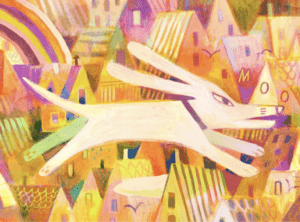
Pokko and the Drum, and – these ideas about the play between energies – between text and text, text and image, image and image – had been swirling around my head for years.
So when I read TGOF – seeing these ideas all laid out so clearly – I was immediately attached.
TGOF is playful and light, but it also puts fairy tales into their rightful historical and psychological place. Fairy tales and stories for children should not be simplified or watered down adult stories.
They should be full stories that are inclusive of children. There is something very democratic about the way they invite anyone to be a writer and artist. I think the arts in our society are heavily gatekept – economically and otherwise – so this was also refreshing.
BB: I’d love it if you could say some words about the role that illustration plays in works for adults, like this one. With periodic illustrations punctuating the text throughout, what is your particular take on illustration for adult readers in contemporary texts?
Matthew: This was the most difficult part of making the book. TGOF is a perfectly written book about writing. The book is already whole and the text is already inviting and lively – it doesn’t really need illustrations or beg for illumination from an illustrator.
I knew I could not add in a linear way to what Rodari was writing because A) I’m not good at that sort thing and B) This is the kind of redundancy that Rodari was railing against. I think the book is an invitation to contrast and surprise.
So by the time Claudia and I were trying to think of how to approach the illustrations, I was already doing writing and illustration workshops with his essay, The Fantastic Binomial. I was asking students to find energies between random words.

As Rodari said, a story is not one word. “Puppet” is not a story. A story is two words. “Puppet” and “Father” is a story. To Collodi, the energy between “Puppet” and “Father” was Pinnochio. But to anyone else, the energy between those words may be something else.
Next we would extend the exercise to finding energies between image and word; and then image and image; page and page, etc. We found that these binary relationships were everywhere: colour and colour, and so on. Every choice we make in placing something beside something else has a different effect. The more surprising the better.
Sometimes, my images don’t fit in the book in an expected way, but we hope that’s an invitation to the reader to add their own story.
BB: I know that some of Rodari’s works, like the original publication of LAMBERTO LAMBERTO LAMBERTO illustrated by Bruno Munari, sometimes were illustrated in an expressive non-representational style. Your work on this book seems to find a middle ground between that style and a wholly representational one. Was that a conscious choice?
Matthew: The only choice was to make paintings I wanted to make. It may seem easy, but I think we are so often unconsciously influenced to make things we don’t want to make that it’s not. Financial reasons; Groupthink.
This is another reason Rodari is obsessed with the creativity of children, who are so unfettered by external expectations. Some of the paintings are more representational, some are fantastical – but I felt if they were fun to make, they would create a coherent and rewarding rhythm.

BB: Two figures appear continually throughout the book that I found interesting. One is the red riding hood figure in all its different colors (as referenced by the text). The other is a little bald white fellow (who occasionally wears a red hat). Beyond these figures, you have so many others. What was your methodology for the spot illustrations of this book?
Matthew: There are about 60 paintings in the book and over half of them were made bespoke for the book. The rest were selected from unpublished personal work from the last ten years that felt thematically surprising or resonant.
Rodari comes back again and again to riding hood and the wolf and we can see why – they are perhaps the ultimate archetypal fantastic binomial. The other characters in my paintings are recurrent dream imagery of my own.

Folks, if you needed an education in all things Rodari, I think we covered that for you today. I cannot thank all four of my speakers here today for their care and thought on the works of Gianni Rodari and his books in the 20th and 21st centuries. You can find Lamberto, Lamberto, Lamberto on shelves now and The Grammar of Fantasy: An Introduction to the Art of Inventing Stories will be out May 13th.
Filed under: Best Books, Best Books of 2025, Conversations, Interviews

About Betsy Bird
Betsy Bird is currently the Collection Development Manager of the Evanston Public Library system and a former Materials Specialist for New York Public Library. She has served on Newbery, written for Kirkus, and has done other lovely little things that she'd love to tell you about but that she's sure you'd find more interesting to hear of in person. Her opinions are her own and do not reflect those of EPL, SLJ, or any of the other acronyms you might be able to name. Follow her on BlueSky at: @fuse8.bsky.social
ADVERTISEMENT
ADVERTISEMENT
SLJ Blog Network
House of Harkness | This Week’s Comics
From Policy Ask to Public Voice: Five Layers of Writing to Advance School Library Policy
In Favor of the Places You Know, a guest post by Natalie C. Parker
ADVERTISEMENT