
Avoiding the Purple Beret Conundrum: An Ink Witch Q&A with Steph Cherrywell

You can’t read all the middle grade novels in a given year. You just can’t. I mean, if you’re on the Newbery Award committee you have to put in a good effort, but I’m sure even some of them are forced to institute the “Two Chapter Rule” where you give a book a good two chapters before giving up on it. For my part, the older the get, the slower I read, and that affects the number of novels I actually review. So last year, it really wasn’t until near the end of November that I picked up and started to peruse The Ink Witch by Steph Cherrywell. I knew that the book had garnered stars from Booklist, PW, and Kirkus. Moreover, I knew it was fantasy, and I really do like a good original fantasy. Still, I was just kicking myself when I finally came to the realization that this book wasn’t just good. It was absolutely delightful.
I had no way of reviewing it (too late in the year) and aside from a couple mentions on my 31 Days, 31 Lists series, I couldn’t help but feel that I did the book dirty by not praising it more. Next thing I know, the book earns itself a Stonewall Honor and I’m pumping my fist like a madwoman. As such, when the opportunity to interview author Steph Cherrywell came up, you KNOW I was going to be on board!
ADVERTISEMENT
ADVERTISEMENT
Before we get into it though, here’s a quick rundown on the book’s plot:
Becca Slugg is bored. It’s the tail end of summer, and it feels like she’s done nothing but run errands for her family’s Cape Disappointment Beach Inn,
argue with her frustratingly overprotective mother, and have one-sided conversations with the giant spider living by the dumpsters out back.When Becca wishes for something to happen, she doesn’t expect her wish to manifest in the form of an unwelcome visit from her mom’s sinister and estranged sister, Malatrice. It turns out Becca’s aunt is a powerful witch—and when she doesn’t get the help she wants from Becca’s mom, she unleashes a devastating ink spell. Becca is left with a mindless puppet for a mother and a whole lot of questions—like Can I cast spells with the ink in my veins, too?
With the help of Natalya, her mother’s tarantula familiar, and Oddvar, a friendly troll living in the motel’s ice machine, a distraught but determined Becca sets out to uncover her own magical abilities and find the ingredients for a potion that will cure her mother. Besides, how hard can it be to find mermaid eggs, troll teeth, and the most precious possession of a Witch-Queen?
This magical adventure is equal parts hilarious and exhilarating, with a sassy, talking tarantula being just the tip of the iceberg.
Got all that? Great. Because we’re diving right in:
Betsy Bird: Steph! Pleased as punch to have a chance to lob questions in your general direction today. I just gotta tell you right at the start that THE INK WITCH was one of those end-of-year delights for me in 2025. I’m shocked how close I came to missing it entirely (though the starred reviews probably should have been a clue). As such, getting a chance to talk to you today is particularly special for me. I have just a ton of questions, but let’s start with the most obvious ones right from the get-go. First and foremost, can you tell us a bit about your own journey as an author? Because when I go to your website I see that on top of everything else you’re also an artist(!!). So give us the old biographical rundown of Steph Cherrywell: Author/Illustrator.
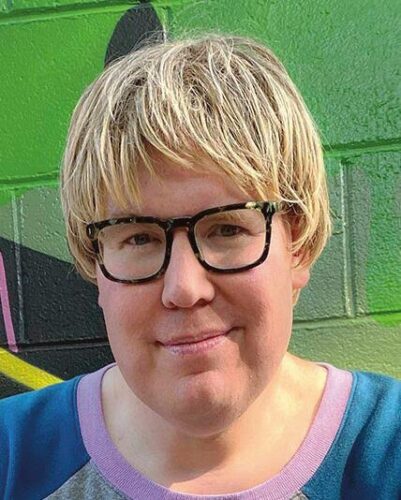
photo credit: Susan Sandford
Steph Cherrywell: I’ve been writing and drawing my whole life, but I’ve switched media a lot. Back in the mid-morning of the internet, I did webcomics. Those were pretty rough and formative, and embarrassing to look back on today, but I did make some lifelong friends in the community. (One of them, Bitter Karella, also had a novel debut last year with the trippy adult horror Moonflow.) Later on, I made a couple of graphic novels for older readers, and a few years after that I wrote and programmed some amateur text games for the Interactive Fiction Competition. I love old-school parser-based text adventures like Zork for how they create a whole world you can enter and explore, and there are now tools which make crafting them much easier than it used to be. After that, I finally got serious about finishing a novel, which led to Unboxing Libby and The Ink Witch.
BB: Oh! I loved Zork, though was more of a Wishstone and Hitchhiker’s Guide game fan myself. So you did a whole range of different things with your writing/illustrating career, but then you starting writing middle grade novels. And that switch is intriguing to me. Both UNBOXING LIBBY and THE INK WITCH could have been graphic novels. Instead, you went the prose route. Why was that the best way to present these stories?
Steph: So, three reasons. One: graphic novels are MASSIVELY time intensive. I love them, but I know a lot of creators who’ve gotten serious burnout trying to meet deadlines. When I did mine, I was only working part time and could devote a lot of the day to drawing. Now that I’m a full-time librarian, I doubt I could manage that.
Two: a great thing about prose is how (relatively) simple it is to edit. It’s much easier to add a paragraph to a finished prose page than to add a panel to a finished comics page. Or, say you realize late in the story that a character should have a hat. In prose, you just add “they always wore their signature purple beret” to their first appearance and it’s there forever. In comics, you’ve got to go back and draw that purple beret on every darn page.
Three: this is obviously subjective, but in my own opinion I’m a better writer than artist, so it made sense to focus on the area where I was stronger.
BB: I can’t speak to your art, but your prose is phenomenal. In fact, part of the reason I enjoyed THE INK WITCH so much was that when you’ve read enough fantasies for kids, everything starts to sound a little samey. And while I have seen fantasies that begin at motels (2024’s THE LUMBERING GIANTS OF WINDY PINES by Mo Netz comes to mind) you pretty much threw everything that I expected to read out the window with your book. Monsters in ice machines, mermaids working in used VHS stores, and the ink magic! The ink! So well thought out! As such, this question is a twofer. First, were you the kind of kid that read fantasies growing up (and, if so, what) and, second, where did THE INK WITCH even come from?
Steph: I read a lot of fantasy growing up, but I read a lot of everything! My parents had an attic full of books, so I read all sorts of things without regard to what age they were meant for. Kids’ fantasies I loved include The Fairy Rebel by Lynn Reid Banks, Tove Jansson’s Moomin books, The Chronicles of Narnia, and Bruce Coville’s Magic Shop series. I remember finding Jeremy Thatcher, Dragon Hatcher in my stocking one Christmas morning and finishing it before anyone else woke up.
Around middle school I got obsessed with the Xanth series, and by extension everything else Piers Anthony ever wrote. The sexual and gender politics of those books is horrifying, but it all went right over my head at the time—I just loved the endless torrent of creativity and goofy wordplay.
The biggest immediate influence on The Ink Witch was a book I read much later: The True Meaning of Smekday by Adam Rex. It’s about a girl who goes on a cross-country trip to find her mother in the wake of an invasion from space, with a misfit alien along for the ride, and it’s utterly hilarious and delightful. I just thought, “road trip! Neat! I’ll do one like that but with witches!”
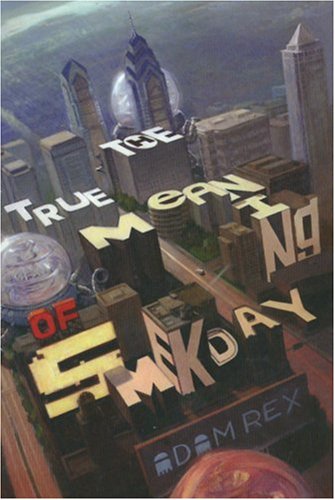
I didn’t plan it out much beyond that when I started. I have a folder full of about a hundred Chapter Ones that I started on a wild impulse to do some kind of story or other. The Ink Witch and Unboxing Libby are just the two acorns that actually got to be trees.
BB: I also was into Xanth once. It happens. And Smekday is the literal best. In terms of your own book, THE INK WITCH is also this ultra-heroic trans kid narrative, which definitely brings up Becca’s transition, but it’s just part of her character, not the central point of the plot. This casual diversity that’s named and acknowledged but is peripheral to the bulk of the storytelling is something that I’m a little surprised we don’t see more often. Right from the start, did you know the degree to which you wanted THE INK WITCH to follow this form? And did the book significantly resemble its initial rough draft or did you make some major changes?
Steph: One thing I’ve learned about myself is that I basically have to write the book first before I know what it’s about, and then I go back and edit it so it’s about that. The first draft of The Ink Witch dates back years and has almost the same major plot beats, but it was just a standard collect-the-MacGuffins adventure without much to say.
Coming back it to it after finishing Unboxing Libby, I realized, hey—I did the thing here where there’s a hidden magic world that keeps itself secret from regular humans, who wouldn’t understand or accept it. That’s a common fantasy trope, and in most stories the deception is presented as a good thing. But is it? Is “as long as nobody knows who we are really are, we’re safe” a fair status quo? I wanted to tell a story that critiqued the idea that we should be satisfied with that. And it made sense to me that the main character of that story would be a trans kid, who would know BS when she smelled it and have strong opinions about the idea that you should be forced to lie about yourself just because someone else doesn’t like who you are.
I also really wanted to do, as you mentioned, a story about a trans character where it was just part of her character, not the central conflict of the story. There’s more to our lives than just battling oppression all day long—this is a mostly-lighthearted fantasy adventure, and we should get to have those too. And with so much vicious prejudice against trans people, and kids in particular, it’s more important than ever that readers who might not be specifically looking for a story about a trans kid encounter us in stories and see that, hey, we’re just people.
Another big change is that originally, there was no ink in The Ink Witch! The witches just waved their fingers and cast spells. When I went back to the manuscript, that struck me as pretty generic, and the magic didn’t feel like it had a strong identity—everyone was just pulling out this or that power as the plot needed. So I came up with the idea of the witches producing ink and literally rewriting reality, like a mix of lawyers, coders, and the magicians who make pentagrams to trap demons. The power of true names is another classic fantasy trope that ended up being important to the story, so why not have a magic system that runs on the stuff used to write them?
BB: I love that. Much along the same lines (and you touched a little on this already) did you have to cut or remove anything from this book that you loved but that, ultimately, just didn’t fit the greater narrative? Put another way, did you have to kill any darlings?
ADVERTISEMENT
ADVERTISEMENT
Steph: In the first version of the story, Marisol, the mermaid who now appears in the Seattle chapters, was being held captive by a wealthy tropical fish collector in Las Vegas. Becca had to pull off a casino heist to get to her, which involved Natalya entering a dog show, and later a dramatic getaway down a secret escape waterslide. There was some great stuff in there, but due to changes in the story it didn’t work at all any more and I had to replace that part completely.
BB: Finally, you’re two for two on the successful middle grade front. I just have to ask it: Are you going three for three? Will we see another middle grade from you? And, failing that, what else are you working on these days?
Steph: It’s too early to give any specifics, but I do have another middle grade project in the works, an illustrated (by someone else) novel about mermaids. What can I say, mermaids are neat! I’m also working on an adaptation of an amazing but little-known fairy tale that, as far as I can find, has never been done as a novel. And that one is about trolls! After that, we’ll see—I have some ideas for adult novels, too, but so far it’s the middle grade ones that have demanded the loudest to be written.

A big thank you to Steph for taking the time to talk to me today, and a thank you too to Victoria Stapleton for setting this interview up. The Ink Witch is, of course, available where any fine books are sold. I know you’ve a lot of award winners to catch up on. I advise you to try this one when you need a little pick-me-up. It’s the best.
Filed under: Best Books, Best Books of 2025, Interviews

About Betsy Bird
Betsy Bird is currently the Collection Development Manager of the Evanston Public Library system and a former Materials Specialist for New York Public Library. She has served on Newbery, written for Kirkus, and has done other lovely little things that she'd love to tell you about but that she's sure you'd find more interesting to hear of in person. Her opinions are her own and do not reflect those of EPL, SLJ, or any of the other acronyms you might be able to name. Follow her on BlueSky at: @fuse8.bsky.social
ADVERTISEMENT
ADVERTISEMENT
SLJ Blog Network
Top 10 Circulated Picture Books of the ’25-’26 School Year
Pancake Trap | This Week’s Comics
From Policy Ask to Public Voice: Five Layers of Writing to Advance School Library Policy
Making the Truth Bearable, a guest post by Kristine Rudolph
ADVERTISEMENT
Whoa! Well, this book is on my pile, now!
Yes indeed. Yes indeed indeed.
I can make this happen! Victoria at LBYR.