
Celebrate Filipino American History Month: A Q&A Balikbayan Box Full of The Shape of Love by Carren Jao

In America, there’s a tendency to dedicate our energies to only one thing per month. October in particular comes across as supposed to be Halloween focused and ONLY Halloween focused for the masses. But let us not forget that, amongst other things, October is also Filipino American History Month, and that’s worth lifting up. Now recently I’ve been a bit peeved that publishers have backed off on a lot of the diversity in publishing a range of experiences and voices in children’s books in the last two to three years. That’s true in general, but as you’ll see by some of the examples below, it’s heartening to see a slight increase in the number of titles about the Filipino experience in America at the same time.
One book in particular that caught my eye this year was The Shape of Love by Carren Jao, illustrated by Corinne Caro. Now if you know me and you know my tastes then you might be surprised that I’d feature a book with a title like “The Shape of Love” since it implies that it would be some kind of “Love Is” innocuous book. But as it happens, this is a book that zeroes in on a very specific phenomenon. One that I, personally, haven’t seen represented in a picture book before (though it pairs nicely with New Shoes for Leo by Lauren Agra Deedy, illustrated by Susan Gal). Plus, this book is the winner of the Lee & Low Books New Voices Award, and that’s worth paying attention to.
ADVERTISEMENT
ADVERTISEMENT
I first became aware of balikbayan boxes from a podcast I’d been listening to just last year. Sent by Filipinos living in America back to their families, these very large cardboard boxes are filled to the brim with an array of gifts, treats, and useful things. In this story a mother in America, living far from her family, fills a box with everything from, “The perfect sneakers for her basketball-loving son, the latest book in her daughter’s favorite fantasy series, delicious chocolates for her youngest child.” Honestly, it’s one of the rare titles I’ve seen to discuss married parents living apart where one is in America sending things back to the people she loves at home.
I think that there’s a lot one can pick apart from a book of this sort, so pick we shall! and best of all, Carren Jao was perfectly willing to answer some of my questions:
Betsy Bird: Carren! Thank you so much for answering my questions today. I first encountered balikbayan boxes in a podcast a couple years ago, and I was surprised to discover that they weren’t really discussed in any picture books that I knew. I was so pleased to learn that that was the subject of THE SHAPE OF LOVE. Can you tell us a little bit about the boxes (for folks who may not have heard of them before) and where you got the idea for this particular book?

Carren Jao: I think of balikbayan boxes as giant care packages sent across the ocean. Some people have called them the slowest, most meaningful love letters. For me, they have been glistening parts of my childhood memories, even though they’re just made of humble, sturdy cardboard.
My dad traveled a lot when I was growing up, and sometimes he would be gone for months. Every so often, though, these boxes would arrive at our doorstep, heavy with objects he’d picked out and collected for our family over many months. Those boxes were filled with all sorts of objects, from cereals and snacks to household goods. They were exciting to open — very much like opening Christmas gifts, but at odd times of the year. The boxes were also very solid, physical reminders that he kept on thinking of us even from far away.
Balikbayan boxes are an iconic part of Filipino life, whether you live in the Philippines and receive them or live abroad and send them. In the Philippines, many families have members who work in other countries, and they all send these boxes filled with their hopes, dreams, and longing. They really are objects of love and connection sent every day around the world.
BB: The story itself isn’t specifically about any one family, when you just look at the text. It could apply to anyone who sends such a full box home. The images, however, tell a distinct story about a single family. When you wrote the book, was such a family your intention or did you leave it purposefully open ended for the illustrator?
Carren: You’re right! Except for the first line, the story itself has no mention of a specific person. I purposely wrote it that way because these balikbayan boxes evoke such a strong emotional response that I wanted it to feel familiar to anyone who read the book, whether or not they were in the same situation.
I’ve also been so fascinated by balikbayan boxes themselves and the incredible journey they take. When I was young, when the balikbayan boxes arrived, you could tell they went through a lot! They were a little battered and sometimes torn, especially at the edges. They were each a mini-Odysseus, literally weathering long ocean voyages and grueling weather to reach the people they loved. I had hoped that by showing the journey of these boxes, I could also show the epic proportions of love and longing of the people sending them.
BB: And we should remember that THE SHAPE OF LOVE was a Lee & Low New Voices Award-winning story. Tell us a little bit about what that was like for you. How did you hear about the award? What gave you the impetus to submit this particular story? And how did you find out about your win?
Carren: I don’t remember exactly how I heard about Lee & Low’s New Voices Award. If I had to guess, it would be some mix of the kidlit network and social media. What stuck with me was that they specifically wanted stories from writers of color, you didn’t need an agent to submit, and they were a well-established publisher with a real track record. These all read like green lights to me! 🙂
I’d started writing for children in early 2022, during COVID lockdown. I was a journalist used to being out talking to people, and between that and two young kids (one just starting kindergarten), I needed a creative outlet I could squeeze into small pockets of time. Something that didn’t depend on interviews. I also hoped it could be something I would eventually share with my own kids.
By the time I found out about the award, I’d written about 11 stories in various stages. This one felt the most “me.” It was lyrical, succinct, and, I hoped, the kind of story that stays with you. Of all my drafts, it was the one I most wanted out in the world.
I didn’t think I would win because I was so green at the time. I figured there would be so many others with equally beautiful stories to share, but I’ve always had a habit of just trying, since there was nothing to lose but a little time. Kudos to Lee & Low because they made it really easy to apply, too! There wasn’t a long form to fill out, and that’s huge! I submitted this story around August 2022 and went about my daily life.
Then that December, right as I was leaving for a trip home to the Philippines, I got the call that I’d won. I was floored. What followed was a crash course in contracts and paperwork, which my future editor, Kandace Coston, patiently walked me through, over emails and a call. Until then, I’d been writing with classic impostor syndrome, not knowing if any of it was going anywhere. The award was the validation that it was getting somewhere, and it gave me the confidence to keep going.
BB: I don’t think it would surprise much of anyone to hear that I simply don’t see a great many Filipino stories for kids in a given year. What, to your mind, are some of the challenges in bringing these stories to publication? What would you like to see happen for these potential books in the future?
Carren: Wow, that’s a tough one to answer briefly because the real answer is systemic.
I’ve been a journalist a long time, and I think of journalism and publishing as related fields. Both depend on people being willing to share their stories. As an arts editor for the local PBS station, I was always hunting for stories that could only be told by someone from that community, with that lived experience. I was lucky enough to find a few and work with wonderful writers who pitched stories like trick roping in Mexican cowboy culture or rondalla, a type of Filipino music still thriving outside the Philippines. Those pitches were rare, and I think it’s partly because people don’t always see their own experience as “story-worthy” enough to write down, which is something I always try to push back on.
On the other side, editors and acquiring teams don’t always share that lived context people want to write about, so it’s harder to fell that strong emotional pull to a story. The onus then on writers becomes writing something that honors the specificity of a community while still landing that universality with readers outside it.
And then there’s the “industry” part of “publishing industry.” Philippine culture hasn’t had the mass-media wave that, say, K-pop has had for Korean culture, so the business case for a Filipino story can be a harder sell. But, Filipinos are the third-largest Asian origin population living the U.S., so there is something to be said that there is a market for more Filipino stories.
Whew, that’s a lot of gloom and doom answers, but there are people and organizations that are pushing on all sides of this. We Need Diverse Books, The Very Asian Foundation’s May Book Project; Lee & Low, Charlesbridge, Little, Brown’s Alvina Ling Books, Christopher Myers’s Make Me a World imprint.
I love seeing authors of color building community and lifting each other up, more editors and publishers actively seeking out diverse stories, and more mainstream visibility for stories outside of their experience. Yes, we all have our special experiences that make up our culture and who we are, but I also believe that we all share in a very universal, human experience. That’s how you grow the audience for these books; that’s how you build empathy among all kinds of people.
BB: That’s so beautifully put, and something I’d love to get highlighted a lot more in discussion of the state of publishing today. Now lest I forget, let’s talk a little bit about your illustrator Corinne Caro. At what point in the process did you get to see some of the finished art? And what’s your reaction to the work she put into these pages?
Carren: I saw Corinne’s finished art about 2.5 years after winning the award. By then she’d already been through much of the process with Lee & Low’s art team. I did have some input in choosing which illustrator to go with (Corinne was my #1 choice :))
I was thrilled to work with her, partly because she’s based in the Philippines herself and could relate to the journey of these boxes firsthand. It shows in the details only someone living there day-to-day would think to include: the shape of the grills outside homes, the sari-sari store signage, even a statue of the Virgin Mary in the living room (the Philippines is deeply Catholic, so that’s a common sight).
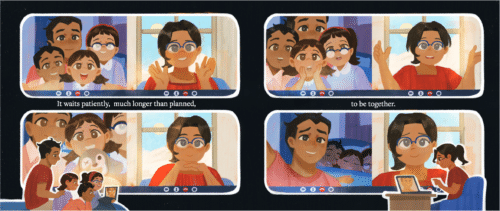
My favorite parts are her two big spreads. The first is a cargo ship crossing the Pacific toward the Philippines. It captures the epic journey of the balikbayan box perfectly, windswept oceans to time differences. The second is a family video call, which hit close to home: much of my family is still in the Philippines, and every month or so we all get on a call and become this grid of tiny squares, everyone crammed in from wherever they are.

Betsy Bird: You do a great job of lifting up other Filipino children’s book creators. Can you give us a couple names and titles that you’d particularly like to highlight for people to see right now?
Carren: I’m so happy to share that there are Filipino children’s books that have come out/are coming out this year, and they’re by Filipinos all over the world. 🙂

“What Makes a Family: Celebrating the Filipino Day of the Dead” by Eric Ruiz Roxas and illustrated by Aldy Aguirre gives readers a glimpse into how Filipinos celebrate the Day of the Dead, from candles and flower necklaces made of sampaguita (jasmine) to karaoke and dancing! Both of these creators are based in the Philippines! Until I heard about this book, I didn’t think about how differently Filipinos celebrate their loved ones who have passed away. It’s just so normal to me. See? Even I’m guilty of undervaluing my own experiences sometimes.

“Ninang’s Here” by Analene Go and illustrated by Alexis Young talks about the special relationship we have with our godparents. Many Filipinos are Catholic (the second major religion is Muslim), so our extended family in the form of godparents also becomes special people in our lives, and Analene depicted that so well with a godmother who’s more of a cool aunt.
And, coming in 2027, there’s “Cloud Peddler” by Isabel Roxas about taho, a Filipino street food dessert, and the street vendors who anchor their communities. I haven’t read it yet, but I’m thrilled to see it from a major publisher and author-illustrated by Isabel Roxas, one of my favorites. I have a dog-eared copy of a book she illustrated from 2010 with a publisher in the Philippines, “Araw sa Palengke,” that I read to my eldest son over and over again!

BB: Shoot, you came with receipts!! Finally, what are you working on next? What else could we hope to see from you?
Carren: I’m happy to share that I’m publishing my second book with Charlesbridge this coming July 2027, as part of their STEM-related books, Steamworks. The book is called “Maya Breaks It Down,” and it pairs coding principles with breakdancing. Filipinos are amazing dancers, and this was another great opportunity to highlight their amazing kinesthetic skills while also encouraging readers to think about science and math in creative ways!
Beyond that, I’m still nurturing early drafts and story sparks. I have a couple of stories out on submission, and I’m crossing my fingers that I’ve done my job of bridging cultural nuance with universal experience.

Huge thanks to Carren for the depth and thought that went into her answers today (to say nothing of lifting up her fellow creators). The Shape of Love is on shelves now, so go on and get your hands on it yourself. And happy Filipino American History Month!
Filed under: Interviews
About Betsy Bird
Betsy Bird is currently the Collection Development Manager of the Evanston Public Library system and a former Materials Specialist for New York Public Library. She has served on Newbery, written for Kirkus, and has done other lovely little things that she'd love to tell you about but that she's sure you'd find more interesting to hear of in person. Her opinions are her own and do not reflect those of EPL, SLJ, or any of the other acronyms you might be able to name. Follow her on BlueSky at: @fuse8.bsky.social
ADVERTISEMENT
ADVERTISEMENT
SLJ Blog Network
One Star Review, Guess Who? (#237)
And Then There Were None (The Manga Adaptation) | Review
Unconventional Narratives in Newbery Contenders
From Policy Ask to Public Voice: Five Layers of Writing to Advance School Library Policy
A Bad God’s Guide to Fart Jokes and Philosophy, a guest post by Louie Stowell
ADVERTISEMENT