
And Where the Sendak Isn’t: A Where the Wild Horses Are Cover Reveal and Q&A with Amy Alznauer
Do you have any idea how difficult it is to come up with a great name for a middle grade novel? I mean, sure, sometimes the title comes to you from the start, and if the stars align then your agent, editor, publicity, and sales team might all agree with one another that this title of yours is “The One”. There are other times, however, where you putz about for months, tweaking and testing, and in the end it still isn’t quite right.
That is not the story of today’s book.
When I first heard that author Amy Alznauer (and fellow Evanstonian) had written her debut middle grade novel and managed to get it named Where the Wild Horses Are (out October 13th), I was floored. Inexplicably, in spite of the fact that this was notoriously the working title of Maurice Sendak’s Where the Wild Things Are, no one has ever thought to turn it into the title of an actual book. Makes you wonder if there’s a middle grade novel out there being worked on called Willi the Worm (IYKYK), but I digress.
ADVERTISEMENT
ADVERTISEMENT
Today we’re going to reveal the cover of this book (which was painted, I kid you not, by Sydney Smith himself!), and before that, I like to get the 411 on these books from the source.
But first, you know the rules. Publisher plot description time!
“Nash Eliza West has been horseless her whole life, and she has one shot to turn things around.
Twelve-year-old Nash is a self-proclaimed cowboy. She sleeps with her riding boots on, takes lessons at the local barn, and reads True Grit for life advice. There’s just one thing missing— a horse of her own.
Enter the Extreme Mustang Makeover contest, a chance to receive and tame a newly-captured mustang for the summer. Signing up will guarantee Nash one hundred days with a horse; and if she wins, she can use the prize money to bring him home for good. It’s the miracle Nash has been waiting for.
But Nash’s attention is divided when her cousin Benny arrives to stay for the summer. While Nash and Benny were once like sisters, the six years since Nash moved away have driven a wedge between them. Benny is everything Nash isn’t: gentle and well-behaved, and Deaf like Nash’s parents are. Sometimes she wonders if they’d rather have a daughter like that than a headstrong cowboy CODA like Nash.
A brave girl and a horse no one believes can be tamed: it’s a tale as old as time, brought to sizzling new life through Nash’s one-of-a-kind voice. Amy Alznauer weaves cowboy bravado, growing pains, and Deaf culture gleaned from her husband’s family into a debut middle grade novel that will lasso you tight by the heart.”
And now, a question or two for the author herself:
Betsy Bird: Amy! What a delight to talk to you today. And congratulations on your middle grade debut! WHERE THE WILD HORSES ARE appears to be an unapologetic horse-loving book, with a significant inclusion of Deaf culture. Tell us a bit about where this book came from.
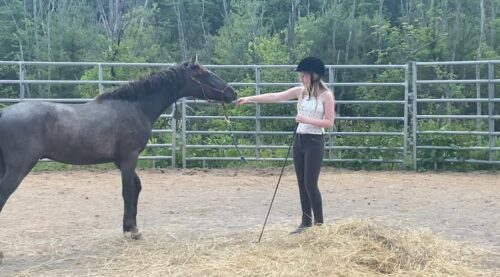
Amy Alznauer: Thank you so much, Betsy! Four years ago, my then twelve-year-old daughter gentled a wild mustang she named Dragonfly. I was with her every step of the way – from watching her put together the application, the dramatic and somewhat terrifying Pick-Up Day at a mountain barn, the endless hours of driving back and forth to and from the barn, and then daily watching her train (often with my heart pounding) in the hot Pennsylvania sun, but most of all witnessing her slowly forge a bond with this beautiful wild animal. I was so riveted by the two of them, it didn’t occur to me till the end of that summer that I might write about it. But when the idea finally came, it felt deeply right. Not only was this a story I’d witnessed and lived, but it was my story and my mother’s story too. Longing for a horse, and even more for deeply communing with an animal, goes far back in our family. My great-great-great grandmother Amanda came across the country to Eugene, Oregon in a covered wagon but spent most of that journey astride a horse, a violin strapped to her back. I like to think the fierce protagonist of my book, Nash Eliza West, takes her cues (and her abiding desire for a horse) not only from my daughter, me, and my mother but from so many of the women in my family. Nash even gets her middle name from two of my ancestors, Eliza Jane and Eliza Glass.
BB: We probably shouldn’t go any further in until we talk a little bit about your rather clever title. As some folks may already know, WHERE THE WILD HORSES ARE was an early draft version of WHERE THE WILD THINGS ARE. You even have a cheeky quote from that original manuscript at the beginning of your book by Sendak himself. How’d you get the idea to finally give this title the book it so richly deserves?
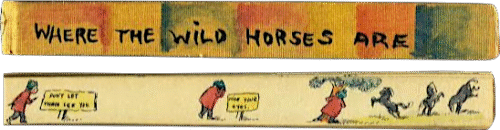
Amy: While I was in the thick of writing, I happened to visit a grand retrospective of Maurice Sendak’s life and work at the Denver Art Museum. There, I came across a strange book dummy he’d created as a first stab at his classic work: a brightly painted, inch-high and maybe seven-inch long, hand-made book. Later, I researched that unpublished work and discovered that Sendak ultimately decided against horses, claiming he couldn’t draw them. And I was stunned to discover these magical opening lines—
Once a boy asked where the wild horses are.
Nobody could tell him.
So he asked himself where the wild horses are.
And he answered, they must be this way.
Luckily the way led through his own room.
He found signs pointing in the right direction.
—which so perfectly captured the primary plot in my book: a child looks out her window, longing for a wild horse, and ends up finding the way herself, via a literal sign pointing in the right direction. It was an honor to work with the Sendak Estate to gain permission for this epigraph.
BB: I bet! So talk to us a little bit about the representation of Deaf culture in this book. For those of us who saw the film CODA, we might have some small familiarity with Nash’s situation, but it must have taken quite a bit of research on your part. I know that you had some help thanks to your husband’s family. Can you talk to us a bit about how you do representation in 2026 in children’s literature? Tell us about the work you put into this.

Amy: For twenty-five years now, my family has been a mix of hearing people, Deaf people, CODAS, and GODAS. From the moment I met my husband’s Deaf parents, I fell in love not only with them as people but with American Sign Language. I began taking ASL classes, reading everything I could get my hands on about Deaf culture and sign language. Then, as soon as they moved from Ohio to Chicago to live on our same block and help us raise our at-the-time small children, I began speaking in sign daily with my family and regularly attending Deaf events: church services, banquets, coffee hours, and theater performances. I continue to work on ASL formally, but my primary “research” has been daily life within my family and the joyful experience of raising bilingual children in a bilingual family. It’s not well understood outside the Deaf community, but Deaf families are almost always a mix of Deaf and hearing people, so language is often fluid, complex, and hybrid, both gestural and spoken. So more than anything, I wanted to put a family like ours on the page: a family where Deafness and sign language are matter-of-fact parts of life, part of the texture and form of life, but at the same time imparting a unique brand of humor and sorrow, articulation and confusion and joy.
BB: Were there any tropes or stereotypes you were hoping to avoid with your text?
Amy: There were so, so many. Stereotypes abound about Deafness, cowboys, horse girls, and even horses. The very best antidote or response to a stereotype (in life or fiction) is the shining particularity of an individual. For example, the saying “cowboys don’t cry” makes a grand generalization, and my protagonist Nash starts out holding with this too. But eventually, through Nash’s actual personality and life, this old truism is transformed. Here’s another: Deaf people are often depicted in film and books as needing help or rescue, and so we get hearing-people savior stories. Wild Horses is indeed a story of both betrayal and salvation, but its failures and feats are carried out and shared by many characters—Deaf and hearing, human and animal alike—each of whom has their own, singular share of flaws, quirks, charms, and depths.
In some sense, overcoming stereotype or rote thinking is the entire aim of fiction – to lay something down so absolutely itself that the old ways of thinking seem weak or insufficient by comparison. So, hopefully, Wild Horses is not a story about Deafness or cowboys or girls or horses, but rather a story, plain and simple, that follows one particular girl, along with her particular family and friends and equines, on a wild quest to end her horselessness once and for all.
BB: Talk to us about horses. Were you a horse girl growing up?

Oh, I love this question, because I left out so much from my earlier response. Yes, resoundingly, YES! I was a die-hard horse-girl and dog-girl, but I will focus here on the horse bit. I took riding lessons for years, and there was this large dark bay at the stable named Bruno. I thought of him as my soul-horse. I’d stand beside Bruno in his stall, listening to him breathe, and believe with all my heart that I could silently talk to him through my hand. Later, my mother bought a horse (my little sister and I are standing with him in the photo), finally answering her own horse longing. I rode him, worked with him, and spent hours up in the hayloft of our little one-horse barn reading and drinking in the smells of oats and straw and warm horse. It was during that time I attempted my very first novel, a story about two girls, a wild dog, and a wild horse. I recently found all my notes and chapters in a box in my parents’ attic and was thrilled to discover this description in particular, which seems so prophetic of Wild Horses:

BB: Since this is your middle grade debut, talk to us a bit about that process. What were some of the challenges in bringing out your first novel?
ADVERTISEMENT
ADVERTISEMENT
Amy: Ever since I was able to write in a diary, I’ve wanted to be a novelist, but writing a novel has also always terrified me. So, I pretty much tried everything else first, poetry, essays, memoir, picture books. I got away with a novel this time, I think, by kind of tricking myself into it. Where the Wild Horses Are is deeply rooted in my past and present, and yet it wasn’t one of the ideas that’s been percolating in my mind for decades, so I didn’t feel all that weight of expectation. The first sentence, and then quite quickly the opening chapter, kind of tumbled out of me before I had time to work up any terror. And for me, getting that first move right is an absolute prerequisite for continued work. If I can’t find my way into the voice and perspective of a work as initiated by the opening lines and paragraphs, then I’m rather profoundly stuck. But here it was already—To be horseless when you’re a girl who loves horses is not a good thing to be. It creates no end of trouble. I should know. I’ve been horseless all my life— so very quickly I was off to the races. After that, I put a hand-drawn chart of days on my wall in our furnace room where I worked and recorded a word count every morning. My goal: an average of 250 words per day. I managed quite a bit more than that most mornings and completed a draft I was happy with in several months. After I started working with my editor Taylor Norman, I began to really analyze how longer-form narrative works. Our shared metaphor was that of a mixing board: tuning up and down all the various voices and metaphors until the balance and harmony was just right. Working with Taylor was a beautiful, revelatory, immersive experience.
BB: And was there anything you’d hoped to keep in the earlier drafts that you had to discard along the way?
Amy: Oh yes, so much. There are entire plot lines, entire long-metaphors and refrains, that had to be cut. But the universe of a book is always so much larger than what finally ends up on the page. Taylor always talks about the “holistic world frame” of a novel – by which she means that long, full, wide life that precedes and encompasses the drama that will actually be staged. I had to meditate on that repeatedly and even had to create an enormous board with colored sticky notes and string and annotations (which I called my murder board) before I could really get it through my skull what this implied for my novel. But it’s far easier to let go of passages, lines, scenes that you love once you know that, in some sense, they’re still there in that larger world frame, but also that what you’re carving out on the page is more vivid and driving without them.
BB: I love every word of that. Finally, what else do you have going on these days? What’s next for you?
Amy: Well, I just won the Mathical Award, Grades 3-5 for my most recent picture book The Five Sides of Marjorie Rice: How to Discover a Shape – which was just thrilling, not only for me but for the other people involved in the backstory and making of this book. So, I’m looking forward to the various encounters with readers, teachers, and librarians that will bring. I’m also revamping my website, hopefully dipping my toe back into social media, and working on a few wonderful side-projects. But most overwhelmingly, I’m starting into my next middle grade novel. This one is a book I have percolated pretty much all my life, so the fear and trembling is currently rather intense. Two weeks ago, I thought I’d found my way in, but sadly it was not to be. Yet every morning I’m at my desk, inching forth, trying to believe (and most days succeeding!) that sitting before a blank page and trying things out is a valiant and good thing to do with one’s time!
Fantastic, yes? God, I love it when authors talk process.
And congrats to Amy on winning that Mathical Award! It always delights me when they show such incredible taste in great books.
Now I believe I owe you a cover reveal, do I not? Behold then!

As I mentioned before, that jacket art is by the illustrious Sydney Smith himself.

Where the Wild Horses Are will be released by Neal Porter Books on October 13th. I can’t thank Amy enough for taking all this time to answer my questions today. Thanks too to Sarah Howard Parker at the team at Holiday House for helping to put this entire reveal together today.
Filed under: Cover Reveal, Interviews
About Betsy Bird
Betsy Bird is currently the Collection Development Manager of the Evanston Public Library system and a former Materials Specialist for New York Public Library. She has served on Newbery, written for Kirkus, and has done other lovely little things that she'd love to tell you about but that she's sure you'd find more interesting to hear of in person. Her opinions are her own and do not reflect those of EPL, SLJ, or any of the other acronyms you might be able to name. Follow her on BlueSky at: @fuse8.bsky.social
ADVERTISEMENT
ADVERTISEMENT
SLJ Blog Network
The Greenies | Review
From Policy Ask to Public Voice: Five Layers of Writing to Advance School Library Policy
Science as an antidote to dread, a guest post by Katy Doughty
Sara Pennypacker visits The Yarn
ADVERTISEMENT