
A Rare Bird of an Interview: A Talk with Elisha Cooper

So here’s the deal. Elisha Cooper? Essentially anytime the man wants to tell me about his latest book, I am on board. I’ve known him for decade(s?) now, and his picture books just provide this steady drip of joy that I think a lot of us need at this moment in time. Take his latest. The Rare Bird (on shelves February 24th) is what you would get if Walter Mitty were of the feline persuasion. Or, as the publisher puts it:
“Caldecott Honoree Elisha Cooper returns with a unique and playful tale about an imaginative house cat who dreams of all the wild things it can be.
The imagination of one housecat takes him to unexpected adventures as he dreams of spreading his wings as a “Rare Bird”.A Rare Bird can do anything!
Fly fast through the forest,
or splash in the bird baths,
or meet animals from faraway lands…..Readers will fall head over heels for this extraordinary tale of dreaming, the power of imagination, and the freedom of creativity.”
Today, Elisha talks with us a bit about this latest title, as well as its debt to Where the Wild Things Are. There’s also a thoroughly enjoyable rant about respecting children’s art, and he confesses which book did him in “in the best way”.
ADVERTISEMENT
ADVERTISEMENT
Betsy Bird: Elisha! Such a delight to get to pepper you with questions once again. When last I heard, THE RARE BIRD had garnered at least FOUR starred reviews, which is extraordinary. I’m going to need the origin story on this one, though. Where did this particular book come from?
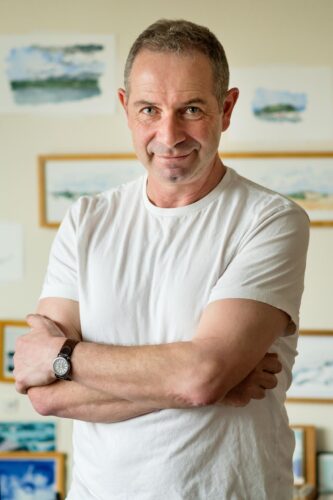
Elisha Cooper: As I write you, my cat is napping next to me, on the arm of our sofa. Usually he’s circling my feet as I work at my desk, pestering me to throw his toy, which he retrieves for hours. One day, he was just flying around our apartment and I looked at him and thought, he’s a bird. That’s the book! What if he actually imagined he was a bird? How would that look? And I thought how this is true for all of us, how imagination lets us take flight. All those little adventures we take in our minds. So with that we’re off into our story.
BB: The book requires a certain degree of interpretation and understanding on the part of the child reader. At no point do you say anything so pedantic as “the cat thought it was a bird”. You respect the kids to catch on. The visuals (the cat starting with a book on sea life and then encountering one on birds) does a lot of the heavy lifting too. And the book itself is much in line with your previous titles in terms of displaying this respect for a child reader’s intelligence. Like your art, you winnow things down to the essentials. Is that a conscious thing you work to achieve or is it just the natural outgrowth of your writing/illustrating process at this point?
Elisha: Oh, it’s probably subconscious! Though my editor and I were intentional about never using the word “cat” anywhere in the book, not even on the flaps. Commit to the bit, right?
And while The Rare Bird is about imagination, it’s firmly rooted in non-fiction, in observing the world around me. That’s our cat. That’s our apartment here in the Village. The other animals are from the Museum of Natural History (stuffed). The landscapes are forests and lakes in Maine. The girl is drawn from old photos of my editors when they were girls.
I’m glad you used the word “respect.” Readers deserve our respect; why disrespect a reader because she’s a child? I often think of something an adult novelist said — a novelist who wrote for adults — that he was actually writing for an intelligent 12-year-old. A great example is Charlotte’s Web. I also think how Maurice Sendak said he wasn’t even really writing books for children. He’s writing for humans. That feels right to me.
To answer your question about winnowing things down, it’s possible that as I get older I’m adjusting to my limitations. I can’t write as long (or run as long). The essay I wrote last year in The New York Times Book Review was hard. When ideas get too busy, I’m lost. So I try to keep things simple, for myself. A short phrase, a splash of watercolor.
BB: The Rare Bird has an outsized personality entirely of its own. Even if folks don’t have cats that encompass every aspect, they’ll at least recognize some of its proclivities in their own felines (my cat Hilo is clearly a bird in his mind, at least once in a while). You’ve sort of covered this already, but I’ll still ask it: Is this kitty inspired by your own cats at all, or entirely out of your head?
Elisha: Um, photos of Hilo please?
BB: Dignity dignity, ever dignity.
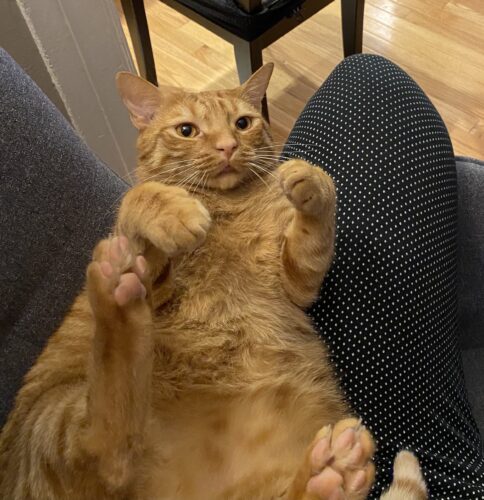
Elisha: Again, the cat here is our cat. I followed him around our apartment for a week with my sketchbook (he was like what are you doing?!). I leaned on other animals in my life, the personalities of the goats I had growing up. And there’s always material as I bike around the city. I’ll see a cloud along the Hudson River, catch it in my sketchbook. Or see a dog playing in Central Park, something about their expression, and I’ll think I’m taking you home to my desk.
BB: I can think of no other author/illustrator who has so thoroughly staked an equal claim in dog AND cat books. Normally one picks a lane. You, however, seem to have an equal affection for both species, so I’ll ask you this: What, to your mind, is the essential difference between a good cat book vs. a good dog book? And is one easier to create than another?
Elisha: What’s a lane?! Yeah, I don’t believe in lanes, except for the bike lane on Broadway. But let’s be clear — in children’s books an animal is not always an animal. This cat is a child. Maybe it’s me, years ago. Or it’s me today. Or it’s you, or all of us. And storytellers have always used animals as stand-ins, from fairy tales to Aesop fables. Think of the kitten in Kitten’s First Full Moon by Kevin Henkes. She is clearly, beautifully, a child. Or at least I think she is. Let’s ask Kevin. I think this transformation, or whatever we call it, allows humans to express deeper, more complicated feelings. It gives us latitude to deal with sadness, or have wild thoughts. A certain freedom. That said, sometimes a cat is just a cat.
BB: You’ve had wordless two-page spreads in your books before, but this title is a bit different because you include a wordless sequence. I don’t recall you doing that before. Was that an aspect from the get-go with the first draft of this title or did you come to it later?

Elisha: I do love a wordless sequence! Ideally one that appears in the third arc of a book, that gives the reader a chance to breathe, to slow down, reflect. The flight sequence in Rare Bird is a pretty transparent homage to the dream sequence in Where the Wild Things Are. I knew I was going to do this when I storyboarded the book. My homage, or thievery, extends to Rare Bird having the same trim size as Wild Things; the flowered rug in the apartment mimics Sendak’s flowered endpapers; there are so many easter egg thefts that I probably shouldn’t admit to them, or the Sendak Foundation will come after me. Hello, Doug!
Here’s something else an effective wordless sequence does — it gives a character, and the story, the space to change, without being so explicit about it. It’s an interior journey. A nap, a dream. So as Max naps, his wild rumpus subconscious takes over, and something switches inside him. A shift that Sendak renders perfectly. We feel one thing, then calm down. We read a book, and become different. Wordless sequences give the story a bendy arc that brings the book home (where the soup is still hot). I don’t know if I achieved that with the flight in my book, but that’s what I was going for.
BB: Your seminal cat book was BIG CAT, LITTLE CAT where you kept backgrounds, shading, etc. to a bare minimum. THE RARE BIRD retains your linework but there are LOTS of details and (comparatively) colors to be found. I know that your style has shifted over the years through different types of books, but this is an interesting compare and contrast with your current run of animal picture books. Did you try anything different with this book artistically (or written, for that matter) that you ultimately rejected for this book, or was it like this from the get go??
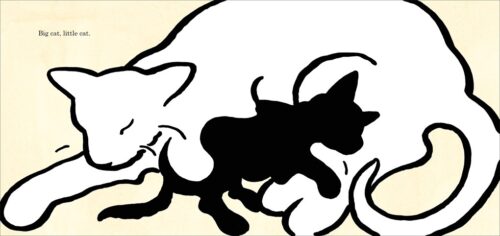
Elisha: Maybe art matches the subject? Years ago, when my daughters were young, our cat died. I wrote Big Cat, Little Cat to tell them that this was hard, but that eventually it would be okay. I think I wrote the story in one morning, at a café in Chicago. I was in town for a library conference. Then I wanted the paintings to be simple, clear, black-and-white, almost like a Japanese woodcut.
When I finished painting Here is a Book two years ago I was gutted. There were rips in the collar of my t-shirt, holes in my socks from scooching our floor. I painted everything in a no-days-off rush. That book did me in, in the best way. A book about making a book felt personal, with those wide ocean landscapes and dashed pencil sketches. It raised my expectations for myself, for what I could do with a children’s book.
So when I started painting Rare Bird I felt I had to give the same effort, sweat, tears, what have you. Using rough pencil again, trying to make the line really fly, like a bird, or a cat who thinks he’s a bird. I wanted controlled recklessness. Letting the pencil and watercolors jump, making art as high as I could. In writing and pacing, too. Sendak once said — and I know I’m citing him a lot here — that artists have to take a dive, risk smashing themselves against the rocks, but if they take that leap then maybe…. Those words have always resonated with me. I’m aiming for an emotional catharsis, where I’m almost destroyed when I finish a book. Like, ooof. That was the best I could do.
BB: I gotta ask it. The book is dedicated “To Mouse and Panda”. Cats? Or someone else?

ADVERTISEMENT
ADVERTISEMENT
Elisha: Yes, Mouse and Panda are our cats! Mouse was the little cat in Big Cat, Little Cat. He became a great, big cat who strode around our apartment with handsome authority. He died last year. It’s just Panda now, he’s growing into himself and approaching great cat status now too, and the furry star of this new book.
BB: Finally, what’s next for you? What else are you working on these days?
Elisha: A picture book called Line Lion, where a single black ink line changes shape from a lion to a bear to a hippo etc…. It’s a simple idea — the line is the narrative — inspired by those curvy wire sculptures by Alexander Calder. I’ll start painting in the next few days, right after I finish this interview!
Before that though, can I return to the subject you raised, of respect? And rant a little? After going to the Calder exhibit at the Whitney Museum, and looking at Picasso’s bull paintings, and driving up to Boston to the Museum of Fine Arts to see the Winslow Homer watercolors, I’ve been thinking more about how children’s book art fits within the broader world of “art.” In that Times essay, I placed Picasso and Sophie Blackall in the same sentence. That was intentional. In my mind they’re on a continuum. I have such admiration for the artists in our community, from Sophie Blackall to Vashti Harrison to Jason Chin. It’s why I love these interviews with you, because you take what we do seriously (and you’re an author, too). Again, respect. In the same breath, I get defensive when children’s books are considered in any way “less than.” We have a role to play here. We’re not helped when we publish books that talk down to children, with obvious and moral messaging, with art that is dull and digital (think of any crappy celebrity children’s book). We are better than that. Our best books should make us reach for the best in ourselves, to risk and dare and dream. And while I can’t know what that may be — and how can we judge art anyway — I believe this is something we can all aspire to. Okay, rant over. Cooper out.
Elisha Cooper, you are hereby given express permission to rant anytime you wish on this site, about anything you like. And that’s a promise.
The Rare Bird is, as I mentioned, on shelves February 24th. And the reviews are in:
★ “Pure imagination.” –Kirkus Reviews, starred review
★ “A seamless, creative progression worthy of study and repeated readings.” –Booklist, starred review
★ “[A] lovely gem of a picture book.” –The Bulletin of the Center for Children’s Books, starred review
★ “A resounding tribute to the power of reading and make-believe.” — Horn Book Magazine, starred review
Look for it soon!

Thanks to Elisha for taking the time to answer my questions, and to Kelsey Marrujo and the team at Macmillian Children’s Publishing Group for helping to put this all together.
Filed under: Interviews

About Betsy Bird
Betsy Bird is currently the Collection Development Manager of the Evanston Public Library system and a former Materials Specialist for New York Public Library. She has served on Newbery, written for Kirkus, and has done other lovely little things that she'd love to tell you about but that she's sure you'd find more interesting to hear of in person. Her opinions are her own and do not reflect those of EPL, SLJ, or any of the other acronyms you might be able to name. Follow her on BlueSky at: @fuse8.bsky.social
ADVERTISEMENT
ADVERTISEMENT
SLJ Blog Network
2026 Books from Asian/Pacific American Award Winners
Clock Hands | This Week’s Comics
From Policy Ask to Public Voice: Five Layers of Writing to Advance School Library Policy
The Choice is Yours, a guest post by Amanda McCrina
Dan Santat Talks Sashimi
ADVERTISEMENT