
Cover Reveal and Q&A with Shifa Safadi: Sisters Alone

Discovering a new author for kids can happen in a number of different ways, but a pretty good litmus test is if they, I dunno, win a National Book Award with their middle grade debut. Or something. That’s what happened to Shifa Safadi when she published Kareem Between back in 2024. No less notable (in my eyes anyway) is how it also ended up on the 101 Great Books for Kids List by Evanston Public Library. That was my first introduction to Shifa. Then, last year, I had the pleasure of discovering a new early chapter book series. The Amina Banana books at first struck me as amusing since I knew that they were coming out in tandem with another early chapter book series called Brianna Banana. Bananas were clearly in the air.
But when I actually sat down and read the Amina books (by, you guessed it, Shifa Safadi), I was delighted (and, quite frankly, relieved) to discover that they were remarkably written as well. As my description of them put it, “One of those cases where you read the first chapter, get worried that it’s going to be all sunshine and roses about the Syrian immigrant experience in America, and then the difficulties start to mount up. Amina has to overcome her own interpretation of what it will take to fit in, but there are distinct hurdles along the way. I thought it brought a fair amount of nuance to what is, at its heart, a rather simple story.”
ADVERTISEMENT
ADVERTISEMENT
You know what isn’t simple? Middle grade fiction. And now Shifa has tackled it head on once more. Sisters Alone (out September 8th) is one of those verse novels that’s able to combine complicated sibling feeling alongside gigantic natural disasters. Or, as the publisher put it:
Rama is all fire—fierce, quick to anger, and trying to hold her family together while battling the monster of intrusive thoughts. Leena is all ice—quiet, numbed to the vibrancy of the world, as she silently blames herself for their mother’s death.
When their father must travel for work, a sudden blizzard traps the sisters alone at their rural home. As the storm tears through their house, they’re left without power, without food, without shelter—and with no one to rely on but each other.
Told in powerful, poetic verse, Sisters Alone is a heart-stopping story of sisterhood, survival, and the quiet strength it takes to keep going, even when the world feels like it’s falling apart.
Today we’re going to show you the cover of this gorgeous book while ALSO talking with Shifa about it. In fact, I just want to talk to Shifa first. Who’s with me?
Betsy Bird: Shifa! Such a pleasure to host you here today! I was so delighted to encounter Amina Banana last year, and we could do a whole talk about the intricacies of writing early chapter book fiction. Today, however, I see that you’re returning to middle grade with SISTERS ALONE. What is it about the middle grade form that appeals to you? And would you ever consider aging up a little to do something young adult?

Shifa Safadi: Thank you SO MUCH Betsy for hosting me (and my SISTERS ALONE cover)! I have long been such a huge admirer of all the beautiful work you do for kidlit, and am so honored to do this! And THANK YOU for all the AMINA BANANA love too!!!
Middle Grade truly is my favorite genre. I think it is one of the genres that transcends age- readers of all ages can fall in love with a middle grade story, and it also stays true to centering kids’ emotions and lives. But my absolute favorite thing to focus on in MG is VOICE!
There is nothing in writing (and reading) that I love more than MG voice. The way that middle grade characters speak has that special magical ability to touch hearts with a special blend of both coming of age growing up grappling with the world, combined with the truthful and raw innocence of young people. MG voice never fails to tug at my heart strings, and I get this urge to go into a Middle grade book and hug the characters and let them know they will be okay!
As a former middle school teacher, and a mom of tweens/teens I think I also just naturally gravitate to MG voice because I can hear it so perfectly and clearly in my mind while writing (after years of hearing it in real life haha)!
As for Young Adult…I do have an idea of a speculative thriller brewing in my mind. So hopefully sooner rather than later.
BB: Oo! That’s a nice preview. right there. So give me the origin story on SISTERS ALONE. Where did this particular book come from? And what compelled you to tell its tale?
Shifa: Originally, I started off truly just wanting to write a survival story in verse as my second Middle Grade. I had read and adored Megan Freeman’s ALONE and Dusti Bowling’s CANYON’S EDGE and I wanted to create a similar story kids would love. I also really love the movie HOME ALONE and all things winter! Living near Chicago means we experience A LOT of snowstorms, so I had a lot of inspiration (although winter has seemed tamer in past years).

So I went ahead and plotted a story about a girl who gets left home alone during a blizzard, but it felt incomplete, and honestly, lonely. I decided to insert the MC’s sister into the book in my next revision (she had been a side character in the first draft).
Immediately, I knew it was the right choice.
The themes of survival go hand in hand with the theme of sisterhood—and I knew that whether my characters were battling their internal storms of anxiety and grief, or the external storms of the harrowing blizzard, that they would need to learn how to work together and figure out their complicated relationship in order to survive.
I hope it inspires readers to know that even when it feels like the world is lonely, they are not alone—that leaning on loved ones helps us all survive.
BB: This story is told entirely in verse. I’m always curious about when an author chooses to write in verse vs. prose. I’m working on a theory that for emotional stories, verse complements the subject matter more adroitly, but I haven’t really explored this idea. What, for you, is its advantage?
Shifa: Thank you for this question. I could talk about verse ALL DAY!
I truly love reading and writing verse, and there are numerous reasons why. One of which is, absolutely your point, in that it brings the reader up close and personal to the character, and therefore complements an emotional story.
By stripping everything but the most important words, poetry has to tell a whole story in sparse and impactful lines. Similar to picture books, a verse novel’s words have to count-every single one!
I love what Mary Oliver says about poetry in one of her craft books-she says that each poem in itself is like a story, and that by the end of each poem, the reader should feel something. I always keep that in mind for every single one of my poems while writing, and I like to describe it to kid readers like a tiktok feed in a way-a stream of consistent moving, different-length stories that capture attention and move the plot along.
Speaking of tiktok-one of the other reasons I love verse is because young reader’s attention spans are truly shrinking. I would truly love to pretend otherwise, but both in teaching and in momming, my kids are constantly asking me for LESS WORDS! A verse novel has lots of comforting blank space, short lines that are easy to read and jump through, and kids get that dopamine burst of satisfaction at finishing a poem each time they turn the page- which might help them keep going! I am always on the lookout to lure reluctant readers to fall in love with literature.
I also make sure my novels are not just verse, but that the novel part of the book is strong too. I don’t like to sacrifice plot for poetry. I want kids to get that same exciting fast paced structure and compelling characters, but in shorter lines and stanzas, and some sneaky English language learning in too while they aren’t looking (I am an English teacher at heart after all). I aim to make my verse accessible so that kids can immediately understand, and enjoy, what they are reading.
I also adore language itself. Verse to me is like music. I am fascinated by the way that certain letters sound when sitting together in a sentence, the way they can mimic movement and shape emotion. I love how figurative language can create images in the reader’s mind. And I love playing with lines over and over to see how swapping in the right word can sometimes make a huge impact—can make rhythm on each line sound like a symphony of literature.
Poetry, I feel, gets a bad rap with kids. When I used to teach Middle school ELA and mentioned our poetry unit, I would immediately get groans. Kids thought it was going to be a whole bunch of poems that talked about nature and had complex, classical language.
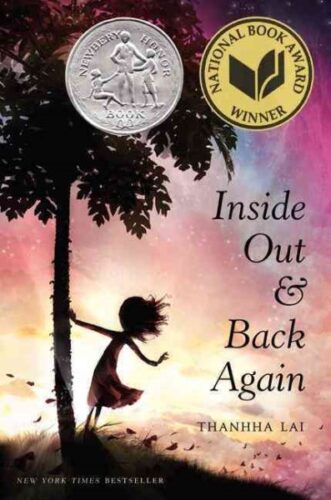
But we would read from a fun, fast-paced novel in verse like THE CROSSOVER or INSIDE OUT AND BACK AGAIN, and I would point out the way free verse doesn’t have rules. Encourage them to try their own hand at crafting poetry. And by the end of our unit, kids would be coming up to me asking for more novels in verse.
I did say I could talk about verse forever, haha…
BB: I think it’s fair to say that NOBODY reading this minds one jot! Now… I mean, I have to ask it. The entire central concept of this story focuses on sisters. So I must know: How much of this is drawn from life? I know you single out a particular sister in your Acknowledgements, so how much of this story is drawn from that real-life experience?
Shifa: I have two sisters, but one was actually born when I had already moved out (there are 25 years between us haha), so while I adore my littlest one, I would say my truest experience of sisterhood comes from the relationship I have with the sister who is five years younger than me.
And yes! The sisters in the story CONSTANTLY bicker, and me and my sister constantly fought as children. She was not into reading (the horror) and would ruin all my barbie doll’s hair. So obviously, we were mortal enemies.
And yet, when she was bullied at school, I would march up to her bully and demand they stop. When she was sick, I would cry and make duaa that she would get better. Whenever she needed advice, she would come to me for help, and I would drop everything for her.
And now, as adults (thought we still do bicker occasionally), I can honestly say that my sister is one of my strongest lifelines, the one who I know I can be myself with, the person I know will celebrate my joys and will commiserate when I am sad – and also, truly the best aunt to my kiddos. Sisterhood is magical, and although it isn’t always perfect all the time, there is always a huge amount of love.
I love writing about the importance of complicated platonic relationships in young people’s lives like sisterhood and friendship, because for me as a kid, those were the most important. And I wanted to show that even when sisterhood feels icy and broken, it can be thawed out and mended once again.
BB: The book takes care to discuss and break down anxiety and intrusive thoughts in a deeply helpful and thoughtful way (even including resources at the end). Why did you choose those particular elements to define your characters and their lives?
Shifa: Anxiety and intrusive thoughts are my own personal struggle, and one of the ways I have learned to manage living with them is to recognize when I am experiencing anxiety, name it, and hope that it will ebb and flow away. I won’t lie and say that it isn’t super hard sometimes, that I wish there was a cure-because I do. And even admitting that I am like Rama (one of my main characters) terrified me. I think I deleted that sentence in my author’s note and then rewrote it like fifty times.
But ultimately, I decided to tell my truth and to lay it out to the reader to let them know that there is nothing wrong with having anxiety and intrusive thoughts. That admitting needing mental health help to loved ones is being brave.That anxiety can give a person the feeling of their brain being “broken” or being “a monster”, but that this feeling is WRONG.
I wanted my readers to accept themselves, and speak their truths.
And so I had to speak mine first.
BB: You mention in your Acknowledgments that this has been the most difficult title for you to write out of all your twelve books and that it went through many many drafts. Why do you think you had such a hard time with this particular book? And what drove you not to give up on it?
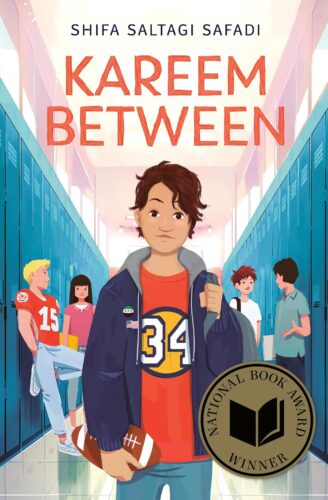
Shifa: At first, I believe my struggle was because I had just won a National Book Award for KAREEM BETWEEN. The idea of readers possibly not liking my second book terrified me! I had not expected the win for my debut, and so I had not put a lot of pressure on myself while writing it. For this novel, the pressure almost swallowed me, until I decided that I needed to zoom into the craft of the story and tune out anything else other than the plot, characters, theme etc. And that helped…for a while.
My second struggle was with the anxiety rep. Every single time I would dive into revisions, I would feel a slight bit triggered. The way that Rama’s thoughts repeat, escalate, and get louder, and the way her thoughts are so very mean to her own self are exactly how my thoughts are, and so it was a bit of a challenge for me to have to compartmentalize my own feelings to work objectively. I also worried if I was doing this story justice-because authenticity doesn’t always translate into literary value. I shared with a trusted psychiatrist friend in order to make sure everything lined up, and rewrote the Author’s note at the end with his help.
Literary wise, I also struggled with the voice, funny enough (even though it is my favorite part in the final book!). Writing a multi-pov book meant I was determined to make both girls sound different! I am an avid reader, and I know that if two characters sound the same, it makes me confused while reading, and a bit frustrated too, to be honest. I wanted the reader to be able to pick up my book at any point and know immediately who is speaking. And so it took a while to figure out what that looked like in terms of syntax, diction, punctuation (or lack of), lyrical language, and personality. My brilliant editor helped me introduce specific motifs, and I hope readers will pick up on the different symbolism I used for each girl.
BB: Oh, I absolutely love that. Well, I hate to end this (you give SUCH incredible answers!), but what else are you working on these days? What’s next for you?
Shifa: I have a picture book coming from Harper Kids in January 2027 titled THE KAABAH CAT, illustrated by the uber talented Nabila Adani that I am so THRILLED to share with readers! It is absolutely gorgeous and features a super feisty kiddo and an equally feisty cat.
I also have a poetic picture book in the works for 2028, and excited to share more when I can.
In terms of chapter books- AMINA BANANA 3 and 4 are coming out this year, and I am currently revising Amina Banana books 5 and 6 with my editor! I am so excited for readers to see more of Amina’s story.
And finally, I am polishing up a secret third novel in verse that I hope to take out on submission soon. This one is actually a mystery and contains a heist….and I will leave it at that! (dun dun dun)
Readers can keep up with any updates and check out all my books on my website www.shifasafadi.com
Thank you so much for having me Betsy!! I am so thrilled to have done this cover reveal and interview with you and I hope readers love SISTERS ALONE!
Wowza! Now THAT is how you answer interview questions, people! Shifa just raised the bar considerably.
And she’s not quite done either! In fact, she had some words she wanted to share with you about this cover. As such, and without further ado, here it is and here’s what she had to say about it:
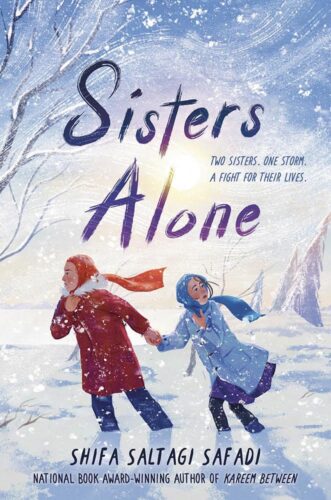
Cover designer: Kristie Radwilowicz
The cover of SISTERS ALONE is illustrated by the brilliant Simona Love and I am so grateful that she took such care to bring these two girls and their story to life. Readers can immediately spot their individual color motifs, their different personalities in how Rama looks ahead while Leena is preoccupied with looking back, the way the setting and snow is almost alive in its movement on the page, and the way the sun peeks behind the cover as a spark of hope shining after the storm. I have a feeling readers will be flipping back and looking at the cover while reading and delighting in the little clues of the story present in Simona’s gorgeous art.

Thanks once again to Shifa. Remember, if she put this much time and attention into answering questions about her book, just imagine how much time and attention is in the book itself!
Sisters Alone is out September 8th. Additional thanks to Tracy Miracle for helping to put this all together.
Filed under: Cover Reveal, Interviews

About Betsy Bird
Betsy Bird is currently the Collection Development Manager of the Evanston Public Library system and a former Materials Specialist for New York Public Library. She has served on Newbery, written for Kirkus, and has done other lovely little things that she'd love to tell you about but that she's sure you'd find more interesting to hear of in person. Her opinions are her own and do not reflect those of EPL, SLJ, or any of the other acronyms you might be able to name. Follow her on BlueSky at: @fuse8.bsky.social
ADVERTISEMENT
ADVERTISEMENT
SLJ Blog Network
You’re Cordially Invited to this ALA 2026 Session
The Delinquent and the Transfer Student, vol. 1 | Review
From Policy Ask to Public Voice: Five Layers of Writing to Advance School Library Policy
Fast Five Interview: Jill Baguchinsky
ADVERTISEMENT