
Tuck Everlasting Turns 50: Talking with Lucy Babbitt and K. Woodman-Maynard About Its Importance and Legacy
When we talk about great science fiction/fantasy/magical-realism Newbery winners throughout history, I feel like all too often we forget about Tuck Everlasting. This is understandable. Even when it was first released it was a bit of an outlier. Its original cover was quiet, reflective, and downright mysterious. Its first page is deeply literary, only barely hinting at its contents. And like Newbery Award winner A Wrinkle in Time, it has never slotted neatly into a single genre. Is it historical fiction or science fiction? Fantasy or magical realism? A teen romance or a book about childhood? A tragedy or triumph?
What we do know is that it is turning fifty this year! This is huge! So how best to celebrate? Well, Macmillan is kicking everything off by re-releasing a special edition of the book TODAY with a new forward from New York Times bestselling author Gabrielle Zevin, an afterword from Natalie’s daughter Lucy, and never-before-seen bonus material that dives into the inspiration behind the book. And just to keep things interesting, they are also releasing a graphic novel adaptation (ALSO on sale today) of the book by creator K. Woodman-Maynard.
ADVERTISEMENT
ADVERTISEMENT
All this begs the question, how best can we celebrate the book in other ways? Well, how about a dual interview with both the aforementioned Natalie Babbitt’s daughter Lucy AND K. Woodman-Maynard, the graphic novelist?
First, let’s talk to K. about the graphic novel adaptation:
K. Woodman-Maynard
Betsy Bird: K! Thank you so much for taking the time to answer some of my questions today. Just to kick this all off, what was your own personal relationship to the original Tuck Everlasting? And why did you feel your style best suited its adaptation into the graphic novel format?
K. Woodman-Maynard: I read Tuck Everlasting in fifth grade and saw the 2002 film when I was in high school. I remember that the story resonated with me in a deep way—the fantasy elements, Winnie’s loneliness, and the magic of nature and life. But I also felt betrayed and angry by the ending. I was afraid of death (and I still am) so the fact that Winnie didn’t have the traditional happy ending really astonished me as a child. Of course, as an adult, I see that Winnie lived a wonderful and impactful life—just not one that went on indefinitely—which is part of what made it beautiful and precious.
I feel that my comics style was ideally suited to capturing the wonder of the natural world as well as the strong emotions of the story. I also think the watercolor medium lends itself to mystery and magic in a way that I don’t often see with digital coloring.
BB: Prior to adapting Tuck Everlasting, you’d adapted The Great Gatsby into a graphic novel form. How was this process of adaptation similar, and how did it differ from your previous adaptation experience?
K: The artistic process was pretty similar between both books. But the biggest difference was the age of the readers, since The Great Gatsby is for teens and adults, and Tuck Everlasting is for 10–14 year olds. I wanted to make sure I geared it appropriately to the correct age so I read through the original with my nine-year-old niece, Fiona, so I could better understand sections or words that tripped her up. It was so useful to see it from the perspective of a kid, as was talking to Lucy, Natalie Babbitt’s daughter, about her experience reading it to her students when she was a teacher.
Of course, working with the Babbitt Estate was another major difference, since The Great Gatsby was in the public domain so I didn’t work with the Fitzgerald Estate. But the Babbitts have been a pleasure to work with and their knowledge of the book and its legacy has greatly enhanced my adaptation!

BB: Tell us a little bit about the process of condensing the story into a graphic novel. In the Q&A at the end, you have a conversation with Lucy about the changes you had to make when adapting the book into a graphic novel. Could you tell us a bit about the sections that had to be changed and why you made those changes?
K: In adapting graphic novels, I try to be very intentional about condensing and making changes from the original. But I do prioritize the mood and meaning of the story over rigid accuracy. For any change I make to text or image, I think through it very carefully.
The biggest change in my graphic novel was in relation to the start of the story. I read an interview with Natalie in which she said kids complained about the slow start to the book and I saw firsthand how my niece struggled with getting through that amount of narration, so I knew I needed to rearrange that section to get to the action faster. I also cut and changed the location of the narration so as to not overwhelm the start of the book with it.
BB: Speaking of which, I know that the very first line of the book is, “The first week of August hangs at the very top of summer, the top of the live-long year, like the highest seat of a Ferris wheel when it pauses in its turning.” I’ve read the book many times before and never noticed how many circles make it into the text until I saw your adaptation. Could you tell us why you focused on circles in the art and how you incorporated them?
K: Since graphic novels are a visual medium, I’m always on the lookout for strong visuals to emphasize and bring to life in my art. On an early read-through of the book, I made little drawings in the margins of repeated symbols Natalie would use. I noticed that there were so many mentions of circles and wheels in the story, which makes sense as it connects to the central message of the cycle of life. Angus Tuck illustrates this so vividly during the scene with Winnie on the pond when he says, “Everything’s a wheel, turning and turning, never stopping.” So I decided to emphasize the circles even more in my art.
Occasionally, I also used a half circle to emphasize when the cycle of life was cut short–like when the Man in the Yellow Suit talks about selling the water from the spring or Winnie pours the water over the toad.
With my graphic novel adaptations, I try to enhance what is already in the original text as opposed to bringing something entirely new to it. At the same time, I don’t want to rigidly adhere to the original since graphic novels are a different medium and have different strengths and weaknesses.
BB: I know that your cat, Huntington, passed away in the course of your work on this book. With its focus on life and death, how did his death affect your work on this book, and vice versa?
K: When I struggle with Huntington’s death, I keep repeating to myself the line, “Dying’s part of the wheel, right there next to being born . . . Being part of the whole thing, that’s the blessing.” I think of how Huntington would steal away muffin tops to eat, walk on a leash around the neighborhood, and his memorable encounters with a skunk in New Hampshire and a moose in Maine. Those things are blessings. That philosophy has helped me be more grateful for the time I had with him, and my own time on this earth.
As far as Huntington influencing the book, I included him in a few places. The Tucks’ cat is based on him and he’s also the cat seen in the chapter header of Chapter 4. To my surprise, the book’s designer, Sunny Lee, included an illustration of Huntington on the title page of the book, which brought tears to my eyes when I saw it the first time.
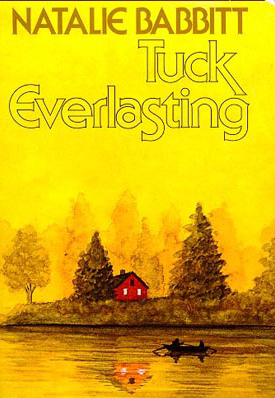
BB: I noticed in the backmatter the original jacket painting for the cover of the original Tuck Everlasting. The caption reads, “Natalie Babbitt’s jacket painting for the original edition of Tuck Everlasting.” It made me wonder . . . did Natalie Babbitt paint that image herself? If not, do you know who did? And did it affect how you painted the art for this book at all?
K: Natalie did indeed paint the cover art. She began her children’s book career as an illustrator and she created the original cover images for many of her novels. This cover art is reproduced on the jacket of the 50th anniversary edition of the novel, which is being published alongside the graphic novel.
While her art didn’t overtly influence my interpretation of Tuck Everlasting, her illustration for the original certainly influenced the cover design of the graphic novel. On her original cover illustration, it shows a lake with two figures in a row boat with a cabin in the background. The cover of the graphic novel has similar subject matter, but the perspective is flipped around, now showing a perspective from behind the cabin looking out at the lake, instead of from the lake looking at the cabin. I love this tribute to Natalie’s original cover.
BB: Finally, if you could adapt any other children’s novel into a comic, what book would that be?
K: Contemporarily, I’ve been loving the work of Naomi Novik like Uprooted or Spinning Silver. For childhood classics, I think some of my childhood favorites like The Phantom Tollbooth and From the Mixed-Up Files of Mrs. Basil E. Frankweiler would be a joy to adapt. Now, thanks to Lucy’s suggestion, I’ll have to read Natalie Babbitt’s The Search for Delicious, too!
Lucy Cullyford Babbitt
Betsy Bird: Lucy, thank you so much for taking time to answer some of my questions today! Your mother’s book truly does stand out as one of the true classics of children’s literature. Tuck Everlasting is also an excellent case for a book getting passed over for a Newbery Medal (which, inexplicably to my mind, went to the fourth book in a series, The Grey King) yet history has proven its merit even when an award committee could not. You’ve grown up with perhaps a better knowledge of the book than anyone else. Why does this book embody the timeless nature of children’s literature as well as it does?
Lucy Babbitt: Thanks, Betsy, and I agree that Tuck deserved the Newbery that year—nothing against Cooper’s Grey King, of course. And while my mother never sighed about it in public, she privately observed that it was better for people to wonder why something didn’t win, than why it did . . . And that’s true enough, isn’t it?
Apparently one of the reasons Tuck didn’t win is that some saw the destruction of the Tucks’ tree as a flaw in the magical logic of the story. It shouldn’t have been able to have been destroyed, some said, since it was fed by the enchanted spring. And this always annoyed my mother, because she saw the tree’s—and the spring’s—eradication, not as a break in the “sense” of her fantasy, but as a continuation of it. The spring was created by some unknown force, after all; so why couldn’t that same force destroy it?
As to why Tuck embodies the timeless nature of children’s literature, I think it comes down to two things. The first being that the idea it explores—what would it be like to live forever—is utterly universal across generations and cultures, and ages. As soon as we learn we’re going to die, the questions rise up in us: the why and the what if. So it’s no surprise that the theme has resonated for so many so deeply and for so long.
But the second reason is perhaps even more significant than the first: my mother completely respected her young audience. She never wrote “down” to them, never oversimplified language or ideas. And when I said she explored the idea of living forever, I chose the word purposefully, because my mother never attempted to solve the idea, or answer the idea. She let her readers form their own conclusions. And that, of course, intensified the pleasure of reading what was already a terrific story.

BB: When I think about the pantheon of children’s literature, stories of time travel or magical powers are fairly common. Stories of immortality? They’re far riskier and far rarer. In many ways, Tuck Everlasting has always worked because on first glance you don’t realize that that is what the story is about. To your mind, how does the book manage to focus on such a fantastical concept while feeling almost realistic and historical in its tone?
Lucy: That’s the power of magical realism, isn’t it? You think you’re in this humdrum familiar world, and then! A magic spring.
If my mother painted the real world of Tuck so believably, it was because she did her research. Every detail in Winnie’s world—and most in the Tucks’—is absolutely historical and also familiar, at least to those who know woods and cabins and water and how different people act and think. This everydayness makes the sudden appearance of the spring and the Tucks’ fate even more powerful; the audience feels, somehow, that they—like Winnie—might also stumble into that realm.
Beyond this, my mother also thought of herself as a kind of pantheist, in that she believed strongly in the power within nature. She felt that human lives and our perception of what is “normal” exist alongside—or within—the greater power of the natural world. With this mindset, it is easy to believe that what people might perceive as “fantastical” is no more than the ordinary extraordinariness of nature.
BB: There are mixed feelings for some folks when it comes to seeing works of literature adapted to a graphic novel format. Whose idea was it to adapt Tuck into a comic, and why do you think the format serves your mother’s story well?
Lucy: It was our publisher’s idea to adapt Tuck into a comic, but I did always agree it could work. Having been a teacher, I’ve seen firsthand how graphic novels can reach readers who might otherwise not pick up a book. But while I’ve seen comics that have been absolutely wonderful, I’ve also held back a graphic version from students because I didn’t think it served its source material well.

Stories that use complex, highly enigmatic imagery are NOT good candidates for comics, in my opinion, because the final rendering becomes that one artist’s opinion, and doesn’t allow readers to use the text to form their own ideas. Just as an example, look at the description of the Ghost of Christmas Past from A Christmas Carol. It’s described as “like a child: yet not so like a child as like on old man, viewed through some supernatural medium, which gave him the appearance of having receded from view.” Try drawing that! And many, many have, but whatever they draw somehow diminishes Dickens’s iconic description.
But Tuck does not use that kind of fanciful imagery; my mother’s depictions are beautifully rendered, certainly, but straightforward.
All the artist needs to do with such a work as Tuck is to respect the original text . . .
BB: And how do you feel about the final product? And what does K. bring to the art of this book and this adaptation specifically?
Lucy: Respecting the original text is exactly what K. does, so on that first VERY important point, I am absolutely thrilled with the final product, as is all of my family. And if my mother were alive to see it, she would be extremely pleased—and relieved—to see K.’s fine work, I have no doubt.
But of course, a graphic novel is more than the text, and here, too, K. has also respected the story, bringing my mother’s descriptions of settings and characters to a vibrant life, with gorgeous palettes and innovative renderings of images and words. Her creative use of the space on each page is thoughtful and surprising and just fun. I’m a huge fan.
BB: In your Q&A with K. at the end of the book, I was particularly interested in what you had to say about the portrayal of Mae in this adaptation vs. the versions of Mae in stage and film productions. To your mind, what did K. bring to Mae that other productions haven’t?
Lucy: Ah, my pet peeve about the “interpretations” of poor Mae . . . And this is nothing against the very talented actresses who’ve been cast in the role, but the film and stage versions—as good as they are in their own right—have very little resemblance to the character in the book.
It was a lament my mother had when these versions of Tuck came out that widely departed from her text: If they loved my story so much, why did they have to change it? It’s only the wonderful play version from Mark Frattaroli that keeps to the real story throughout. That’s why my mother approved its publication—not just because the adapter happened to be my husband.
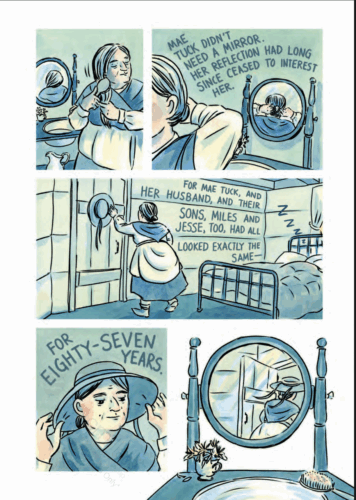
And this is also why my mother would so approve of K.’s graphic novel, because once again, hallelujah, her text has been respected. In Tuck, Mae is a “great potato of a woman with a round, sensible face and calm brown eyes.” I mean, it’s right there in the book. But while both Hollywood and Broadway couldn’t seem to bring themselves to star a potato-shaped woman—and don’t get me started on the reasons for that—K.’s work has returned Mae to her ordinary one-of-us glory. And it wasn’t just her physique that the other versions abandoned, they also left behind her earth mother nature, which is absolutely necessary to the story, since her maternal protectiveness of Winnie is what impels Mae to kill the Man in the Yellow Suit. Which K. also understood.
And I am very grateful for that.
BB: In addition to all this, I was delighted to hear that Gabrielle Zevin did the Foreword for the 50th anniversary edition of the original book. It releases on the same day as the graphic novel adaptation. How did Zevin get attached to the project, do you know?
Lucy: We were so lucky to get her. Our editor, Wes Adams, knew that Gabrielle was a fan of Tuck, as my mother’s book has an important cameo role in the final act of her acclaimed YA novel Elsewhere (celebrating its 20th anniversary this year!). Gabrielle totally recognizes the respect my mother has for her young readers, in that Tuck lays out these very sophisticated, very human issues for them to ponder: “The questions Winnie contemplates in Tuck are enormous for a person of any age,” Gabrielle writes. “If you could live forever, would you? What is the value of a mortal life? Is killing sometimes justified? Winnie may be ten, but Babbitt believes her to be up to the task. Reading Tuck today, thirty-seven years after I first read it, I am struck by its lack of condescension—both in the way Winnie is depicted and in the demands Babbitt makes of her ostensibly young audience.”
BB: Finally, while this might be your mother’s best-known book, there are a plethora of others for kids to explore. If you had the chance to have another of her books adapted to the graphic novel format, which book would it be?
Lucy: I would be happy to have K. adapt any of my mother’s other works, but if I had to choose one, I’d say The Search for Delicious. It’s a terrific—and poignant—adventure story filled with ridiculous people and supernatural forces, and would be amazing as a graphic novel. I would love to see what K. would do with the characters of the “winds.”


I am truly honored and grateful to both K. and Lucy for taking so much time, care, and attention to answer my questions today. Thanks too to Samantha Sacks and the team at Macmillan for helping to put this all together. As I mentioned before, both the new special edition of Tuck Everlasting and its graphic novel adaptation are out today. Be sure that you enjoy the book thoroughly, no matter the format.
Filed under: Interviews
About Betsy Bird
Betsy Bird is currently the Collection Development Manager of the Evanston Public Library system and a former Materials Specialist for New York Public Library. She has served on Newbery, written for Kirkus, and has done other lovely little things that she'd love to tell you about but that she's sure you'd find more interesting to hear of in person. Her opinions are her own and do not reflect those of EPL, SLJ, or any of the other acronyms you might be able to name. Follow her on BlueSky at: @fuse8.bsky.social
ADVERTISEMENT
ADVERTISEMENT
SLJ Blog Network
2026 Books from Pura Belpré Winners
Skating Wilder | Review
From Policy Ask to Public Voice: Five Layers of Writing to Advance School Library Policy
Fast Five Interview: Shana Targosz
Jasmine Warga Visits The Yarn!
ADVERTISEMENT