

The Best Book He’s Ever Written? Dan Gutman Talks The Picasso Curse
If you’re a new up-and-coming children’s book creator, what’s your goal? I mean, what level do you aspire to? Do you simply want to be able to make a living? Or do you want to make an impact on some kid’s life? Maybe you’d like to be remembered for a popular series, beloved by hundreds of thousands of kids (and maybe even more than one generation)? Perhaps you’d like to be a bit of a household name.
If you’re Dan Gutman, of course, you are all of these things at once. And that ain’t half bad.
Even so, you can write all the My Weird School books you like, but at the end of the day sometimes you might want to write something with a little more heft. A book with a cool cover and an even cooler title. Something along the lines of…
ADVERTISEMENT
ADVERTISEMENT
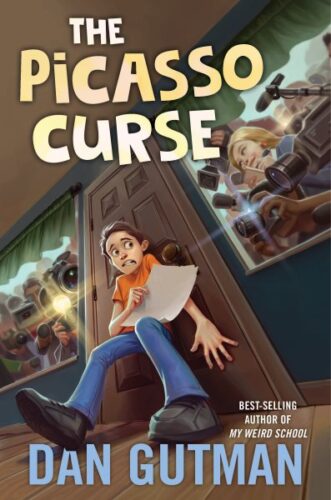
So Dan writes me the other day, and he tells me that he has this new book called The Picasso Curse out September 2nd and, “I think it’s the best thing I ever wrote.” Now if you’re an intrepid reporter like me, that’s a scoop. I am not, technically, a reporter, but even my non-reportery eyes know when something sounds interesting. Even more so when you get a look at the publisher’s description of the plot:
There were so many things Edwin Hodge didn’t know when he paid $10 for a cool poster of Kobe Bryant at the local flea market.
He didn’t know that hidden within the frame of the poster was an original drawing by Pablo Picasso, one of the most famous artists in history. He didn’t know the Picasso might be worth millions of dollars. He didn’t know that kids at school were going to treat him differently, or that he would become a world famous social media superstar.
And he sure didn’t know that people would tap his phone, follow him home, break into his house, or threaten to burn it down. He didn’t know the Picasso was going to ruin his life.
Have you ever had to make a decision–a really hard decision? A decision that would change the course of your life from that moment on? Edwin is faced with lots of crucial decisions in this gripping adventure, a blend of fact and fiction by Dan Gutman, an author who says, “I want my readers to think that reading my books is like watching a movie. One where you never know what’s going to happen next.”
Shoot. Well… now I have questions. Good think I know a guy I can ask them to:
Betsy Bird: Dan! Such a delight to get a chance to chat with you like this. Okay, so tell us all a little something about the origin story behind THE PICASSO CURSE. Where did this book come from? And why did you want to write it?

Dan Gutman: Back in my college days, some of my favorite classes were about art history, and I’ve always wanted to write a book about art. For many years, I had these two thoughts knocking around in my head…
1. The most famous painting in the world, the Mona Lisa, was stolen from the Louvre in 1911 and was missing for two years.
2. The prime suspect of that theft was Pablo Picasso, the most famous artist of the 20th century.
It seemed like there was a cool idea for a novel in there somewhere, but I couldn’t see how to put a story together. In most of my books, I take an ordinary kid and put that kid into an extraordinary situation. It’s usually a “what if” kind of situation. And finally I figured it out…
While Picasso was nervously waiting to be questioned by a judge at the Palais de Justice in Paris, WHAT IF he doodled a drawing in his sketchbook? WHAT IF he tossed it in the garbage when the questioning was over and he was released? WHAT IF a janitor plucked that drawing out of the trash and brought it home with him? WHAT IF the drawing wound up in a flea market in Illinois over a hundred years later? And WHAT IF a poor kid at the flea market bought a poster for ten dollars, and when he took off the frame, Picasso’s drawing slid out? How would his life change after he came into possession of an original Picasso that could be worth millions of dollars?
That was the what-if idea that inspired The Picasso Curse.
BB: Dude. That is some good what-ifing. But with all that you’ve written and all that you’ve done, what is it about THE PICASSO CURSE that stands out for you? Why is this particular book of yours special?
Dan: I hope it isn’t arrogant to say that this book is special to me because it’s better than anything I’ve written. I’ve been doing this for a long time. My first book came out in 1985. But I never took any writing classes. I never read any books about how to write. I taught myself. And I wrote a lot of crap for a long time. But little by little I got better and learned what makes a compelling story. It took me forty years, but I think I finally figured it out! The Picasso Curse is the result.
BB: Well, librarian that I am, I can’t help but make connections. And the easiest fiction/nonfiction connection I can think of is to pair this book with THE MONA LISA VANISHES by Nicholas Day. Were you aware of that book at all when you wrote your own? And since you have so many facts and real life situations and history here, what kind of research did you do?
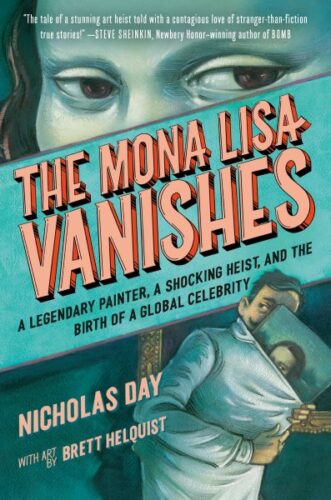
Dan: Yeah, when I heard that The Mona Lisa Vanishes was coming out, I kind of freaked out. No author wants to see a new book that’s just like the one he or she is working on. Fortunately, Nicholas Day’s book is very different from mine. The Mona Lisa Vanishes is a straight non-fiction description of the theft in 1911. The Picasso Curse is a novel that uses the Mona Lisa story as a jumping off point to start a story that takes place in the present day about a boy who has to deal with the good and bad things that happen to someone who suddenly becomes incredibly rich.
Even though my story is fictional, I still had to do a lot of research to make it come to life. I read books and websites to learn all I could about Picasso, the Mona Lisa theft, and the art market. I learned how much tax you’d have to pay if you suddenly came into a fortune. I learned how much it would cost to insure a priceless drawing. I consulted with a friend who is a psychologist to learn about decision anxiety, which is a major theme of my story. And I went to The Pace Gallery in New York, which had an exhibit of Picasso’s sketchbooks. You can always just make stuff up for a novel, but I wanted my story to feel real.
BB: I’m not going to spoil it, but you do something a little different with the end of this book that I haven’t seen anyone do in a really long time. Was this always going to be the ending of the book, or was it something that came to you later?
Dan: I love surprise endings, and I always try to end my stories in a way that the reader doesn’t see coming. Usually, I have the whole story planned out from the beginning. But not this time. I started writing “The Picasso Curse” before I knew how it was going to end, and it wasn’t until I started writing the final chapter that I decided on the ending that I think will knock everybody’s socks off. It’s not a happy ending, and it’s not sad either. But I like to think that it’s the ending, that makes the most sense, and readers will be totally surprised by it.
BB: Somewhat along the same lines, how much does the final version of this book resemble the first draft? I know so little about your writing process. Do you always have a clear vision of a book from the get-go when you write it, or does it come to you slowly while you’re doing the writing?
ADVERTISEMENT
ADVERTISEMENT
Dan: I’m in awe of authors who just open up a blank file on their computer screen and start typing a new story from scratch. I could never write that way. I’m a planner. While I’m doing my research, I brainstorm about the story, jotting down any good ideas (and sometimes bad ones) on file cards. Then I juggle the file cards around until I can shape those ideas into a story. That’s my outline. After that, I sit down and start to write it. And rewrite it. And edit it. And keep fine tuning it until I’m staring at the screen and can’t see any more changes to make. That’s how I know the book is done.
But sometimes—and it was certainly the case with “The Picasso Curse”—as you’re writing the story other ideas come to mind and you make bigger changes along the way. It’s great to have a plan, but I also think it’s good to be open to new and better ideas as they reveal themselves.
BB: Makes sense to me! Finally, what else is going on with you these days? What else do you have coming out?
Dan: The My Weird School series, which I’ve been writing for 21 (!) years will continue with Miss Sherman Is Determined! Mrs. Granger Is In Danger! Mr. DiPilla Is a Gorilla! and Mrs. Towne Is a Clown! And I just completed a top-secret project, a middle grade novel about a magical typewriter. Hopefully, I’ll be able to tell you about that one next year.

Very awesome. Big thanks to Dan Gutman for taking the time to talk to us today. As I mentioned before, The Picasso Curse is out September 2nd. Be sure to give it a looksee and pre-order if you have a chance.
Filed under: Interviews

About Betsy Bird
Betsy Bird is currently the Collection Development Manager of the Evanston Public Library system and a former Materials Specialist for New York Public Library. She has served on Newbery, written for Kirkus, and has done other lovely little things that she'd love to tell you about but that she's sure you'd find more interesting to hear of in person. Her opinions are her own and do not reflect those of EPL, SLJ, or any of the other acronyms you might be able to name. Follow her on BlueSky at: @fuse8.bsky.social
ADVERTISEMENT
ADVERTISEMENT
SLJ Blog Network
The Greenies | Review
From Policy Ask to Public Voice: Five Layers of Writing to Advance School Library Policy
Science as an antidote to dread, a guest post by Katy Doughty
Sara Pennypacker visits The Yarn
ADVERTISEMENT