• Skip to primary navigation
  • Skip to main content
  • Skip to primary sidebar
  • About/Contact
  • Fusenews
  • Reviews
  • Librarian Previews
  • Best Books
    • Top 100
    • Best Books of 2022
    • Best Books of 2021
    • Best Books of 2020
    • Best Books of 2019
    • Best Books of 2018
    • Best Books of 2017
    • Best Books of 2016
    • Best Books of 2015
    • Best Books of 2014
    • Best Books of 2013
  • Fuse 8 n’ Kate
  • Videos
  • Press Release Fun

Fuse 8 n’ Kate: The Trees of the Dancing Goats by Patricia Polacco

Fuse 8 n’ Kate: The Trees of the Dancing Goats by Patricia Polacco

December 22, 2025 by Betsy Bird

It’s a Christmas book! It’s a Hanukkah book! It’s a Christmas AND a Hanukkah book! And a Patricia Polacco book as well. She’s back, baby. Will Kate be charmed by the message of this inclusive title or will other elements win out in the end? We discuss the grammatical components of when one “thrills”, continuity errors, kosher menorahs, and more!

Listen to the whole show here on Soundcloud or download it through iTunes, Stitcher, Spotify, Google Play, PlayerFM, Audible, Amazon Music, or your preferred method of podcast selection.

Show Notes:

If you’re curious about our previous Polacco title, you can listen to The Keeping Quilt here (circa 2020).

According to Kate, and I will defer to her on this, this is not a kosher menorah. And yep. She’s right.

We determined that this story took place “a ways in the past-like direction” based on this car.

I can’t believe she spotted it. Kate has clown-dar. Look and see.

Oh man, Cherry. We feel you, man. We’ve been there. This is actually how Kate felt while recording this episode.

Kate has been having a hard time with the kids’ faces. This was one of her examples. I thought they were fine. Thoughts of your own?

Kate pointed out a bit of a continuity error on the part of the aforementioned non-kosher menorah. Earlier the candles are different sizes and on the next, all the candles are the same height.

Kate Recommends: Sean Combs: The Reckoning on Netflix

Betsy Recommends: Replaceable You (particularly the audiobook, read by author Mary Roach herself)
Filed Under: Fuse 8 n' Kate Tagged With: Christmas, Fuse 8 n' Kate, Hanukkah, Patricia Polacco, The Trees of the Dancing Goats

31 Days, 31 Lists: 2025 Science Fiction Books for Kids

December 21, 2025 by Betsy Bird

Query: Is it possible that the rise of interesting science fiction in children’s books walks hand-in-hand with the state of the world? In happier times do we see less of it on our shelves? I can’t answer that. All I can do is point out that I’ve seen a nice uptick in publications in the last few years. Nothing trendy or anything, but enough that I can make a nice concise listing of my favorites here today. If you’re a fan of robots, post-apocalyptic floods, aliens, and more, you’ve come to the right place.

You can find a full PDF of this list here.

Want to read other science fiction lists that ALSO deserve love? Then check these out:

  • 2024
  • 2023
  • 2022
  • 2021
  • 2020
  • 2019

2025 Science Fiction Books for Kids

Picture Books

FEATURED TITLE

Little Moments in a Big Universe by Todd Stewart

While I’ll acknowledge that this book could, potentially, have also been included on the Unconventional Children’s Books list, I guess I just love it here instead (and, if I’m being honest, I didn’t write it up in time, which is probably more significant). It certainly belongs here, but of all the science fiction-minded picture books on the list today, this is undeniably the most beautiful of them all. This is the kind of book where the front endpapers are a map of the nearest galaxies in the universe “used by space explorers and robots to fly their spaceships” while the back endpapers are diagrams of chemical compounds, whose structures are identical throughout the universe. “Many organic compounds, such as cellulose, are the building blocks for life.” Alas, I don’t know how Stewart creates this art. I just know that I want more of it. In this tale, a space explorer and robot crash on a strange new planet. However, I’m making this sound a lot more simple than it really is. The book is written in the first person from the explorer, robot, spaceship, forest, planet, solar system, galaxy, universe, and more’s point of view. On the planet the two encounter friendly life, depicted in a myriad of cool and interesting ways. You know what this book does for kids? It expands their minds. You’ve the text to help you out, which you’ll need because the art is doing this wide range of interesting things on beyond the immediate words. Mind-blowing is the only way to describe this. And maybe beautiful as well. The kind of book I may just keep for myself, it’s just that great. 


Astro by Manuel Marsol, translated by Lizzie Davis

[Previously seen on the Unconventional List]

Naturally I start with this one. How could I not? In it, a sweet alien recounts his time befriending a curious spaceman. A bittersweet tale of love, loss, friendship, and the fragility of life. Boy, they just don’t make ‘em like this in America, do they? I think I can faithfully say that this is one of the very few picture books I’ve encountered where the plot is recounted by a deceased narrator. But before we get to any of that, let’s just take a moment to admire the art itself. So many picture books try to show alien worlds, but this one really committed to the bit. Things don’t just look alien to us. This world seems to operate on an internal logic that it’s not particularly interested in catching up the reader on. Then there’s the story, which is so sweetly recounted and told. I adored the relationship between the alien and Astro. And that was before I reached that 2001 Space Odyssey-styled ending. Wowza. This is the kind of book that is going to wiggle its way deep into some young readers’ minds so that they spend the rest of their natural born lives asking people, “Do you know that picture book? That one about the spaceman and the alien and the alien dies? I think it’s orange?”


Field Trip to Dinosaur Valley by John Hare

[Previously seen on the Wordless List]

I am beginning to have some serious concerns about the safety protocols at this school. If you know John Hare then you know that he has already produced such wordless science fiction titles as Field Trip to the Moon and Field Trip to the Ocean Deep. I suppose one should be relieved at the premise behind Field Trip to Dinosaur Valley, since at least the kids will be able to breathe freely on the trip. Time travel is the name of the game behind this new installment in the series, and I rather like the dial that simply reads, “PAST”, “PRESENT”, and “FUTURE” on the driver’s dashboard. We’re definitely not adhering to the rules stipulated in the old Ray Bradbury story “A Sound of Thunder” in this book, since almost immediately one of our intrepid students gets their lunch stolen by a hungry pterosaur. Attempts to retrieve it means getting left behind by their classmates, which isn’t great news. They then befriend and feed an array of other dinos, before a hungry T.Rex puts an end to their fun. I was amused by the final sequence in which our hero has been retrieved and their classmates share lunch with them since they left their own lunchbox back in the past. Meanwhile, the teacher is getting seriously chewed out by someone over this lapse (and there’s a nice poster instructing people not to feed the dinos hanging quietly on the wall in the back). Hare is a master at wordless storytelling, of course, so you won’t have a lick of difficulty following along in the least. 


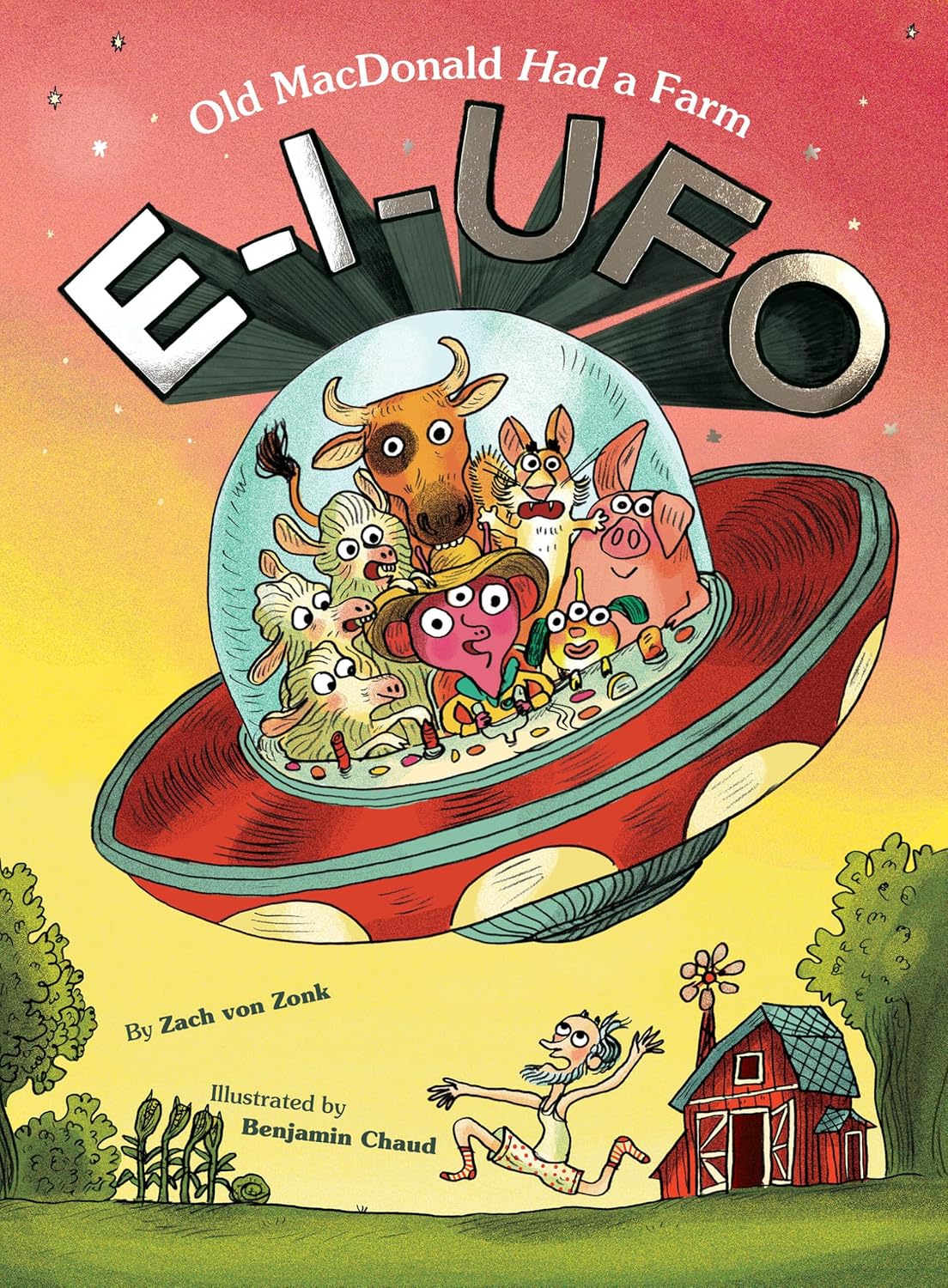
Old MacDonald Had a Farm E-I-UFO by Zach von Zonk, ill. Benjamin Chaud

[Previously seen on the Readaloud List]

Extra points for the italics on the word “Had” on the cover.

Classic storytime songs meets alien abduction. Two great tastes that taste great together! One should never discount the power of the art of Benjamin Chaud. The man simply knows how to illustrate something fun. This book starts off simply enough, with a great two-page spread where everything is exceedingly normal. “Old MacDonald had a farm, E-I-E-I-O!” You might not even notice the flying saucer in the sky at that moment, but you’ll certainly pick up on it when the book goes “And on that farm he had a …” [page turn] “spaceship? E-I-UFO!” Now the farm, I should note, is exceedingly small. Just a barn, a fence, some lands, a nice looking crop of corn, and about eight animals in total, not including the farmer. The kind of farm that would fit into a Jon Klassen board book, honestly. Promptly (and with plenty of catchy music) everyone gets abducted, except the farmer who manages to save himself (but not his clothing). The clothing is key, by the way, because it means that now the alien can dress the part. That’s about the happiest it becomes, however, because the animals immediately begin to trash the place in their own distinct ways. Now the book/song lets you MUNCH MUNCH, GLOOP GLOP, HISS SCRATCH, and more. In the end, the alien returns the animals, Bremen musicians-style, and then it cleans up. Perfect if you’re doing a space/science fiction/alien storytime of any kind. E-I-E-I awesome! 


The Search for Our Cosmic Neighbors by Chloe Savage

I wonder what it says about Chloe Savage that, until now, all her picture books were about people searching for things that they might never find? Previously her characters have searched the seas for giant arctic jellyfish, or down below the waves for octopuses with names like Carmella (you can find The Search for Carmella on my Caldenott list this month). But Cosmic Neighbors strays from this strict format. A ship is still involved, but this time it’s a spaceship. And where those other books ended with both disappointment and found family, here we finally have success! If these three books are a trilogy then it seems fitting that Savage would finally end it with a happiness of this sort. After all, there’s nothing worse than traveling through space and finding nothing at the end. And considering the end of this book (where the crew decides to stay just “a little longer”) it’s possible that this is also a tale of found family. Just of the more extraterrestrial variety. 


Tate Tuber: Space Spud by Michael Slack

[Previously seen on the Easy Book List]

Definitely on the upper level for new readers, so don’t go handing this to someone who’s just starting out. As a fan of the movie The Martian (and yes, I really do need to read the book) I was already primed to find a story of a potato with ambitions and launched into space up my alley. Based on a true story (backmatter informs us that in 1995 a crew on the space shuttle Columbia grew five small potatoes in the Microgravity Astroculture Laboratory), we follow Tate. When he’s selected to join a crew headed to a space station, he’s under the misapprehension that he’s a part of the team. When it becomes clear that he’s just a seed potato, his little heart is crushed. Fast forward a couple weeks and Tate has successfully grown four more potatoes. That’s the good news. The bad news is that they’re exactly like him in terms of personality. But when a potential disaster occurs, it’s these little spuds that step up to save the day. With its panels and speech balloons, you could just as easily put this in your graphic novel section as your easy readers. Even so, those comic book elements definitely add to the book’s appeal. And extra points for including more backmatter than I see in some nonfiction titles! 


To Activate Space Portal: Lift Here by Antoinette Portis

[Previously seen on the Readaloud List]

Before we even get into the contents of this book, I just want to give a little shout-out to the cleverness of its design. Antoinette Portis has always been good at designing her book, after all. That old classic Not a Box (still in print after 19 years) was, after all, a book of design perfectly suited for its storytelling. Here, Portis has placed a large yellow arrow on the cover of her book for the “Lift Here” part of the title. I cannot describe to you how satisfying it feels to obey those words. Inside, the story is a meta interactive story that is meant to be read out loud. I mean, not only do you have fun alien voices that you can make up, but the bold colors and black frame of the “screen” is incredibly easy to see across vast distances in a storytime room. In the tale, two aliens communicate with you through a device that has presumably landed on their planet (one begins to wonder if the instructions of the title are aimed at them and not us). Kids are clearly meant to say and yell things at the book as they answer the aliens’ various questions. It’s pretty darned delightful, honestly. Ideal for a science fiction-powered storytime. 


Books for Older Readers

FEATURED TITLE

The Forest of a Thousand Eyes, by Frances Hardinge, ill. Emily Gravett

Feather knew it was wrong to steal the spyglass for the stranger she met, but her curiosity about the world beyond her small community has always been outsized. Now she must track him down. Does she have the courage to face the forest on her own? After the 2024 election results, I pointed out to my kids that the pop culture songs on the radio seemed to be separating into two different camps: I’m depressed and The world is ending. Because pop music moves at a rate slightly quicker than that of literature, I guess it hadn’t really occurred to me that I might see similar themes in my books for kids. The Forest of a Thousand Eyes by Frances Hardinge isn’t necessarily an answer to the times in which we live, but it’s not NOT an answer either. It takes place in a future where forces beyond our control have separated humans into different camps and our only salvation is to join with one another, no matter how different we all are, because therein lies our salvation. Hardinge seems to quite fond of these small novellas she’s gotten into recently. Last year her new venture began with Island of Whispers. That was very much within her comfort zone of eerie fantasy. This book is entirely different. It’s still a short little novella, but instead of fantasy this is essentially science fiction. Post-apocalyptic science fiction at that! Her greatest strength has always, to my mind, been her ability to world build in a short amount of time. That’s truly put to the test here, and I’d say it pays off. A story about individual communities learning to come together in a hostile world feels awfully prescient, I must say. And yes, I literally gasped when the inciting incident happened at the beginning of the book (I won’t give it away). Evocative and FILLED with Hardinge’s beautiful language but also sweet and caring. You can’t miss this.


The Experiment by Rebecca Stead

You know how a first page is supposed to capture a reader’s attention and intrigue them right form the start? That doesn’t always happen with classic kids’ books (I’m looking at you, Watership Down). Of course Charlotte’s Web is a prime example of not only a killer first chapter, but a killer first sentence as well. And considering the degree to which Rebecca Stead’s delightful alien invasion science fiction tale The Experiment owes to Charlotte (extra points to anyone who catches the direct Charlotte reference at the book’s end), it seems fitting that her first chapter is as good as it is. In fact, this book is just pure fun. Our hero, Nathan, isn’t that outgoing a guy. If his best friend Victor is Calvin, then Nathan is Hobbes. But in spite of this fact, there is something special about Nathan: He’s grown up his whole life knowing that he’s an alien. His parents have never been secretive about the fact that they are the Kast. This is why Nathan has to brush his teeth five times a day with a special pink toothpaste, why his mom tracks everything he consumes, and it probably is why recent he started growing a tail. Now the other Kast kids are disappearing and no one will tell him why. I’ve noticed that in 2025 there’s a distinct trend amongst children’s books to discuss what happens when the people you care about refuse to acknowledge that they may have been lied to because it would negate the stories they tell about themselves. Stead throws twist after twist into this clever book, to the point where you can’t stop turning those pages. It’s caring and smart and so incredibly fun. Also? I’m a BIG fan of the kind of aliens you see in this book.


Higher Ground by Tull Suwannakit

[Previously seen on the Comics & Graphic Novel List]

Welp, I’m not sure what to think about the fact that 2025 is clearly the year that author/illustrators decided to write a bunch of very sweet and affectionate post-apocalyptic tales. I mean, between this book and Oasis (see below), we pretty much have the market cornered, wouldn’t you say? It wasn’t immediately apparent to me by the cover of this book that this even was a graphic novel. And, perhaps, purists would protest the label. Are there panels? Sure. Speech balloons? Well… no. Not exactly. But the whole book inhabits that space between an early chapter book and a graphic novel, and I like to think that the sheer number of (quite frankly) beautiful illustrations in this book tip the balance in favor of comics. The premise of the title is that a natural disaster in the form of rain floods the world. Our child heroes and their grandmother are lucky enough to have an apartment with not only roof access, but a working garden up there as well. As the months pass they tend to the garden, more than a little perturbed that the water levels are only climbing higher and higher. And when the water threatens to flood the garden, big choices must be made. It’s a children’s book, so expect a happy ending, but it rivals How to Say Goodbye in Cuban in terms of beautiful watercolors (to say nothing of the graphite powder, gouache, and acrylic paints) in a graphic novel format). The last words in the book? “Don’t give up.” A message we can all use this year.


Oasis by Guojing

[Previously seen on the Comics & Graphic Novel List]

In a barren desert, two children strive to survive while their mother works in the city. But when they discover an abandoned robot and fix it up, they find a new kind of mother. Knowing, as I do, how long graphic novels take to make, I know that Guojing didn’t write this to almost coincide with The Wild Robot movie, but whatta tie-in! Mom robots, man. They’re very “in” right now. Of course, the entire reason this (or really any Guojing book) works is because she ties the plot in so completely to the reality of children left behind by their parents on their own (Guojing’s first book in America The Only Child was based on that concept along with her own childhood experiences). She’s done so many lovely books over the years that I didn’t really expect “dystopian hellscape” to be in the cards for her, but that’s what I like about Guojing. She always keeps you guessing. And as dystopian hellscapes go, this is probably one of the sweetest and gentlest you’ll find, though there are plenty of dark scary corners here and there. Still, the idea of finding a substitute mom when you can’t reach your real one? That felt right to me. Gorgeously illustrated and beautifully written. I adore this. Would pair weirdly well with The Storm in the Barn by Matt Phelan too.


Space Chasers by Leland Melvin, Joe Caramagna, and Alison Acton

Okay, so to call this “science fiction” means that this book is far more on the The Martian side of the science fiction spectrum than, say, Star Trek. The concept is realistic, even when there are times that it strains a bit of credulity. The focus is primarily on Tia Valor who takes a test for an exclusive NASA program on a whim. She cheats on the test by copying another girl’s answers, a fact that wouldn’t mean much except that Tia is chosen and the other girl is not. So with some serious imposter syndrome in place, Tia and her fellow cadets train to go to space as kids. And then everything goes really really REALLY wrong. Now you could argue that the likelihood of people sending a ship full of kids into space without an adult on board is just the tiniest bit convenient from a narrative perspective, but if you can get around that then the story is pretty gripping. Melvin employs some serious Apollo 13 methodologies and solutions when problems arise. The true strength, of course, lies in Tia’s story and overcoming her fears and doubts, but alongside great art and coloring and an original story, this is one science fiction tale that’ll give kids a taste for space. 


Starstuff: Ten Science Fiction Stories to Celebrate New Possibilities, edited by William Alexander and Wade Roush

Take a trip to the distant, and not so distant, future! From miracle drugs that keep you young to clones, alternate universes, aliens, space-crazed billionaires, and more, these are stories to make you think and wonder. I don’t think I mentioned this before, but my new year’s resolution for 2025 was to read more science fiction. It’s the genre I love so dearly, and it just gets completely ignored sometimes by the rest of children’s literature. This book is pure, unapologetic, unfiltered science fiction in the best sense. The ten stories collected in this title include some particularly good tales. Are they all 100% the best? Not exactly, but at the same time I wouldn’t say that any of them are duds. The connecting thread is that they all incorporate real science in some way (which is the best kind of science fiction). I was particularly keen on “The Traveler and A Proposal to the Animal Congress” (though it is weeeeeird). “The Most Epic Nap in the Universe” reminded me a little of Stephen King’s “The Jaunt”, though without the creepiness. All told, I really enjoyed this. 


Stitch by Pádraig Kenny

If we consider the fact that Frankenstein really was the first science fiction story, then it makes perfect sense to include Stitch on this list (and it is NOT to be confused with the somewhat similar Stitch Head). Wide-eyed Stitch looks for the good in everybody, which can be hard to do when people see him as a monster. A Frankensteinian tale and the sweetest little undead guy you ever will meet. It can be difficult to say how much of the pleasure of this book comes from recognizing all the Frankenstein Easter eggs that Kenny drops in his writing, but I’d wager that even a kid who had never even heard of Frankenstein would get a kick out of this book. There’s just so much humanity at work on these pages. Do I think the ending where the villagers accept the weirdo monster family into their midst is a bit of a stretch? Oh, absolutely. But as a found family narrative I really enjoyed this thoroughly. I thought it nailed the characterizations, the villain was nicely complicated, and it stuck the landing.


That’s it for today! Be sure to stay tuned for more lists on 2025 titles. The full roster is here:

December 1 – Great Board Books

December 2 – Picture Book Readalouds

December 3 – Simple Picture Book Texts

December 4 – Transcendent Holiday Children’s Books

December 5 – Rhyming Picture Books

December 6 – Funny Picture Books

December 7 – Caldenotts

December 8 – Wordless Picture Books

December 9 – Bilingual Books for Kids

December 10 – Math Books for Kids

December 11 – Books with a Message / Social Emotional Learning

December 12 – Easy Books

December 13 – Translated Children’s Books

December 14 – Fairy Tales / Folktales / Religious Tales

December 15 – Gross Books

December 16 – Poetry Books

December 17 – Unconventional Children’s Books

December 18 – Early Chapter Books

December 19 – Comics & Graphic Novels

December 20 – Older Funny Books

December 21 – Science Fiction Books

December 22 – Fantasy Books

December 23 – Informational Fiction

December 24 – American History

December 25 – Science & Nature Books

December 26 – Unique Biographies

December 27 – Blueberry Award Contenders (Celebrating the Environment)

December 28 – Nonfiction Picture Books

December 29 – Nonfiction Books for Older Readers

December 30 – Middle Grade Novels

December 31 – Picture Books

Filed Under: 31 Days 31 Lists, Best Books, Best Books of 2025 Tagged With: 31 days 31 lists, Best Books of 2025, middle grade science fiction, science fiction, science fiction picture books

31 Days, 31 Lists: 2025 Funny Books for Older Kids

December 20, 2025 by Betsy Bird

As strange as this may sound, it was actually fairly difficult coming up with a list of older funny books for kids this year. Maybe it’s just the general attitude of 2025, but humor has not been in abundance recently. I mean, you have some authors that can work in an occasional joke around tough topics, but generally speaking I’ve tried to limit this list to books that were mostly inclined towards hilarity. You’ll see some familiar titles on the list, as well as the occasional newbie. And if there was some book that just had your kids rolling on the ground, PLEASE let me know what it was in the comments. As long as it wasn’t Wimpy Kid. Love the guy, but let’s make a little room for the other folks, eh?

If you’d like like to have a PDF of today’s list, you can find that here.

Need more older funny titles besides today’s books? Then be sure not to miss these previous titles:

  • 2024
  • 2023
  • 2022
  • 2021
  • 2020
  • 2019
  • 2018
  • 2017

2025 Funny Books for Older Kids

FEATURED TITLE

Ducky the Spy by Sean E. Avery

Order of Thoughts Regarding this Book:

  1. Wow! This is hilarious! Sean E. Avery? Why does that name sound so familiar?
  2. Holy smokes! That’s the guy who did Frank’s Red Hat! 
  3. Geez, what else is he capable of?

Or something approximating that.

The fact of the matters is that this little graphic novel sports a really site specific kind of humor. Obviously the publisher would love to tie it to Dogman or something like that, but Avery’s funny content is a very different breed. Australian, perhaps. See, unlike Pilkey, he has the advantage of a little more detail. Facial expressions, pregnant pauses, the whole nine yards. The premise of this book lies in our overly confident spy hero, Ducky. In spite of the fact that his enthusiasm outstrips his competence by yards, he is continually hired by Mr. Pig to spy. That spying takes many forms, including encountering a gang of cats and rescuing Mr. Pig’s son. I might contend that there are 35% more fart jokes here than are strictly necessary, but a LOT of the other jokes land beautifully. Humor is subjective. The fact that this book is so good, isn’t. 


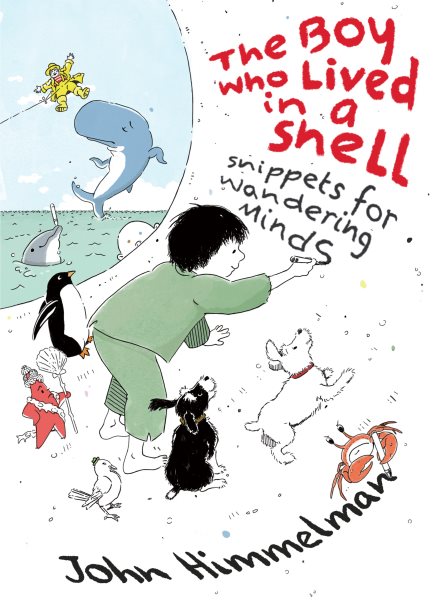
The Boy Who Lived in a Shell: Snippets for Wandering Minds by John Himmelman

[Previously seen on the Poetry List]

Once there was a boy named Ivo who lived in a giant moon snail shell on a beach. Read the poems he writes on the wall of the shell, in this ribald, witty, and occasional touching collection. Okay, I don’t even know how to predict what John Himmelman is going to do next anymore. When I was first starting out as a children’s librarian he was known primarily for picture books like the incredible, fantastic, and never-to-be-forgotten Katie Loves the Kittens. Then he takes some time, pivots, and does that incredible, wackadoodle early chapter book series Albert Hopper. But then I go to his website and apparently the man is also prone to doing YA and middle grade and THEN he apparently noticed that there were a couple slots empty on his bingo card, so he’s come to us with a book of poetry. And not just any poetry either. GOOD poetry. Like, high quality this-is-better-than-90%-of-kids-poetry-out-there poetry. I’m not going to say that every single poem in here is equally good, but you couldn’t say that for Shel Silverstein’s poems, for crying out loud. You’ll note the blurb from Chris Harris (My Head Has a Bellyache) on the back. That’s deserved. THIS is the poetry book of 2025 you don’t want to miss. Some of these poems will have you laughing out loud. Some will cause you to sit and think for a while. And some, like “Toby and Pip” are sad enough to warrant such concluding sentences as, “Not all stories are happy ones.”


Cabin Head and Tree Head by Scott Campbell

[Previously seen on the Unconventional List AND the Comics & Graphic Novels List]

Only very very rarely do I allow a book to appear on THREE lists. This book? It’s the exception that proves the rule.

Meet Cabin Head and Tree Head! Two great buddies helping one another through a series of small adventures. Join them and all their friends as they enjoy portraiture, leafcuts (both good and bad), treasure hunts, and more! I want to dive deep into whatever world this is that Scott Campbell has conjured up and just live there for a while. Apparently the man hasn’t produced a picture book since 2019 and decided to celebrate his own return with a book that perfectly combines the sweet and strange. His publisher is selling this with the description that it’s, “like Bill and Ted crossed with Frog and Toad.” Not sure I entirely agree with that, but it’s more on-the-nose than you might think. In this world, everything is on somebody’s head somewhere. This gets taken to its logical extreme when we pan back at one point and see that Cabin Head and Tree Head and all their friends live on an Earth Head (the Satellite Heads delight me). The fact that all these Heads have tiny people who occasionally come out and do stuff is just adorable. I had a lot of fun watching the little people swinging on Tree Head’s tire swing from time to time. I guess you could put this in your graphic novel section OR your early chapter book section, depending on your mood. There are six main stories and then three additional bonus stories about some of the other Heads. Obviously, I’m a fan of Library Head, but that was probably a given. The tone in these stories is so sweet and strange that you’ll have a hard time putting this down. I want to go to there!


Creature Clinic by Gavin Aung Than

[Previously seen on the Comics & Graphic Novels List]

A young orc doctor takes care of mythical creatures in need of (sometimes hilarious) medical help. When a human (gasp!) enters their fantastical realm, she must hide him! Oh, this is a hoot. The downside of having so many graphic novels coming out these days is that you really can’t tell which ones are going to be fantastic charmers and which ones are snorefests. Drop this one down the “fantastic charmer” slot, please. It’s sort of E.R. for the fantasy set. Than is just having SO much fun with all the different ideas here, but I also kind of loved the personal relationships and distinct personalities on these pages. Plus, we don’t see a ton of books for kids where a young woman is trying to earn her mother’s respect in the field of medicine. And I loved the info at the end that Than got the idea for pushing a unicorn’s horn back in place after he had to have that happen to his own nose. 


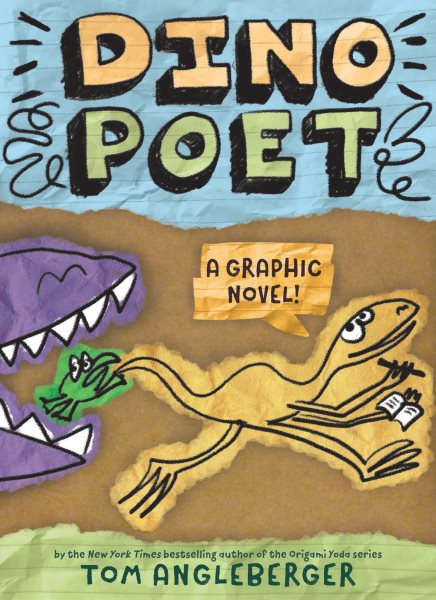
Dino Poet by Tom Angleberger

Remember when I said earlier that Ducky the Spy wasn’t quite in the same vein as Dav Pilkey? Well THIS book is 100% a great companion to the Cat Kid Comic series! After all, it contains a plethora of inadvertent learning (about poetry!) alongside moments that mix photography and illustration (a shot of a pile of plastic dinosaur toys comes to mind). That’s the way you probably market this book. Now I’ve known Tom so long than I remember when he used to write under the pen name Sam Riddleberger. Then his Origami Yoda series took off and the rest was history. He’d done some recent stuff with two-headed chickens, but this story about a prehistoric frog aiding a dino in writing better poetry is downright keen. A marvelous mix of verse, humor, and goofy art. What more could you ask for?


Fresh Start by Gale Galligan

[Previously seen on the Comics & Graphic Novels List]

Having trouble at school? No worries! Thanks to Ollie’s dad’s job, she moves from place to place all the time, never having to live with her past mistakes. But what happens when the family lands in Virginia… forever? Welp, I’m sold. I feel like Galligan’s been holding back on us until now. Obviously they couldn’t break out their raucous humor in their Babysitter’s Club adaptations, but even Freestyle was a little more subdued than this. Clearly they just needed to do something a little more personal. This book fills that requirement, but is also just this incredible mix of styles with an overarching theme that felt incredibly real. And funny? So funny! Extra points for the Bonus Comics in the back (to my mind, all funny GNs should include Bonus Comics, even if they’re just sketches). The storyline that I enjoyed the most here was actually the one involving the way the parents really did treat Ollie’s younger sister poorly. The fact that Ollie sees this and then continually brings Cat into the conversations… I’ve never seen that before. This one’s a keeper.


I Am Not Okay by David DeGrand

[Previously seen on the Comics & Graphic Novels List]

I mean, how we all didn’t adopt this book as the Official Title of 2025 is still a bit of a bafflement to me. Could any other book sum up this year so well? I think not. And I can tell you, from a personal standpoint, I identify HARD with Fluff Nugget here. Feeling grumpy? Feeling sad? Let Fluff Nugget cheer you up then! But what happens when the cheeriest creature around feels downtrodden and defeated? I mean, the cover sells itself, but the interior is pretty darn good as well. This is about a people pleaser who has an inevitable breakdown of massive proportions. I am deeply amused by any children’s book graphic novelist who clearly was influenced by Ren & Stimpy on some level. David DeGrand, j’accuse! Loved the tone, the writing, and the general mix of relatability on this one. Plus, it’s hilarious (which always helps). I mean, how can you resist a hero named Fluff Nugget for crying out loud? I submit to you our new King.


I’m a Dumbo Octopus: A Graphic Guide to Cephalopods by Anne Lambelet

What makes the dumbo octopus so special? That’s the question it wants to know! And it’s going to tell you about all the cool cephalopods it can in order to find out. All right, here’s the question for you today: Do you put this in the older nonfiction or the graphic novel section of your library/bookstore? I only ask because this book (which is highly amusing from start to finish) is so stuffed full o’ facts that even if you think you know everything about deep sea creatures, you are bound to learn something new. Like, blanket octopuses rip off man o’ war tentacles and use them like whips? And Japanese flying squid launch themselves into the air? And flamboyant cuttlefish have 75 different color combinations? See, this is precisely the kind of book that’s going to make a kid follow their parents around saying, “Did you know that…” “Hey, did you know…?” “Ohmigosh! Guess what?” It’s got all the kid-friendly fact-friendly fun you’d expect AND great backmatter (a Glossary, a Selected Bibliography, and section for Further Reading) AND it’s hilarious but best of all? They were clever and put a photograph of a real Grimpoteuthis at the end. Smarties. 


The Island of Forgotten Gods by Victor Piñeiro

A summer in Puerto Rico with his abuela and cousins is just what Nico needs to escape his troubles. New troubles come, however, in the shape of a mysterious winged creature that keeps appearing all over the island. And that’s before they’re attacked by an ancient god… Wasn’t sure what to expect with this one, since I’d never read a book by Piñeiro before. What I found is that this writer is remarkably good at invoking a sense of place. I’ve never been to Puerto Rico before but he knows just how to bring to life not just the big things, like beaches where the waves try to kill you, mountains, etc. but also small local things. Best of all? The man has a serious sense of humor. Like when our hero thinks the “wind witch” he saw on a plane is either delusions or waking nightmares (“I loved that for me”). This was a delight to read, and he does a great job of linking together Taino mythology, chupacabra tales, and PR’s recent spate of tragedies. Extra points for the clear Lin-Manuel Miranda stand-in named (I kid you not) “Juan Miguel Baranda”.


My Presentation Today is About the Anaconda by Bibi Dumon Tak, ill. AnneMarie Van Haeringen, translated by Nancy Forest-Flier

Welcome! Today we have gathered to listen to animals give oral presentations about one another. Hear what the southern cassowary has to say about the hummingbird or the rhino of the shoebill. Hilarity and fun facts mix and meld in this truly original collection. So apparently 2025 is the year when I have to relax some of my more draconian just-the-facts-ma’am takes on nonfiction for kids. As such, I’ve amended my stance. I don’t particularly mind a book like this one, which is chock full of animals talking to one another about… well, animals. I don’t mind it because there’s no child alive that’s going to pick this book up and think that foxes are that obnoxious in person (they would be that hungry, though). The book itself is just kinda, sorta a delight. And it very cleverly shows how animals (human ones included) really only see other animals through their own lenses. It’ll teach you a thing or two (I did NOT know all that info about koalas’ sex lives), the art is delightful, and if Nancy Forest-Flier doesn’t get some kind of a Batchelder Award for her translation, I’ll eat my bloomin’ hat. One of the most enjoyable nonfiction titles of the year, that’s for sure.


 Scarlet Morning by N.D. Stevenson

Orphans Viola and Wilmur have lived all their lives on the boring island of Caveat. When an exciting stranger appears, they trade a strange book for a life of adventure. But is their captain the infamous pirate Scarlet Morning? I’m so sorry, folks. I’ve just discovered, quite late in the game, my favorite fantasy novel for kids of 2025. It’s sort of what you’d get if you combined The Pirates of the Caribbean with Lemony Snicket. I don’t know that I can describe it any better than that. N.D. Stevenson is best known for the graphic novel Nimona, but here he’s just using his art skills to illustrate his own book. I forgot that at one point and found myself thinking, “Man. The illustrator here is WAY better than I’m used to on these books.” Is it a standalone? Not really. I mean, some threads get tied up but some are definitely dangling. Still, I was just GRIPPED by this and the writing is absolutely jaw-droppingly good. Definitely on the older side, but so much fun and funny funny funny. Hugely imaginative too! Please give it a read


True Colors: Growing Up Weird in the ‘90s by Elise Gravel, translated by Montana Kane

[Previously seen on the Comics & Graphic Novels List]

Elise knows she’s a weirdo, but she’s pretty okay with that, as long as she has her best friend Asma. But when Asma and a new friend start hanging out without her, is their friendship over? I’m just so friggin’ PEEVED that Drawn & Quarterly went and labeled this as a YA gn. It ain’t. At most it’s maybe a middle school one (there is some mention of periods and a brief look at sex ed) but Gravel is WAY more interested in the ins and outs of friendship than relationships. It’s also, and I mean this sincerely, one of the funniest books of 2025. I mean, those of us who have read Elise Gravel won’t find that fact particularly surprising. Even so, I was struck by how often I found myself laughing out loud as I read this. You just want to go back in time and befriend this girl. An incredible look at having ADHD in the ‘90s.


Ultrawild: An Audacious Plan for Rewilding Every City on Earth by Steve Mushin

[Previously seen on the Gross List]

When I think how close I came to not seeing this book before the end of the year came, it gives me chills. Folks, please meet my favorite older nonfiction book for kids. I almost never do this, but I think a trip to its website might be a good way to at least get a start on understanding what it is that Mushin has created here. Imagine if someone were to mix Where’s Waldo with David Macaulay and then add in every insane (but possible!) scientific invention and solution to our current environmental crisis. That’s this book. It’s an import from Australia where, I should note, it won Best Designed Children’s Non-Fiction book (2024 Australian Book Design Awards), and the 2024 Elsie Locke Award For Best Nonfiction (NZ). It was also shortlisted for The 2025 NSW Literary Awards, Patricia Wrightson Prize for Children’s Literature, The 2025 NSW Literary Awards UTS Glenda Adams Award for New Writing, and the 2025 Spark! School Book Awards (UK). It should win more. Honestly, it should have appeared on ALL the best books lists that came out this year. So why hasn’t it? Probably because, like myself, the committees didn’t hear about it in time. You can bet that I would have fought tooth and nail to put it on my library’s 101 Great Books for Kids list if I’d known about it. Fortunately, my library’s Blueberry Awards come out later, so it has a chance to appear there.

Why’s it so good? Two words: Poop cannons. I mean, come on. I’m not made of stone. In this book Mushin offers extreme (and I do mean extreme) solutions to rewilding cities. He also faces a dark moment of the soul mid-book, but then he comes roaring back with even MORE ideas! I’ve never seen a book as hugely inspirational to kids as this. It’s tall (sorry, library shelves) and made for young eyes with pages packed with type and graphic novel elements. And yes, the man has a bit of an odd obsession with us eating our own legs (it makes sense in context) but I am HERE FOR IT. Seriously. Get on this thing. You’ll be glad you did. You’ll also want to hand it to the first kid you see. 


That’s it for today! Be sure to stay tuned for more lists on 2025 titles. The full roster is here:

December 1 – Great Board Books

December 2 – Picture Book Readalouds

December 3 – Simple Picture Book Texts

December 4 – Transcendent Holiday Children’s Books

December 5 – Rhyming Picture Books

December 6 – Funny Picture Books

December 7 – Caldenotts

December 8 – Wordless Picture Books

December 9 – Bilingual Books for Kids

December 10 – Math Books for Kids

December 11 – Books with a Message / Social Emotional Learning

December 12 – Easy Books

December 13 – Translated Children’s Books

December 14 – Fairy Tales / Folktales / Religious Tales

December 15 – Gross Books

December 16 – Poetry Books

December 17 – Unconventional Children’s Books

December 18 – Early Chapter Books

December 19 – Comics & Graphic Novels

December 20 – Older Funny Books

December 21 – Science Fiction Books

December 22 – Fantasy Books

December 23 – Informational Fiction

December 24 – American History

December 25 – Science & Nature Books

December 26 – Unique Biographies

December 27 – Blueberry Award Contenders (Celebrating the Environment)

December 28 – Nonfiction Picture Books

December 29 – Nonfiction Books for Older Readers

December 30 – Middle Grade Novels

December 31 – Picture Books

Filed Under: 31 Days 31 Lists, Best Books, Best Books of 2025 Tagged With: 31 days 31 lists, Best Books of 2025, funny, funny books, funny graphic novels, funny nonfiction, middle grade funny books

31 Days, 31 Lists: 2025 Comics and Graphic Novels for Kids

December 19, 2025 by Betsy Bird

Note how I hedge my bets in the title, calling them both comics AND graphic novels. I accept all terms. I’m cool like that.

This was the first year that both of my children were too old to be read to at night. In the past, I managed to cut through the neverending swath of children’s comics by reading to the both of them every night (half the bedtime was dedicated to a graphic novel and half to a novel). But this year I went cold turkey (one is in middle school and one is in high school). No more of that. As a result, the number of comics for kids I saw dropped precipitously. I make no excuses. I saw what I can see. I’ll just tell you that yesterday at work I tearfully returned about ten GNs I wasn’t able to get to, thanks to the time crunch. *sigh* As such, while I stand by every book on this list, if you’re missing one of your favorites please feel free to mention it in the comments. This is a good example of the limitations of a one-woman-show.

And if you’d like a PDF of today’s list, you can find one here.

Still can’t get enough comics? I can’t blame ya. Here are the round-ups I’ve done in previous years:

  • 2024
  • 2023
  • 2022
  • 2021
  • 2020
  • 2019
  • 2018
  • 2017
  • 2016

2025 Comics and Graphic Novels for Kids

FEATURED TITLE

I Am Not Okay by David DeGrand

I mean, how we all didn’t adopt this book as the Official Title of 2025 is still a bit of a bafflement to me. Could any other book sum up this year so well? I think not. And I can tell you, from a personal standpoint, I identify HARD with Fluff Nugget here. Feeling grumpy? Feeling sad? Let Fluff Nugget cheer you up then! But what happens when the cheeriest creature around feels downtrodden and defeated? I mean, the cover sells itself, but the interior is pretty darn good as well. This is about a people pleaser who has an inevitable breakdown of massive proportions. I am deeply amused by any children’s book graphic novelist who clearly was influenced by Ren & Stimpy on some level. David DeGrand, j’accuse! Loved the tone, the writing, and the general mix of relatability on this one. Plus, it’s hilarious (which always helps). I mean, how can you resist a hero named Fluff Nugget for crying out loud? I submit to you our new King.


The Bizarre Bazaar: Mirror Town by Daniel Nayeri, ill. Liz Enright

Oh yeah. You got so wrapped up in his The Teacher of Nomad Land that you didn’t even notice he put out a graphic novel this year as well, did you? A picture book too, for that matter, but that’s neither here nor there. In this book, Abel Azari doesn’t live an enviable life until the day he stumbles into a peculiar curio shop. Next thing he knows he’s the most popular guy in town.. but what’s really going on?  With its Twilight Zone feel, this would actually pair remarkably well with Jasper Rabbit’s Creepy Tales. Nayeri (who apparently wants to try ALL the formats!) gives creepy graphic novels a go with this tale of a traveling magical curio shop and its mischievous (some might say demonic) denizens. I was a little thrown by the tempestuous relationship of our two narrators at the start, but once it became clear that something weird was going on I settled right in. I always like stories where characters get exactly what they want for creepy reasons. Certainly worth a read in any case. 


Botticelli’s Apprentice by Ursula Murray Husted

Mella yearns to be trained as a classical painter, but in Renaissance Italy such dreams are unavailable to girls. Can she convince the great Botticelli to take her on? Years ago Husted did a book called A Cat Story in which she was able to replicate the artistic styles of a number of classic artists. Now she’s doubling down with this story of a girl who yearns to be an apprentice. Botticelli just isn’t as well-known to kids these days, not like Michaelangelo and Da Vinci (both of whom have very amusing cameos in this book). It can be so difficult for a book to balance girl power with historical accuracy. I thought that giving Mella a rich female patron was a very clever solution to an almost insurmountable historical problem. Contains what may be the most dog-like dog in the history of comics (I’m still cringing over what the dang mutt eats in this story). Great art, of course, but equally magnificent storytelling.


Cabin Head and Tree Head by Scott Campbell

[Previously seen on the Unconventional List]

Meet Cabin Head and Tree Head! Two great buddies helping one another through a series of small adventures. Join them and all their friends as they enjoy portraiture, leafcuts (both good and bad), treasure hunts, and more! I want to dive deep into whatever world this is that Scott Campbell has conjured up and just live there for a while. Apparently the man hasn’t produced a picture book since 2019 and decided to celebrate his own return with a book that perfectly combines the sweet and strange. His publisher is selling this with the description that it’s, “like Bill and Ted crossed with Frog and Toad.” Not sure I entirely agree with that, but it’s more on-the-nose than you might think. In this world, everything is on somebody’s head somewhere. This gets taken to its logical extreme when we pan back at one point and see that Cabin Head and Tree Head and all their friends live on an Earth Head (the Satellite Heads delight me). The fact that all these Heads have tiny people who occasionally come out and do stuff is just adorable. I had a lot of fun watching the little people swinging on Tree Head’s tire swing from time to time. I guess you could put this in your graphic novel section OR your early chapter book section, depending on your mood. There are six main stories and then three additional bonus stories about some of the other Heads. Obviously, I’m a fan of Library Head, but that was probably a given. The tone in these stories is so sweet and strange that you’ll have a hard time putting this down. I want to go to there!

It also happened to have the BEST promotional video of the year. Watch all the way to the end, if you’d like to see the surprise cameo:


The Cartoonists Club by Raina Telgemeier and Scott McCloud

When Makayla and Howard start a comics club at their school, they have no idea how to even begin. A clever combination of great storytelling and practical advice for kids who want to make comics of their own. Well, this book was sort of sold on being a version of Scott McCloud’s Understanding Comics for kids, and by gum that is pretty much precisely what it is. It’s rather genius. It’s not the first book for kids I’ve ever seen to discuss the process of making comics, but rather than being pedantic and doing a kind of step-by-step process that a lot of books indulge in, this manages to be both full of practical advice and a deeper philosophical understanding of how much work a reader has to do to even read comics. I was a bit surprised that they didn’t mention the differences between different kinds of comics (or that any of the kids were into manga) but I guess they’re leaving that for the sequel. And darned if the doggone book didn’t make me tear up… twice! Twice I tells ya! It’s the best of all possible worlds, this collaboration.


Chickenpox by Remy Lai

[Previously seen on the Gross List]

A visually inventive (and at times extremely gross) memoir, told from the P.O.V. of the author’s older sister, about the time the Lai kids all caught chickenpox. Will they get along while trapped together in quarantine? Ha! No way! Man, I swear I had chickenpox when I was a kid but I don’t remember it being anything quite as interesting as this. Lai is giving STRONG oldest sister vibes with this title. The dichotomy of being part of a large, raucous family particularly rang true on every page. Since most of the book is set in the home during the family’s quarantine, the danger is of making the story repetitive or boring. Turns out, Lai has the situation well in hand (this would make a GREAT play/musical!). I was also impressed by how efficiently the character of Abby was able to mess up all her friendships at once. I literally wasn’t sure she’d be able to pull it all off, but lo and behold, I need not have worried. Happy endings for all! Oh, and if you want some pus with your children’s literature, there is a visual (not seen here) of a pox bursting that is pretty stomach-churning.


Creaky Acres by Calista Brill and Nilah Magruder

Even though I’m reading books for kids all year long, I miss a lot of the best titles. I’m just one gal and there are a LOT of books out there! All this is to say that I wish I’d located Creaky Acres sooner. I credit the Best of the Year lists put out by Chicago Public Library and New York Public Library for pointing me in the right direction with this one. The premise is that Nora is a star of her horseback riding team. Unfortunately, because of her nerd dad’s job, she has to move to a smaller community in the country. Now she’s the only Black girl in her school and the local barn, called Creaky Acres, is downright decrepit compared to her last one. Brill does a brill-(see what I did there?)-iant job of making Nora a complicated character. She’s an absolute jerk about her new location when she first moves in, but she’s also dealing with a concentrated array of microaggressions at school, thanks to being the first Black kid there. Watching her slowly come to love the new barn and its denizens (though maybe not the overly affectionate opossum) is a real mark of excellent graphic novel writing. See, it’s books like this one that make me wish, yet again, for an ALA award for comics. Just the most fun you can find in a book this year. 


Creature Clinic by Gavin Aung Than

A young orc doctor takes care of mythical creatures in need of (sometimes hilarious) medical help. When a human (gasp!) enters their fantastical realm, she must hide him! Oh, this is a hoot. The downside of having so many graphic novels coming out these days is that you really can’t tell which ones are going to be fantastic charmers and which ones are snorefests. Drop this one down the “fantastic charmer” slot, please. It’s sort of E.R. for the fantasy set. Than is just having SO much fun with all the different ideas here, but I also kind of loved the personal relationships and distinct personalities on these pages. Plus, we don’t see a ton of books for kids where a young woman is trying to earn her mother’s respect in the field of medicine. And I loved the info at the end that Than got the idea for pushing a unicorn’s horn back in place after he had to have that happen to his own nose. 


Don’t Cause Trouble by Arree Chung

When your mom cuts your hair, you have to buy your clothes at thrift stores, and all you want is a pair of cool shoes, life can feel rough. Ming just wants to fit in, but can standing out be okay too? Boy, the graphic novel memoir really is the way for picture book creators to get into the comics world now, isn’t it? I wonder if they’re told to go this route or if it’s just a natural path. Chung’s narrative has many of the elements we’ve seen in some other comics, but he definitely has his own distinct style and frame of reference. The mom in this book, for example, is a very different mom than I’ve seen in a while: Perpetually cheery, never getting mad. Arree’s anger on the page is palpable, and I’d say it’s fairly strong, and quick, read.


The Fire-Breathing Duckling by Frank Cammuso

Mama Duck loves all her ducklings equally… even the fire-breathing ones. Nort isn’t like his brothers and sisters. Will he ever find the place he belongs?  It can be a touch difficult to find young graphic novels for the earliest of ages in a given year. TOON, therefore, makes sense as an ideal place to look. Plus Frank Cammuso is an old hand at this work. Now even though he’s gone the old predator-lives-with-ducks storyline (which we’ve seen in every possible combination, though this version reminded me particularly of Lambert), I really liked the tone, the art, and the story here. It’s just a classy class act altogether. More than a little sweet, without getting all messagey and in your face.


Fresh Start by Gale Galligan

Having trouble at school? No worries! Thanks to Ollie’s dad’s job, she moves from place to place all the time, never having to live with her past mistakes. But what happens when the family lands in Virginia… forever? Welp, I’m sold. I feel like Galligan’s been holding back on us until now. Obviously they couldn’t break out their raucous humor in their Babysitter’s Club adaptations, but even Freestyle was a little more subdued than this. Clearly they just needed to do something a little more personal. This book fills that requirement, but is also just this incredible mix of styles with an overarching theme that felt incredibly real. And funny? So funny! Extra points for the Bonus Comics in the back (to my mind, all funny GNs should include Bonus Comics, even if they’re just sketches). The storyline that I enjoyed the most here was actually the one involving the way the parents really did treat Ollie’s younger sister poorly. The fact that Ollie sees this and then continually brings Cat into the conversations… I’ve never seen that before. This one’s a keeper.


Higher Ground by Tull Suwannakit

Welp, I’m not sure what to think about the fact that 2025 is clearly the year that author/illustrators decided to write a bunch of very sweet and affectionate post-apocalyptic tales. I mean, between this book and Oasis, we pretty much have the market cornered, wouldn’t you say? It wasn’t immediately apparent to me by the cover of this book that this even was a graphic novel. And, perhaps, purists would protest the label. Are there panels? Sure. Speech balloons? Well… no. Not exactly. But the whole book inhabits that space between an early chapter book and a graphic novel, and I like to think that the sheer number of (quite frankly) beautiful illustrations in this book tip the balance in favor of comics. The premise of the title is that a natural disaster in the form of rain floods the world. Our child heroes and their grandmother are lucky enough to have an apartment with not only roof access, but a working garden up there as well. As the months pass they tend to the garden, more than a little perturbed that the water levels are only climbing higher and higher. And when the water threatens to flood the garden, big choices must be made. It’s a children’s book, so expect a happy ending, but it rivals How to Say Goodbye in Cuban (see below) in terms of beautiful watercolors (to say nothing of the graphite powder, gouache, and acrylic paints) in a graphic novel format). The last words in the book? “Don’t give up.” A message we can all use this year.


How to Say Goodbye In Cuban by Daniel Miyares

Who would have thought winning the lottery would be such a problem? Carlos didn’t want to leave his grandparents’ Cuban farm for the big city, but that’s what happens when his papi hits it rich. Then Castro takes over and things change further still. The Cuban experience of leaving under Castro has definitely been rendered into a graphic novel experience for kids before, sure it has. What hasn’t really been done, though, is a breakdown of why the Cuban Revolution happened in the first place. Even so, it’s the story of Miyares’s dad’s experiences that are the heart of this book. I LOVE his grandfather, by the way. That guy shines through the pages, making inappropriate jokes in tense times (I’ve been telling folks that he has Uncle Iroh energy). Add in the fact that Miyares made the entire book in watercolor (no digital illustration for this man) and you’ll notice that the colors just undulate off the page. I’ll say it! This is my favorite Cuban Revolution graphic novel to date! 


I Witnessed: The Lizzie Borden Story by Jeramey Kraatz, ill. Crystal Jayme

Who killed Lizzie Borden’s parents? When 14-year-old Charlie Churchill sees something strange next door, who is to blame for the crime? A tale of uncertainty and an unsolved murder. I don’t know what I was expecting when I started this book. Probably some sordid story (but age appropriate for kids??). Instead, I found a hugely compelling tale of murder that leaves precisely what happened to Lizzie Borden’s father and step-mother wide open. Kraatz gives us a world-weary Lizzie, clearly aching for some kind of freedom, but a murderer? It’s just as unclear to the reader at the end as it is to the young hero. Along the way you also get this incredible series of courtroom set pieces (the book is an excellent introduction to how courts work in general). It was nicely historical but felt very contemporary too. A nice bit of uncertainty (with great backmatter to make things interesting) for budding true crime enthusiasts.


Into the Bewilderness by Gus Gordon

What to do? Luis the bear has ended up with tickets to a performance in the big city, but he’s never been out of the deep woods before. Good thing he has grumpy mole Pablo to come along for the ride. Now due to the fact that I would run over small mammals on the road to get to the newest Gus Gordon book, I may not be the most unbiased reader of this title. As weird as this may sound, this book has a VERY similar tone and feel to the TV show We Bare Bears, right down to the awkward Sasquatch who just wants to hang out and be groovy. Gordon is just so good at capturing the feel of cities that it’s almost a pity that it takes our two protagonists so long to get to one. I could also spend a long time just staring at the map at the front. But, of course, the true heart of this book lies in the friendship between cheery bird-chomping Luis and perpetually grumpy Pablo. There’s kind of an Ernie and Bert energy to their friendship (though their personalities are different). Worth your time and a quick read.


Kindred Dragons by Sarah Mensinga

I’d be the first person to tell you that the tagline that this is Anne of Green Gables meets How to Train Your Dragon is annoying… and 100% accurate. Happily, Mensinga appears to be the kind of author/illustrator who is perfectly at ease with taking some basic source material and then spinning it into something bright, shiny, and new. In this story Alice is 100% obsessed with dragons. She’s convinced that soon she’ll be given an egg of one by the fairies to bond with (so, yes, there’s a bit of the old Dragonriders of Pern in this tale as well). Even though her strict grandmother tells her it’s impossible, she believes… but it never happens. What does happen, however, is that she becomes friends with an old dragon named Brim in the woods. But what happens when that dragon gets sick? The art of this book? Gorgeous. The tone? Ideal. The story? SO much fun. Oh, and I probably shouldn’t even say this (it’s a little bit of a spoiler), but can I tell you how relieved I was at the end that Mensinga managed to find a way to give Sarah a happy ending utilizing her special skills? Find this one!


Loki by George O’Connor

There was a time, oh best beloved, when picture book creators could get away with murder on their pages. Think of Trina Schart Hyman hiding a copulating couple on the edge of a wooden table or any number of weirdnesses populating Tomi Ungerer’s books. These days, good luck with all that. Picture books go through the finest sieve imaginable, so any weirdness that manages to squeak through is almost miraculous as a result. Not so, comics. Graphic novels in the last couple years have sprung up en masse, and the end result is that there are so many of the darn things that some of the creators are managing to put stuff on the pages that gives me hope in this massive book banning age. Nathan Hale, for example, somehow managed to include the desiccated face of a man in a full two-page spread in Bones and Beserkers (see below) while George O’Connor here has an entirely DIFFERENT half-a-desiccated corpse face (his is more vertical and Lane’s more horizontal). Oh, and Loki totally ties his bits and pieces via rope to a goat to get a laugh. The thing about O’Connor’s Asgardian series as opposed to his Olympians series is that he has a lot less sources to draw from, and the sources he does have are very very very weird. The emotional thrust of this book is how Loki goes from trickster to villain. I thought the title did a remarkably good job with it all, honestly. But that’s George O’Connor for you. Getting away with murder and just a little bit more. 


My Trip with Drip by Josephine Mark, translated by Andrew Shields

[Previously seen on the Translation List]

Optional Alternate Title: They Just Don’t Make ‘Em Like This In America! It’s the Germans this time, and let this be yet another poked hole in American belief that the “Germans aren’t funny”. Maybe the stuff for adults isn’t, but the children’s stuff is fantastic! Case in point, a graphic novel with more guts than you’re going to see all year (and a serious Batchelder contender, by the way). The story focuses on a small rabbit who is taking some kind of medicine. He’s pretty much permanently attached to an IV, his gums are bleeding, and he’s losing his fur. But all that is almost secondary to the adventure he finds himself on when his IV stand accidentally repels a bullet and saves a wolf’s life. Now the wolf is honor bound to the bunny (whether the bunny wants it or not) and the next thing you know they’re stealing cars, kicking over the motorcycles at a biker bar, gambling, and escaping an Inspector Javert-like hunter who is determined to get them in his sights. Yet the heart of the piece (and it has a lot of heart) is the increasingly tender relationship between the bunny and wolf. As the bunny spends time with the wolf he finds himself growing braver and more confident, while the wolf begins to come to terms with not being alone anymore and finding a pack. Personally, I always have a problem with books where someone needs to take medication regularly and doesn’t, but that is NOT this book. The wolf himself takes the bunny’s medication plan very seriously. I don’t know that we see a lot of books with heroes disabled in this particular way, but if this story is any indication, we could use a lot more.


Nathan Hale’s Hazardous Tales: Bones and Berserkers by Nathan Hale

[Previously seen on the Gross List]

Oh wow. So the cover is a bit misleading on this one, I’d say. The endpapers, in contrast, dead on. Emphasis on the dead. Nathan’s always harbored a love of good old-fashioned horror, but it’s tended to come out more in his standalone books like One Trick Pony or (most especially) Apocalypse Taco. His Hazardous Tales, in contrast, can get gory but always stayed relatively safe (a remarkable balance when you’re dealing with something like the Donner Party). But in this latest, with its “13 True Tales of Terror” on its cover, he lets himself go completely. I mean, the first story in this book has a newborn baby killing everyone in the receiving room so… y’know, it lets you know what’s going on right from the start. That’s why this cover, with its Viking on the cover, is downright tame in comparison. Now Nathan has always harbored a special love for Stephen Gammell, he of the Scary Stories to Tell in the Dark (which means Nate should take a gander at the poetry book Nightmare Jones from this year). Indeed, this book is even dedicated to Gammell and Alvin Schwartz. Years and years and years ago, I did a challenge on my blog for folks to Re-Seussify Seuss, which is to say, to rework a famous Seuss image in the style of another artist. Nathan chose to do a selection from One Fish, Two Fish, Red Fish, Blue Fish, in a Gammell style and it was damned well the best thing I ever saw. Here take a gander:

So with all that in mind, just know that if you’re handing this one to kids, maybe don’t make it the first Hazardous Tale they see. This book’s a lot more interested in folktales, legends, and urban legends (another Alvin Schwartz similarity) than strict history (though there is some of that as well… *shudder*). 


Night Chef: An Epic Tale of Friendship with a Side of Deliciousness by Mika Song

Though I’ve heard the book compared to Ratatouille, anyone familiar with the film Everything Everywhere All at Once is going to know that the true comparison here is Raccoontouille. In this tale we meet the Night Chef. Having grown up in the walls of a restaurant, she’s a raccoon with a particularly keen sense of cooking. Naturally, she’s only ever known human food. When her search for an egg leads her to a newly hatched baby crow she becomes determined to reunite it with its kind. This means epic cross country adventures, a lovely animal-run restaurant where she discovers cricket, earthworm, and firefly dishes, and a villainous owl out for blood. Mika Song has dabbled in food-related graphic novel fare involving rodents for years and years now, honestly. I’m sure many of you have seen her younger books like Donut Feed the Squirrels. Night Chef is just a bit older than all of that, but is still on the younger side of middle grade readers (so more for the 9-year-olds than the 6-year-olds). After reading the 2025 nonfiction title Bug Snacks by Jess French, I went out and purchased some cricket flour. It’ll be the perfect accompaniment for the Fly Frittata recipe at the back of the book (no flies included). Consider pairing the two books together!


North for the Winter by Bobby Podesta

[Previously seen on the Holiday List]

A supervising Pixar animator tries his hand at middle grade comics and comes out with a legitimately fun Christmastime tale. Silly that I am, color me surprised when I learned that the critter on the cover of this book is Donner. Dasher had her time in the sun with Matt Tavares, so it seems only fair that Donner should have a turn. The story fixes on a broken family. Virginia and her dad are driving to her aunt’s home just in time for Christmas and the kid is NOT happy about it. Ever since her mom’s death, Virginia’s father has been withdrawn and moody. It probably doesn’t help when he almost hits some animal in the road and gets a flat. While he’s taking care of that, Virginia runs into the animal in question and accidentally ends up with the strange compass it wears around its next. What follows is a trip to the city where department store elves, a trapper with a Javert-like mindset, a new friend for Virginia, and more than a dose of magic mean that by hook or by crook, it’s up to Virginia to save Christmas itself! I was particularly taken with the continual shots of the army during all of this, as they try to deal with the flying objects that make no sense on their radars. Set in 1955, the book is peppered with little callbacks to a lot of classic Christmas fare. Reading it, you’re never quite sure where Podesta will head next. Gripping storytelling, fantastic art, hopefully we’re going to see a lot more books out of Mr. Podesta in the future.  


Oasis by Guojing

In a barren desert, two children strive to survive while their mother works in the city. But when they discover an abandoned robot and fix it up, they find a new kind of mother. Knowing, as I do, how long graphic novels take to make, I know that Guojing didn’t write this to almost coincide with The Wild Robot movie, but whatta tie-in! Mom robots, man. They’re very “in” right now. Of course, the entire reason this (or really any Guojing book) works is because she ties the plot in so completely to the reality of children left behind by their parents on their own (Guojing’s first book in America The Only Child was based on that concept along with her own childhood experiences). She’s done so many lovely books over the years that I didn’t really expect “dystopian hellscape” to be in the cards for her, but that’s what I like about Guojing. She always keeps you guessing. And as dystopian hellscapes go, this is probably one of the sweetest and gentlest you’ll find, though there are plenty of dark scary corners here and there. Still, the idea of finding a substitute mom when you can’t reach your real one? That felt right to me. Gorgeously illustrated and beautifully written. I adore this. Would pair weirdly well with The Storm in the Barn by Matt Phelan too.


On Guard! by Cassidy Wasserman

I used to run a post on my blog that would discuss the contenders for “Worst Parents in Children’s Books” of that particular year. I just don’t read widely enough to know all the potential inclusions, but I can tell you that if I was inclined to make such a list for 2025, Grace’s mom in this book would be RIGHT up there. You don’t see a lot of parents slapping their kids across the face these days, but that’s just one of the memorable moments in this title. In this story, Grace has had a falling out with her (now) former best friend. On top of that she’s having to navigate her parents’ divorce. It wouldn’t be such an issue, except that even divorced they constantly fight, and Grace’s mom isn’t exactly the most attentive parent. Fortunately, when Grace discovers the fencing team at school, she also finds friendship and a self-confidence she never had before. Now this is hardly the first fencing graphic novel I’ve ever seen (Duel by Jessixa Bagley and Foiled by Jane Yolen both come instantly to mind), but I found the storytelling and easygoing incorporation of fencing terms and rules into the book just super. Plus, that painful moment when your friend no longer wants to be friends with you is handled so well. A great title about finding something to love, and advocating for yourself (even if the person you have to advocate with is a parent). 


One Crazy Summer by Rita Williams Garcia, ill. Sharee Miller

I don’t know why I resisted reading this for as long as I did. After all, I adored the original (it’s my own personal Shoulda Won a Newbery Award soapbox book). Maybe I worried that Sharee Miller’s art was too simple to dip into the nuances of this story. That thought was, I admit now, inherently stupid. I wasn’t two or three pages into this story before I realized that it’s not about the complexity of the art. It’s about the way in which the graphic novelist plucks out the storytelling elements of the original text. And seeing a gigantic Muhammed Ali boxing a plane in the sky? Right there I was sold. Best of all, Miller somehow manages to really relay the key moments of Garcia’s original text without sacrificing anything. Now I’ve seen some objections to the art in this book, pointing out small inaccuracies (like the fact that the takeout Chinese food comes in plastic bags when it should have been paper bags). I’ll grant that, but I’ll counter that while that is annoying, it doesn’t negate the fact that this is a seamless adaptation. And the best part? Reading this comic makes you want to reread Garcia’s original book. It’s the perfect gateway drug to literature.


Otis & Peanut Find a Way by Naseem Hrab, ill. Kelly Collier

Three small stories follow the adventures of best friends Otis and Peanut. Whether it’s anxiety over travel, missing someone who’s gone, or planning an upcoming visit, these tales handle it all with equal parts humor and kindness. If we’re always on the lookout for younger and simpler picture books then, by extension, we should also be always on the lookout for younger and simpler graphic novels as well. This book may be #3 in a series, but it stands entirely on its own. Hrab is shockingly good at the writing here. It’s just three little stories (“The Trip”, “The Stone”, and “The Visit”) but the last one sums up the previous ones nicely. It’s compact but also touches on some really serious issues with a gentleness that can’t be taken for granted.


Say Something, Poupeh Babaee! by Dr. Haleh Massey, ill. Ghazal Gadri

Anyone else getting El Deafo vibes off of this book? Not necessarily in terms of the content, but there’s something about Gadri’s illustrative style that certainly invoked Cece Bell to my mind. This book has, unfortunately, flown distinctly under the radar this year, and that’s a serious shame. Seems to me that a middle grade novel that talks about travel bans against Muslim countries is DISTINCTLY timely. In this story Poupeh Babaee has flown from Iran to the U.S. to stay with her relatives ahead of her parents. They stayed behind to sell their business and get everything ready for this move. Unfortunately, in that gap the U.S. has instituted new guidelines on who is allowed to enter the country, and Iran is on the “dangerous country” list. Poupeh, meanwhile, has to deal with the fact that her classmates call her “Poopy Baby”, her cousin doesn’t seem to even want her there, and she’s dealing with selective mutism at precisely the time that she’s supposed to talk to a government official about getting her parents to the States. It’s a lot. There’s not a kid out there who’s going to come away from this book without feeling an overwhelming gratitude that they don’t have to deal with the stuff that Poupeh is dealing with. The adults in her life (particularly the men) are NOT particularly open to hearing what a kid like her is going through. It’s a rough ride (the kid with the America First dad is a trip) but it all ends happily at the end. Whew!


Sea Legs by Jules Bakes, ill. Niki Smith

Janey’s family lives on a boat traveling through the Bahamas. She feels isolated and wants to make a friend…but all too soon learns to be careful what you wish for. Based on the author’s childhood, I came into this thinking it was some happy little basic middle grade comic about living on a boat. Yet the minute Janey’s new friend, Astrid, steps onto the scene, the whole mood of the piece shifts. Growing up, I had a friend with an alcoholic dad, and I was just as oblivious as Janey to what was really going on. There’s an intriguing dark underbelly to this tale, and it elevates the story from pretty-good–but-forgettable to great. Sure, it takes a little while to find its sea legs, but once it knows where it’s going it’s nothing short of extraordinary. 


Sky & Ty: Dinomite! by Steve Breen

You know me. Always on a desperate search for graphic novels that can speak to our youngest of readers. I’ll be the first to admit that cowboys don’t hold the same sway over young minds as they did for my parents’ generation, but anything’s better with dinosaurs, right? Particularly dinosaurs that rock good looking cowboy boots. This little sequel picks up where the first Sky & Ty book left off. Partners in the truest sense, this unlikely duo of girl and dinosaur (think of it as a younger version of Moon Girl and Devil Dinosaur) is split into two separate chapters. Breen knows juuuust how much humor he can work into each story so that it’s still easy to read, but it also sports a wry wit of its very own. Extra points for the jokes at the back and info on cowgirls (accompanied by an image of Calamity Jane). 


The Snips: A Bad Buzz Day by Raúl the Third, colors by Elaine Bay

Evil barbers have a diabolical plan that involves hundreds of unsuspecting victims to receive terrible buzzcuts, but never fear! The crime-fighting Snips are on the case! Certainly I’ve seen a fair amount of Raúl and Elaine’s work before, but this struck me as more of a labor of love than I’d seen before. They’re really tapping into a 1930s cartooning vibe that I dig, with direct references to Nancy, Richie Rich, Betty Boop, Ignatz, and more obliquely to things like Felix the Cat. I’ve always admired the way the duo is able to drop a reader directly into a story without having to dwell too much on exposition. Still, for me it’s the look of the piece that I find so thrilling. If they do more of this series, I really hope that they lean all the way into these early cartoons and their influences. 


Survival Scout: Lost at Sea by Maxwell Eaton III

It wouldn’t be a true year-end roundup without as many Maxwell Eaton III titles as I can cram into my lists. This isn’t exactly the first in a series either. As the third Survival Scout title, we’ve already figured out how to survive in the wilderness AND how to survive a tsunami (of the two, pick the wilderness). Now let’s talk about being stranded at sea without any particular idea where land is or how far it might be. First and foremost, Scout’s mom needs to stop sending her daughter out with her eldest son. That dude is a certifiable menace. Still, the scrapes he leaves his younger sibling in are always absolutely fascinating. With her snarky skunk friend at her side, Scout covers a WIDE range of scientific concepts in the course of explaining how to find your way back to land. You learn how to steer a sailboat (I literally did not know you could sail into the wind until this title explained it to me how), navigate with maps, charts, and satellite phones, and everything! Plus they’re funny! These books are a friggin’ delight (though I’m increasingly worried that Scout’s going to get herself stranded in space at some point). 


True Colors: Growing Up Weird in the ‘90s by Elise Gravel, translated by Montana Kane

Elise knows she’s a weirdo, but she’s pretty okay with that, as long as she has her best friend Asma. But when Asma and a new friend start hanging out without her, is their friendship over?  I’m just so friggin’ PEEVED that Drawn & Quarterly went and labeled this as a YA gn. It ain’t. At most it’s maybe a middle school one (there is some mention of periods and a brief look at sex ed) but Gravel is WAY more interested in the ins and outs of friendship than relationships. It’s also, and I mean this sincerely, one of the funniest books of 2025. I mean, those of us who have read Elise Gravel won’t find that fact particularly surprising. Even so, I was struck by how often I found myself laughing out loud as I read this. You just want to go back in time and befriend this girl. An incredible look at having ADHD in the ‘90s. 


The Vanishing of Lake Peigneur by Allan Wolf, ill. Jose Pimienta

Nonfiction time! On November 20, 1980 an entire 1,100 acre lake disappeared. How did it happens? Action packed graphic novel storytelling relays this forgotten piece of Louisiana history. BLAST! This is amazing!!! Last year we had that rip-roaring nonfiction about people escaping Mt. St. Helens. This year? A Louisiana disaster, utterly lost to history, from 1980 that is so gripping you’ll be on the edge of your seat. Characters probably spend a little too much time talking about what an “ordinary day” it is for my liking, but once the disaster begins you wonder how anyone ever forgot about it. This has everything! Trapped miners. Deadly whirlpools. Equally deadly waterfalls. Dogs in peril! People in peril! Geyers! I love the note at the end that says that maybe the reason this wasn’t better reported and remembered is that no one died, everyone was focused on the hostages in Iran, and on Dallas, who shot J.R.? Whatever the reason, this is gripping, and a great mystery to boot. 


Very Bad at Math by Hope Larsen

Middle grade graphic novel alert! Verity has it all at her school. Popularity and friends galore! But she has a secret. Math makes no sense! If she doesn’t do better, she will have to give up things that mean everything to her. Will she prevail? It’s good and it includes a nice bit of info about dyscalculia that I haven’t seen discussed in children’s books much before. I also really liked that Very is the rare popular, nice character. I knew kids like her when I was a kid but we almost never seen them on the page. And, naturally, I love the math connection here. True, Very’s not a huge fan of it, but she comes around once she realizes that her problems stem from a disability, not a lack of trying. I wouldn’t call it the MOST positive portrayal of math this year, but at least it doesn’t demonize it. Plus, it takes some time to explain how math is useful in the real world (which is good stuff). All told, this is enticing and new in ways I haven’t seen before.


That’s it for today! Be sure to stay tuned for more lists on 2025 titles. The full roster is here:

December 1 – Great Board Books

December 2 – Picture Book Readalouds

December 3 – Simple Picture Book Texts

December 4 – Transcendent Holiday Children’s Books

December 5 – Rhyming Picture Books

December 6 – Funny Picture Books

December 7 – Caldenotts

December 8 – Wordless Picture Books

December 9 – Bilingual Books for Kids

December 10 – Math Books for Kids

December 11 – Books with a Message / Social Emotional Learning

December 12 – Easy Books

December 13 – Translated Children’s Books

December 14 – Fairy Tales / Folktales / Religious Tales

December 15 – Gross Books

December 16 – Poetry Books

December 17 – Unconventional Children’s Books

December 18 – Early Chapter Books

December 19 – Comics & Graphic Novels

December 20 – Older Funny Books

December 21 – Science Fiction Books

December 22 – Fantasy Books

December 23 – Informational Fiction

December 24 – American History

December 25 – Science & Nature Books

December 26 – Unique Biographies

December 27 – Blueberry Award Contenders (Celebrating the Environment)

December 28 – Nonfiction Picture Books

December 29 – Nonfiction Books for Older Readers

December 30 – Middle Grade Novels

December 31 – Picture Books

Filed Under: 31 Days 31 Lists, Best Books, Best Books of 2025 Tagged With: 31 days 31 lists, Best Books of 2025, comics, graphic novels

31 Days, 31 Lists: 2025 Early Chapter Books

December 18, 2025 by Betsy Bird

It may surprise you to learn that the term “early chapter book” is probably way too broad for the books I’m about to show you here today. Contrary to popular opinion, such books go by a number of names because they can fulfill a number of needs. Some of the books on today’s list you will find distinctly older in both content and art/design. Others will seem to be just a hair older than an easy book. All of them linger in that liminal space between novels and beginner titles.

For the full PDF of this list, you can find it here.

Interested in previous years? Then check out the following.

  • 2024
  • 2023
  • 2022
  • 2021
  • 2020
  • 2019 & 2019
  • 2018 & 2018
  • 2017 & 2017
  • 2016 & 2016

2025 Early Chapter Books

FEATURED TITLE

The Shindig Is Coming! by Cherise Mericle Harper

It’s coming! The Shindig! But what exactly is a Shindig? The forest animals need to figure out the answer to this question and fast, because something truly IS coming… and it’s unexpected. Oh man. Oh geez. I desperately need everyone else to read this book. It starts out with all the trappings of a typical folktale. In fact, I was kind of reminded of Why Mosquitoes Buzz in People’s Ears as I went through it. But as it continued I began to realize that Harper is doing something daring with this seemingly simple story. Then I got to that ending… Look I have read a LOT of children’s books in my life, and none of them have prepared me for that ending. I’m still pondering it. If I didn’t know Cherise myself I would SWEAR this book was an import. So it’s a quick read, and I know it won’t take you long. Please pick it up and then talk to me. At. Length.


Adi of Boutanga: A Story from Cameroon by Alain Serge Dzotap, ill. Marc Daniau

Adi loves living in the Cameroon village of Maka 2, going to school, playing with her sisters, and generally having fun. Yet when her uncle announces he’s marrying her off, all that comes to an abrupt end. A daring tale of escape and freedom. One of those sleek books that clock in at 60 pages and could fit in a number of different places in the library. You wouldn’t necessarily think a tale about child brides could be appropriately written for kids, but how wrong such an assumption would be. Dzotap, who lives in Cameroon, does a magnificent job with this story. Adi is such a vibrant person, and he gives both her and the setting in which she lives ample time on the page before the gutting visit from her uncle. The art of Daniau just pops off the pages too. The colors and people and action and sheer vibrancy of the piece are hard to describe. Plus, look at all the patterns that get worked into the pages. It’s a happy story at its heart, though there’s a lot of grief worked in there as well for the girls who could not escape. Love the backmatter as well.


Amina Banana and the Formula for Friendship by Shifa Saltagi Safadi, ill. Aaliya Jaleel

She may have just immigrated to America from Syria with her family, but Amina is determined to fit in. She even has a helpful list she’s made on how to do precisely that, but all too soon she finds that making friends isn’t quite as difficult as she might have thought. One of those cases where you read the first chapter, get worried that it’s going to be all sunshine and roses about the Syrian immigrant experience in America, and then the difficulties start to mount up. Amina has to overcome her own interpretation of what it will take to fit in, but there are distinct hurdles along the way. I thought it brought a fair amount of nuance to what is, at its heart, a rather simple story. Naturally my mind now wonders what a crossover book between Amina Banana and Brianna Banana (see below) might look like. In any case, this feels familiar but is doing new things with the subject matter on its own. 


The Boy Who Lost His Spark by Maggie O’Farrell, ill. Daniela Jaglenka Terrazzini

2025 was a good year from “Boy Who” titles. There was this, The Boy Who Lived in a Shell, and The Boy Who Became a Parrot. In this title, a doubtful boy’s encounter with the mischievous nature spirit that inhabits his new home leads to trouble until the two learn to get along. This one grows on you, slowly and steadily. The plot of a boy who has grown out of believing in magical things is always a good place to begin, and when you add in resentment over having to move in the first place, that’s golden. The fantastical creature in this book, the nouka, was an interesting variation on a range of mythical creatures. Its mischief seems intended less as a corrective or punishment and more to make humans amused. Love the art by Terrazzini too! I was expecting the old woman in this book to resemble some standard crone. Instead, this lady looks like someone you might run into at the health food store.  Finally, I kind of love that if we take this book at face value, Jem’s little sister really was the one doing all those pranks at the beginning of the story. Ha! Read it to see what I mean.


Brianna Banana: Helper of the Day by Lana Button, ill. Suharu Ogawa

All Brianna wants in the whole entire world is to be Helper of the Day in school. But when the new girl gets the job instead, Brianna receives something unexpected: a friend. This struck me as a really difficult book to pull off. Brianna clearly has some kind of attention deficit issues that aren’t being addressed, and Button doesn’t shy away from how difficult she can be as a student. I got some serious Joey Pigza vibes from this book, because, as with Joey, the reader is both sympathetic to Brianna (easy to do when someone has zero friends and gets picked on a lot) and frustrated with her. Unlike Joey, of course, the book is written for the early chapter book crowd and that means that the author can only squeeze in so much backstory. The fact that Brianna’s dad took off and never came back, and we hear next to nothing about her mom, makes this an exercise in succinct restraint. It’s rather beautifully done, honestly. I wouldn’t mind seeing more of Brianna’s adventures, if only to see if the well-meaning adults in her school are capable of getting her the help she so clearly needs.


Brianna Banana: Worst Surprise Ever by Lana Button, ill. Suharu Ogawa

Oh. You know a moment ago when I said I wished I could see more of Brianna in a book? Welp, it happened. But it was only with the second Brianna Banana book that I began to see what Button was doing here. First off, I read the ad copy and saw that when the author was a kid they used to call her Lana Banana (oof). And Button is so good at never letting the reader get comfortable with Brianna’s behaviors. You don’t want to see her bullied but she also gives into her baser instincts with such ease. There’s a lot of anger there and it probably has a fair amount to do with the fact that her dad got laid off from work (for reasons unclear to Lana and, by extension, us) and then left to find work elsewhere. Her parents are definitely breaking up but Brianna seems to be willfully ignoring that fact. In this book she terrorizes a substitute teacher new to the job (not on purpose, of course) and then, in the course of a single day, things do turn around. It doesn’t hurt that she has the most caring principal in the world, who both understands her, while also never letting her get away with stuff (a delicate balance). BOY, these are good!


Everyday Bean by Stephanie Graegin

Eleven of the smallest, sweetest stories you ever did see, follow Bean, a little hedgehog, and her small adventures with her Grandma. Who amongst you is capable of resisting the allure of the art of Stephanie Graegin? Who, sez I? Not a one of you, that’s who. Now I always liked Graegin’s style, but it was when I found myself reading and rereading the picture book Water In the Park by Emily Jenkins, illustrated by Ms. Graegin, to my children that I truly fell in love. How do I go about explaining what it is that works so well? It has something to do with her tone, of course. Cute without cloying. Sweet but never saccharine. This isn’t her first solo effort, but it’s the book that I, for one, adore the most. In spite of the fact that it contains eleven tiny stories, the publisher is selling this one as a picture book rather than an early chapter or easy book title. Seems a bit of a pity, but you know what this really is? A bedtime book. Extra points to Graegin for managing to tell such short stories so very very well. This is an exercise in restraint that every up-and-coming children’s book creator should study intently.


From Memen to Mori by Shinsuke Yoshitake, translated by Ajani Oloye

[Previously seen on the Translation List]

In strange and sweet little sequences, a brother and a sister question the world around them in this gently philosophical title. I know that I keep putting weird European books into this category, but I’m not doing that now. No. No, now I’m putting weird Japanese books into this category. Improvement! So I’ve loved Shinsuke Yoshitake for years and years, but he’s never done anything quite as long as this book. It’s separated into little stories that really and truly do embody the spirit of Memento Mori (remembering that you will die). That sounds dire, but they’re sad and sweet. I loved particularly the story of the snowman who wishes for just a little bit of remembrance, even as it melts. Absolutely pitch perfect.


Have a Good Trip, Mousse! by Claire Lebourg, translated by Sophie Lewis

When the days are dreary and everyone seems to be gone, what else is there to do but take a delightful vacation to the sunny south? But when a new creature horns in on Mousse’s vacation with his best friend, will it spoil everything? Now I admit that even as I write this comment, there is snow coming down outside and the sheer dreariness of the days is beginning to crush my little spirit. Maybe that’s why I was so open to a tale of a small creature in equally (if not worse) dreariness going on vacation at what looks to be the French Riviera. I wanna go there too! The ice cream! The spas! The shell collecting! Though this is the second Mousse book, you needn’t have read the first. And, quite frankly, I like this even more than the first one. I’m always there for a story of good old-fashioned jealousy and this fits the bill. It gets a hella good translation, plus that art!! A small, quiet winner. 


Henry’s Picture-Perfect Day by Jenn Bailey, ill. Mika Song

In 2025 one clings to those things that are reliably good. Unquestionably excellent. Universally understood to be strong. And if there’s one thing that is always good, with every additional inclusion in the series, it is the Henry books. This would be the third to be released so far, and I am happy to report that it’s just as good as its predecessors. Henry is us. I can’t think of a better series starring a kid with some atypical neurological tendencies that feels like more of an everyman than Henry. Now for me, a large chunk of my enjoyment with this series is rooted in the relationship between Henry and Samuel. Should Bailey & Song ever feel inclined to do a spin-off series about Samuel, I would 100% be here for it. Where Henry frets and worries, Samuel dives head-first without thinking about consequences. Long-suffering Mrs. Tanaka would probably also be worth a series of her own, but that one would be strictly for adults. I imagine she has stories. As ever, the stories in this book end happily and to everyone’s satisfaction. It’s nice to exist in a world where there is the kind of sanity that exists at the end of every Henry book. 


Jasper Rabbit’s Creepy Tales: Troubling Tonsils by Aaron Reynolds, ill. Peter Brown

Charlie Marmot was just an average kid with an average problem: His tonsils were infected and had to come out. What no one warned him about was what happens when tonsils get ideas of their own…The Rod Serling vibes are strong with this one. As a kid, I really enjoyed seeing the occasional Twilight Zone episode on TV. Capturing that tone and feel in an early chapter book sounds like a recipe for disaster. Like R.L. Stine lite. Yet Reynolds and Brown truly know their material. After all, they’d already honed it to a fine point in three picture books (though I’d argue the creepy factor was strongest in Creepy Carrots). Now they’ve kind of tapped into what made Creepy Carrots such a strong hit in the first place: Disturbing, unnerving phenomena. I thought the disgusting pink of the tonsils was perfect. The weirdo ending without any logical explanation? *chef’s kiss* This is perfect for those kids that want something deeply unnerving but aren’t ready for older fare yet. Looking forward to reading the others in this series!


Snow Day (Weekend and Zay) by RaQia Lowo, ill. Christian Paniagua

COVID killed many things in our world, and one of the first bastions of childhood to fall was, in fact, the snow day. Transformed into e-learning days at home, there is always the possibility of an e-learning day being foreshortened. So maybe the hijinks associated with snow days can live on in some fashion. Even if they can’t, at least we have books like this one by Lowo and Paniagua to fill in some of the blanks. Now this is a bully book at its core, which is usually my least favorite kind of children’s literature. I always find bullies to be easy sources of friction for authors. However, in this case, bullying leads directly to innovation and experimentation. Weekend and Zay are best friends but they have a problem. Tomorrow’s a snow day and the neighborhood bully is threatening them. Now in spite of the fact that e-learning doesn’t exist in this world, technology most certainly does and it’s woven into the fabric of the storytelling. To combat their problem (not being able to have a decent snowball fight because of the jerk on the street) our heroes use a clever combination of science, engineering (snow fort engineering, that is) and surreptitious video footage to win the day. Do our heroes essentially blackmail the baddie to keep him from bothering them again? You bet. Do you care? You do not. 


The Unlikely Aventuras of Ramón and El Cucuy by Donna Barba Higuera, ill. Juliana Perdomo

So let me get this straight. One moment Donna Barba Higuera is penning what, to my mind, has to be the most harrowing science fiction Newbery Award-winning title of all time, then the next she’s writing an original interpretation of an ancient Mesoamerican myth in a graphic novel-ish style and THEN I find out that she also dips her pen in ink for an early chapter book series kickoff based on the picture books she wrote with these characters before?!? And it’s good?? The original picture books of Higuera took a creature of myth and legend and rendered it small, cute, and scared. The early chapter book does much the same thing. In this story El Cucuy lives in a kind of Monsters, Inc. world. His mission, the one he’s training for, is to go out into our world and scare some kind into behaving well. Trouble is, El Cucuy is the youngest in his class, and all he really wants is a family (or “Clump”) of his own. When he’s paired with Ramón, a boy who recently moved to Seattle from Albuquerque and is miserable, the two discover that they need one another. You’d never know that these characters had existed in any other form and Higuera keeps everything pretty light and fun. So glad I caught it in time to add to this list!


That’s it for today! Be sure to stay tuned for more lists on 2025 titles. The full roster is here:

December 1 – Great Board Books

December 2 – Picture Book Readalouds

December 3 – Simple Picture Book Texts

December 4 – Transcendent Holiday Children’s Books

December 5 – Rhyming Picture Books

December 6 – Funny Picture Books

December 7 – Caldenotts

December 8 – Wordless Picture Books

December 9 – Bilingual Books for Kids

December 10 – Math Books for Kids

December 11 – Books with a Message / Social Emotional Learning

December 12 – Easy Books

December 13 – Translated Children’s Books

December 14 – Fairy Tales / Folktales / Religious Tales

December 15 – Gross Books

December 16 – Poetry Books

December 17 – Unconventional Children’s Books

December 18 – Early Chapter Books

December 19 – Comics & Graphic Novels

December 20 – Older Funny Books

December 21 – Science Fiction Books

December 22 – Fantasy Books

December 23 – Informational Fiction

December 24 – American History

December 25 – Science & Nature Books

December 26 – Unique Biographies

December 27 – Blueberry Award Contenders (Celebrating the Environment)

December 28 – Nonfiction Picture Books

December 29 – Nonfiction Books for Older Readers

December 30 – Middle Grade Novels

December 31 – Picture Books

Filed Under: 31 Days 31 Lists, Best Books, Best Books of 2025 Tagged With: 31 days 31 lists, Best Books of 2025, early chapter books

31 Days, 31 Lists: 2025 Unconventional Children’s Books

December 17, 2025 by Betsy Bird

Today’s post is one of the most enjoyable of the month. There are children’s books that come out every year that defy easy categorization. And in a world in which, this very holiday season, loads of schlock AI picture book titles crowd the virtual shelves, fooling well-meaning relatives to buy them for kids, this list stands as the antithesis of everything AI. There’s not a book on this list today that a computer could ever dream up, because each one defies algorithms. They are original. Eclectic. And, as ever, I must mention that this list has a sibling over at 100 Scope Notes called The Most Astonishingly Unconventional Children’s Books of 2025. He has impeccable taste, so you’re certain to see some overlap. It was also from him that I once stole the descriptive “unconventional”. It lacks the judgemental quality of so many other terms, after all.

You can find a full PDF of today’s choices here.

Curious about other unconventional titles? Then check out these previous lists:

  • 2024
  • 2023
  • 2022
  • 2021
  • 2020
  • 2019
  • 2018
  • 2017
  • 2016

2025 Unconventional Children’s Books

FEATURED TITLE

Astro by Manuel Marsol, translated by Lizzie Davis

Naturally I start with this one. How could I not? In it, a sweet alien recounts his time befriending a curious spaceman. A bittersweet tale of love, loss, friendship, and the fragility of life. Boy, they just don’t make ‘em like this in America, do they? I think I can faithfully say that this is one of the very few picture books I’ve encountered where the plot is recounted by a deceased narrator. But before we get to any of that, let’s just take a moment to admire the art itself. So many picture books try to show alien worlds, but this one really committed to the bit. Things don’t just look alien to us. This world seems to operate on an internal logic that it’s not particularly interested in catching up the reader on. Then there’s the story, which is so sweetly recounted and told. I adored the relationship between the alien and Astro. And that was before I reached that 2001 Space Odyssey-styled ending. Wowza. This is the kind of book that is going to wiggle its way deep into some young readers’ minds so that they spend the rest of their natural born lives asking people, “Do you know that picture book? That one about the spaceman and the alien and the alien dies? I think it’s orange?”


All the Stars in the Sky by Art Coulson, ill. Winona Nelson

One can be unconventional in their storytelling, but why don’t we include a book or two on this list that’s unconventional in terms of illustration styles. Artist Winona Nelson identifies as queer and Two-Spirit (pronouns she/her) and is a member of the Leech Lake Band of Minnesota Ojibwe. If you read the publication page of this book, you’ll see that this art has been created “with colored pencil, watercolor, and glass beads.” It’s the beads that struck me as most interesting. So I looked her up and found that beadwork is just one of the many tools at her disposal. She includes a note at the beginning of this book (the only note I could find about her work) that “There’s an indigneous beadwork tradition of making a bead the ‘wrong’ color in every piece as a reminder to keep us humans humble, which I’ve incorporated into the art throughout. It’s kind of fun to look for them too!” Hope you have good eyesight, though, because the beads themselves are minuscule. In this story, a kid wants to be the star of the week in his class, but runs into his grandmother’s pretty straightforward statement that, “I love you, chooch, but I have news for you: you will never be the most important person at your school. No one person is more important than his family and his community.” Sort of turns the whole Star of the Week idea (which tends to be a lovely way of creating conflict in books for kids) on its head. So the writing and story is fresh, but the beadwork, man, the beadwork. Illustration and beads are seemingly seamlessly integrated and it’s fairly incredible. Nothing else looks like this book. 


Art’bracadabra by Raphaël Garnier

A show of hands: How many of you are singing that Lady Gaga song in your head right now? Yeah, I thought so. Honestly, I think that’s a point in Garnier’s favor. This book’s a funny beastie, that’s for sure. There are flaps and cut-outs and see-through pages, all of which might make an older kid hesitant to consider this anything more than a baby board book. But the size is too large for that to be the case, and the ideas inside become increasingly sophisticated as you read. Soon you realize that the point of the interactive elements is to better illustrate the book’s points about things like contrast, scale, composition, and more. I was personally quite taken with the perspective section. Due to its originality, it may well be punished for not falling into the usual rote understanding of what an art book is supposed to do. Who cares? Get this in the vicinity of those artsy kids that pick up books at random. Before they know it, they might learn a thing or two. 


Brain Train: An Off-the-Rails Journey from A to ZZZ by Charlie Mylie

This book almost single-handedly made me want to revivify the old Alphabet Books List I haven’t done since 2018. Almost. The thing is, Mylie’s book looks normal on the outset. It’s just a cute little alphabet book, right? My advice to you with this title is to read it to a group or a kid after two or three other fairly standard (but good!) abecedarian titles. Then read them this book and watch their little heads explode (in a nice way). The premise just seems sooooo normal at first. It’s an alphabet train! Yay! “We’re going all the way to the Memory Palace to visit the queen”. And since this is the “Brain Train” then we must be in the brain in some way, right? Sure. Maybe. Don’t overthink it. Everything starts out very standard. You see that this is the kind of alphabet book where you can identify things on the page that begin with those letters. And if you’re not paying attention you might miss that on the A page there’s an alien angel (I certainly did) or that there’s a devil duck on the D page. Then things literally go off the rails around “F” and suddenly the book goes I, G, H, J… T?!? For the kid that absolutely needs things to be in the correct order, this book will prove to be pure torture. For others, madcap, chaotic, insanity. Just the way I like my alphabet books! 


Cabin Head and Tree Head by Scott Campbell

Meet Cabin Head and Tree Head! Two great buddies helping one another through a series of small adventures. Join them and all their friends as they enjoy portraiture, leafcuts (both good and bad), treasure hunts, and more! I want to dive deep into whatever world this is that Scott Campbell has conjured up and just live there for a while. Apparently the man hasn’t produced a picture book since 2019 and decided to celebrate his own return with a book that perfectly combines the sweet and strange. His publisher is selling this with the description that it’s, “like Bill and Ted crossed with Frog and Toad.” Not sure I entirely agree with that, but it’s more on-the-nose than you might think. In this world, everything is on somebody’s head somewhere. This gets taken to its logical extreme when we pan back at one point and see that Cabin Head and Tree Head and all their friends live on an Earth Head (the Satellite Heads delight me). The fact that all these Heads have tiny people who occasionally come out and do stuff is just adorable. I had a lot of fun watching the little people swinging on Tree Head’s tire swing from time to time. I guess you could put this in your graphic novel section OR your early chapter book section, depending on your mood. There are six main stories and then three additional bonus stories about some of the other Heads. Obviously, I’m a fan of Library Head, but that was probably a given. The tone in these stories is so sweet and strange that you’ll have a hard time putting this down. I want to go to there!

It also happened to have the BEST promotional video of the year. Watch all the way to the end, if you’d like to see the surprise cameo:


The Couch in the Yard by Kate Hoefler, ill. Dena Seiferling

There are big, brassy, loud and colorful books that are unconventional, and then there are books like this one. Unassuming. Understated. Quietly subversive. The title pretty much tells you what you need to know too. If ever you’ve driven somewhere and passed a home with a couch in the front yard, you might understand the knee-jerk reaction a lot of people might have to that image. Not kids, though. Kids might see a couch in a yard and wish they had one of their own. Why is the couch there? Does it stay there always? Author Kate Hoefler includes a Note from the Author at the end of this book says as much. She used to drive around Ohio’s Appalachia with her kids, and they were the ones who called out the couches when they saw them. As she says, “there is beauty, magic, and meaning around us all, and a more tender way of seeing – a way that can perhaps serve as a reminder that all of us have people and ‘junk’ we can literally love to the moon and back.” Pairing the text with Seiferling, an artist that has a direct current of dreamlike fantasy running throughout everything that she does, is a masterstroke. 


The Coziest Place on the Moon by Maria Popova, ill. Sarah Jacoby

There’s a particular talent to making your picture book feel like an import. Considering its plot and art, Maria Popova’s latest picture book would fit the bill… were it not for the language. I’ve nothing but respect for translators but the sentences that Popova conjures up in this odd little brew are the kind of thing that makes a person feel confident that AI will never pose a true threat so long as we have Popovas in the world. Listen to this: “At exactly 7:26— a pretty number, a pretty hour— Re mounted a beam of light and sailed into space.” That’s the plot of the book, by the way. A small furry creature resembling a blue be-hatted hedgehog, wakes up feeling lonely and so decides to go to the coziest place on the moon instead. When it gets there and finds it, it discovers another creature. What happens next isn’t that they decide to spend all their time together. They are adjacent, nearish, but in their own separate spaces. This would be the kind of book that distinguishes between loneliness and happy solitude. Of course the story in the book is based on science (as is Popova’s wont), particularly the fact that scientists truly have found places on the moon where the temperature averages in at about 63 degrees Fahrenheit. Not too shabby. 


The Expedition by Tuvalisa Rangstrom, ill. Klara Bartilsson, translated Saskia Vogel

[Previously seen on the Translation List]

Hope you like translations because you’re about to swallow a slew of them. Transit Editions (the American publisher of this book) once told me that when they were at the Bologna Book Fair a couple years ago, they asked one of the fellow publishers there to tell them which title they were most surprised hadn’t yet been brought to America. The publisher replied that this book was without a doubt the one to take. Little wonder that when it was published here, Transit Editions went all out. The title and creators are displayed in beautiful gold lettering on a cover awash in deep pinks and this massive mouth. In a way, the story of this book begins on the cover. There, you can see our four characters as they embark on an epic journey into the body itself. Though they appear to go in through the mouth, things really beg in when they’re taking a boat ride in the stomach and small intestine. The book does amazing things with details, colors, and something a little more ineffable. There is a feeling to this book. It exudes a funny kind of calm, even as the people go through a series of fun adventures. Then there’s that psychedelic ending when our hero makes it to the brain, and that final two-page fever dream of a spread is worth the entire price of admission right there. I will note that when I posted this book previously, a commenter correctly noted that the font is awfully difficult for some eyes to read. Note that.


Lamberto Lamberto Lamberto by Gianni Rodari, ill. Roman Muradov, translated by Antony Shugaar

[Previously seen on the Translation List]

Well, that was the darndest thing. Charming too. Okay, so this is a book that, insofar as I can determine, was never released in the United States before. And since I was rather fond of the Rodari/Shugaar team title The Book of Whys (to say nothing of the picture book Telling Stories Wrong), I figured that it would make for an interesting read. Interesting doesn’t even get into it, though! The whole story is about the Baron Lamberto. This guy is rich. We’re talking Uncle Scrooge levels of rich. He is also old, with twenty-four maladies to keep track of. So when he discovers a way to reverse the effects of aging (let’s just say it’s the original talking cure) he pounces on it. Along the way we also meet the six people he’s employed to say his name on a nonstop loop, his scheming nephew, and a troupe of robbers also named Lamberto. It’s wonky, wacky, utterly bizarre, and charming. Extra points to Rodari for creating the feminist icon Delfina who refuses to be girlfriend, wife, or mother to any of the dingbat men in this story. The art by Muradov is a lot of fun (in spite of his seeming inability to understand in which direction the ends of knitting needles are supposed to point) because as he explains in his Artist’s Note, the previous illustrator of the book was the great Bruno Munari, and he was more inclined to create pictures of “semi-abstract images”. This style seems a lovely compromise. Lots of geographic shapes but also recognizable figures. A charmer at its core.  


The Lighthouse Keeper by Eugenio Fernandez Vazquez and Mariana Villanueva Segovia, translated by Kit Maude

[Previously seen on the Translation List]

When I featured this book as part of my Tapioca Stories round-up I mentioned at the time that, “Though originally written in Spanish, they’re publishing it first for English readers, and will release the Spanish edition afterwards. This book was also a Sharjah Children’s Books Illustrations Exhibition 2024 Selection (the Sharjah Children’s Reading Festival is a HUGE international children’s book festival held annually in the United Arab Emirates).” Since that mention I had a chance to read the book for myself and what a wild title it is. Now for a while there I read my children the strange and wonderful Fog Island by Tomi Ungerer, and this book reminded me considerably of that evocative oddity. Of course, the Ungerer book always carried the light threat of possible danger at every turn. This Lighthouse Keeper is an odd looking fellow, but in spite of the Guernica-esque images of sailors near drowning in the sea, this isn’t a book about death but about rescues. This lighthouse keeper is one “the sailors adore”. He fishes them out, sometimes climbing down his hot pink tower in a natty yellow suit with green stripes to save them. But he’s not just saving them physically either. “He embraces everyone he finds floating lost and alone,” and you see him giving a great big hug to a guy in a pink Hawaiian shirt. But, of course, it’s the wild and so strangely beautiful art that’s the greatest draw. From enormous two-page spreads of a single eye, to seas teeming with blue, pink,and yellow sea creatures, this book is a sheer delight to eye and ear alike.  


My Brother by Laura Djupvik, ill. Øyvind Torseter, translated by Martin Aitkin

[Previously seen on the Translation List]

A daughter and father miss her brother, who is dead and gone. When they fish him up from the deep in a fjord, they finally can start to talk about him and move past their grief. I just have such an odd feeling of affection towards this sweet and weird and heartbreaking and weird and cathartic and WEIRD little book. I mean, I can’t think of that many stories off the top of my head where someone is dead, emerges from a fjord, and that becomes a sweet rather than creepy situation. This book is shouldering a LOT of different interpretations, and I can’t help but think of all the conversations you might have with kids about what precisely it all means. Not your usual American fare, that’s for certain. 


Nosy! by Seymour Chwast

[Previously seen on the Board Book List]

Damndest thing. So I took the liberty of asking the folks at Creative Editions what precisely the deal was with this Seymour Chwast board book. I mean, has he ever done one before? Not quite like this, they said. Until now, Chwast has never published a book originally as a board book in its first run. And considering that the man is now a mere 94 years of age, this “ode to the node” is as delightfully odd as you might expect from the legendary graphic designer. The shape of the book is bound to raise a couple eyebrows in the library setting, but it sets it apart from all those dull square-shaped items. Inside you’ve an array of nosey-goodness. And after all, as it’s quick to point out, “Whatever the shape or size, all noses are good.”   


One Little Goat: A Passover Catastrophe by Dara Horn, ill. Theo Ellsworth

In retrospect, this graphic novel probably should have gone on the Holiday list as well. Remember the books of Mark Alan Stamaty? Well, I’m getting some serious Stamaty vibes with this eclectic deep dive into Passovers past and present. There are very few children’s books that you can slap with the “magical realism” label in 2025. Either they get slotted into fantasy/science fiction or they’re most definitely realistic. When we encounter a true magical realism work, it makes us uncomfortable. And by “us” I mean “Americans”. Now you might huff and say that’s not true of you, and I believe you, but for a great many people we are unnerved when a book doesn’t catalog itself neatly somewhere. The entire premise of One Little Goat is that because the hidden half of the afikoman got lost during the Passover Seder, Passover can never end. So this family has been at this same seder for six months. Where did the afikoman go? That’s for the time-traveling goat, who just showed up, to show us. It’s not a G.O.A.T. in the Greatest Of All Time sense. More a goat in the scapegoat sense (and it often deserves the blame). The Lemony Snicket blurb on the back says, “At long last, here is the time-traveling, goat-centric Passover adventure my people have been awaiting for thousands of years,” which I can’t really top, so I won’t even try. I will say, though, that Jewish graphic novels these days can be so much more creative and interesting than their peers. Pair this with Hereville: How Mirka Got Her Sword and last year’s Mendel the Mess-Up and stat. 


The Ordinary Life of Jacominus Gainsborough by Rébecca Dautremer, translated by Charis Ainslie

[Previously seen on the Translation List]

In this utterly unique telling with sumptuous art, we see the entire life of Jacominus Gainsborough from birth to death and consider what it is that makes a life worth living. While I think that technically one would call this an older picture book rather than an early chapter book, this is one of those titles that straddle a couple different genres simultaneously. Its theme, also, is distinctly on the mature side. In essence, it’s a person’s life from the beginning to the end, only in this case it’s an anthropomorphized rabbit. The story is good (and it’s a crime and a shame that Post Wave didn’t put the translator on the cover since this would be an EXCELLENT Bachelder Award contender) but the art is the true lure. It took me a little while to realize that once you identify the characters at the start, you see them over and over and over again throughout the text. Some images are like seek-and-find books (just try to locate Jacominus at the seashore). It’s introspective and philosophical but I truly do believe that for the kid that loves ANIMALIA, they’re just gonna pore over these images and figure out entirely plotlines in the art that are never mentioned in the text. 


The Paper Bridge by Joelle Veyrenc, ill. Seng Soun Ratanavanh, translated by Katy Lockwood-Holmes

[Previously seen on the Caldenott List]

What, to your mind, is the greatest picture book that incorporates cut paper in a three-dimensional way? For me, there are any number of them, and how could you possibly choose between them (though when pressed I might go with Fox’s Garden by Princess Camcam, but that’s neither here nor there). Sometimes the best picture books are the ones where the format is justified by the text. And the best example of this that I’ve seen in 2025 in terms of cut paper is The Paper Bridge. Originally published in France, the publication page informs us that the illustrations were created “using the art of kirigami (paper cutting and folding). Artwork was hand-crafted with pencil and watercolour on paper and cardboard, which was hand-cut and arranged into scenes and these were then photographed.” Whew! The end result is undeniably lovely. In this story, on the top of a jagged mountain, is the village of Paperlee where everything and everyone is made of paper. All well and good until huge winds come and start wrecking havoc. It turns out that the winds are being caused by the people not made of paper on the neighboring mountain. Will the people of Paperlee be able to plead their case? They will, but only with the help of one small child. You might consider pairing it with another beautiful book that uses paper in new ways (only, in its case, die-cuts) The Glasshouse by Helene Druvert. 


People Are Weird by Victor D.O. Santos and Catarina Sobral

Okay. So the word “weird” doesn’t engender quite the same knee-jerk response that the word “hate” in a book for kids, but I wouldn’t be surprised to find people a bit perturbed by this story’s rather clever messaging. To read this title correctly, you have to trust that kids have the intelligence to understand what it is saying. The very first sentence, after all, is “Have you ever noticed the world is full of weird people?” What follows is a somewhat judgemental assessment of all kinds of folks. The kid at school who says he’s a magician all the time? The guy who wants to make his lawn perfect? The woman who closed her eyes on a flight because she was so scared? Weird. But the kid is making points along the way. Like, if the woman was afraid, wouldn’t she want her eyes to be open? The thing is, as you read more and more of the book, both the child reader and the kid reader start to realize that everyone, in some way, is weird. “Could it be normal to be weird. If so, would it be weird to be normal?” The last line is, “Huh… weird,” as we watch the kid unicycling to school with their dad and dog. This is all accompanied by the truly fun and incredible art of Catarina Sobral, a Portuguese book creator that I certainly HOPE we see more of on our shores in the future! Weirdly good. Just make sure you read the whole thing. 


Pilgrim Codex by Vivian Mansour, ill. Emmanuel Valtierra, translated by Carlos Rodríguez Cortez

This story of people desperately try to get to America, and facing untold dangers along the way, draws upon Mesoamerican mythology while drawn in the style of an ancient codex! Oh boy. Oh boy, oh boy. I think it’s going to take me a while here to parse precisely what it was that I read. So the subject matter and the art (the ART!!!) are both absolutely incredible. The storytelling… it could have used a couple tweaks.  For instance, you never have a clear sense of WHY these people are going to America precisely. Considering the epic things they run into (harrowing doesn’t even begin to encompass it) I would have liked a little clearer sense about why it was so important to keep going and not get sent back. But some elements are really strong. Shoes! The woman in bare feet and then our hero getting his own shoes stolen… I’ve never read a book where shoes were so important. I thought it really picked up as it went. It’s completely original and unique. 


Ra! Ta! Ma! Cue! by Howie Shia

Back in November I interviewed Howie Shia about this eclectic picture book. I asked him a whole slew of questions about the book’s origins. And at one point Howie said, “Picture books are a really special medium because they not only enjoy endless varieties in style, subject, and tone, but they also have a wide audience that advocates that variety. Nobody I know who reads picture books only reads one kind of picture book (whereas lots of people only read crime novels or superhero comics or histories).” Here, the man goes out of his way to find his own particular style and look. The story takes place in a land where the adults have all been kidnapped away from the children. Determined to get their grown-ups back, the children march and, to the beat of their own drums, chant the titular “Ra! Ta! Ma! Cue!” Whence that phrase? Howie said, “Ratamacue is one of forty patterns that drummers learn when they first start drumming. The patterns – called “rudiments” – are basically the equivalent of scales for other musicians (although drummers should learn those too) and they all have really great names that reflect how they sound. Paradiddle, Flam, Pataflafla, etc.” With its epic storytelling, visually eye-popping art, and lesson our 21st century children need NOW, this one stands apart from the pack.


Sketch by Jacques Goldstyn, translated by Helen Mixter

Is this a picture book? Sure. Maybe. I dunno. Clocking in at 88 pages, it’s just a bit longer than you’d expect, sort of defying the usual categories libraries here in the States ascribe to. Goldstyn had two books out this year, you know. One involved feeding stray cats, and this one involves a sketchy child (in the literal sense). What we have here is a big, beautiful metaphor of a book, and you wouldn’t have it any other way. When Sketch is born (this book is French Canadian so they don’t skimp on the reality of birth, baby parts, and breastfeeding here) he literally looks like a preliminary sketch of a person. The trouble isn’t with Sketch, it’s with other people. People don’t want their kids to hang out with him and teachers dislike how original he is in class. Only his art teacher sees his potential. Now in any other children’s book the kid would either find other kids like himself or he’d grow up and we’d get the full scope of his life and the wonderful things he does then. This book goes in a slightly different direction and we end up in high school. There he finds kids as different as he is. They’re all drawn differently and they wonder if they should all leave. Sketch’s response? “No. We mustn’t go. We have to draw ourselves in.” And then on the last page, “The world needs us.” Shoot, it’s good. 


The Tree That Was a World by Yorick Goldewijk, ill. Jeska Verstegen, translated by Laura Watkinson

[Previously seen on the Translation List]

Do you know how the good people at Eerdmans sold me on this book? They read me a chapter from it aloud. It wasn’t a particularly long chapter, but it was one in which an aphid sister finds herself inexorably drawn to the idea of eating her siblings. Now cannibalism is a whole thing. It can be done right. It can be done wrong. But in this particular weirdo little story, it is done very very well. The book is a series of eighteen short stories centered on the animals that live around and about a single tree in a forest. Some of these tales are funny, like the sloth that loves to run like the wind at night (but only if nobody’s watching). Others are strangely poignant, like the two pikes that share a pond. One pike is convinced that the other is stuck up and snobby. The other pike is desperately in love with the first pike and scared to death of showing it at all. Laura Watkinson’s translations are so keen (and Batchelder-worthy) and often very beautiful in their lyricism. The art by Jeska Verstegen is a funny blend of beautiful, sometimes creepy, and always interesting. Honestly, this is an IDEAL pairing with My Presentation Today Is About the Anaconda (which is also Dutch, so apparently people in the Netherlands have a thing for opinionated animalia). It’s also a slim little book. It might make for a fascinating read by a teacher to a class. But is it normal? Not in the slightest. Maybe that’s its edge. 


 A Winter’s Morning by Angélique Leone & Grégoire Solotareff

French? Perhaps. No translator is mentioned on the publication page, but one might assume from the nationalities of its creators. I’m going to level with you. This book? It’s not quite as “unconventional” as some of the others on this list. I mean, it is a little odd. It features a seemingly sentient teddy bear and the wolf that falls in love with her (friendly-like, not romancey-like). But what this truly is, is heartfelt and I don’t actually have a Heartfelt List on my 31 Days, 31 Lists round-ups. Ah well. Into this sort of miscellaneous category it goes then. In this tale we meet Sylvester the wolf, who has been alone as long as he can recall. When he spots a patch of red in the snow, he finds a small teddy bear. Swiftly he names her Poppy and she reveals herself (in the subtlest way possible) to be capable of moving about. They have grand times, but one day Poppy is spotted by the human that lost her. Then you get this heckuva twist. Sylvester is reaching for Poppy, “He can’t be left alone, he wouldn’t be able to bear it. Not again…” and you get this huge twist when the dad of the little girl says, “Sylvester! I can’t believe it! I lost him when I was a boy, even younger than you, Alix!” So suddenly that moment when Sylvester said before that Poppy was “just like him” makes so much more sense. Now they’re all together again, though you do get this kind of hilarious last image of Sylvester reading a book in bed with Poppy while she gives him, what I would describe, as a definite “You’re seriously going to ignore me right now?” kind of look. Okay, I take it back. This is hella unconventional. And I love it.  


That’s it for today! Be sure to stay tuned for more lists on 2025 titles. The full roster is here:

December 1 – Great Board Books

December 2 – Picture Book Readalouds

December 3 – Simple Picture Book Texts

December 4 – Transcendent Holiday Children’s Books

December 5 – Rhyming Picture Books

December 6 – Funny Picture Books

December 7 – Caldenotts

December 8 – Wordless Picture Books

December 9 – Bilingual Books for Kids

December 10 – Math Books for Kids

December 11 – Books with a Message / Social Emotional Learning

December 12 – Easy Books

December 13 – Translated Children’s Books

December 14 – Fairy Tales / Folktales / Religious Tales

December 15 – Gross Books

December 16 – Poetry Books

December 17 – Unconventional Children’s Books

December 18 – Early Chapter Books

December 19 – Comics & Graphic Novels

December 20 – Older Funny Books

December 21 – Science Fiction Books

December 22 – Fantasy Books

December 23 – Informational Fiction

December 24 – American History

December 25 – Science & Nature Books

December 26 – Unique Biographies

December 27 – Blueberry Award Contenders (Celebrating the Environment)

December 28 – Nonfiction Picture Books

December 29 – Nonfiction Books for Older Readers

December 30 – Middle Grade Novels

December 31 – Picture Books

Filed Under: 31 Days 31 Lists, Best Books, Best Books of 2025 Tagged With: 31 days 31 lists, Best Books of 2025, unconventional, unconventional children's books

  • « Go to Previous Page
  • Page 1
  • Interim pages omitted …
  • Page 18
  • Page 19
  • Page 20
  • Page 21
  • Page 22
  • Interim pages omitted …
  • Page 1049
  • Go to Next Page »

Primary Sidebar