

The 40-Year-Old Icon: A Redwall Celebration with Editor Patti Lee Gauch and Illustrator Sean Rubin
What’s your own personal association with Redwall?
As you may or may not know, the fantasy book series was originally released by author Brian Jacques in 1986. I was eight-years-old at the time and kind of missed it. My younger brother didn’t. So on the sly, I’d go about finding his copies and reading passages from them. I didn’t know how to pronounce Asmodeus (I thought it was As-Moe-Dee-Us), and I liked the masked fox because I was really into Phantom of the Opera at the time. That kind of stuff.
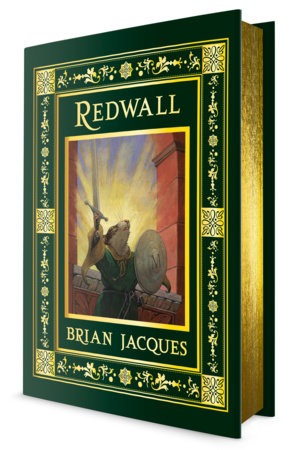
Fast forward friggin’ forty years and Redwall isn’t just a hit. It’s iconic, baby. And yet in spite of its various adaptations, it very much remains a literary phenomenon. So today, in honor not simply of its 40th anniversary but also the upcoming REDWALL: The Collector’s Edition (on sale October 13th) we have a bit of a treat for you. Not only will we be speaking with its editor, the iconic Patti Lee Gauch, but also illustrator Sean Rubin about continuing to illustrate the works.
ADVERTISEMENT
ADVERTISEMENT
Patricia Lee Gauch was Editorial Director of Philomel Books for almost 25 years and has edited three Caldecott books, Owl Moon by Jane Yolen, illustrated by John Schoenherr, Lon Po Po by Ed Young and So You Want to Be President by Judith St. George, illustrated by David Small. She has also worked with many well-known authors and artists, including Patricia Polacco, Eric Carle, T.A. Barron, Andrew Clements and Loren Long.
Sean Rubin is an artist whose first comics story was a contribution to the Eisner-winning Mouse Guard: Legends of the Guard anthology. He is also an illustrator for the New York Times Best-Selling Redwall Series; The Astronaut Who Painted The Moon (Scholastic, 2019); and The Passover Guest, (Neal Porter Books/Holiday House 2021), which won the 2022 Sydney Taylor Book Award. This Very Tree (Holt, 2021) was Sean’s first self-authored picture book, followed by The Iguanodon’s Horn (Clarion, 2024), which was a Cook Prize Silver Medalist.
Enjoy!
Betsy Bird: Patti! It’s been a minute or two since last we spoke! And how did I not know you were instrumental in editing Redwall back in the day? So let’s get down to basics. How did you get connected to this series in the first place?)

Patti Lee Gauch: I was lucky, Betsy. I started working at Philomel in November 1986 and the galleys for Redwall were on my desk when I came. The Putnam editor, Margaret Frith, had received the galleys from Caroline Roberts, the editor at the original British publisher Century Hutchinson but Margaret had never liked mice and knew that I, previously one of her writers, liked fantasies of all kinds, including animal fantasies. Arthur Levine, Margaret’s assistant then, had read the Redwall galley for her and advised her it was an outstanding fantasy. So, Margaret thought it might be just the right book to get me started in the publishing world “if I l read it and liked it.” I read it and loved it. So, we bought American rights from the British publisher.
BB: Wait, Arthur was involved in this whole process too? Geez! That’s fascinating in and of itself. So I had the pleasure of meeting Brian Jacques only once. The man had a great big personality. It just filled a room! So what was the process of editing him like? What did your working relationship resemble?
Patti: Brian was bigger than life. With that booming voice and scouser Liverpool accent he commanded attention wherever he went. Growing up in school he was the class clown. It took some early years before the teachers discovered he could write. One teacher, while reading an assignment Brian had written, thought he had plagiarized and punished him. But he was a natural storyteller, as many Liverpudlians are and he began to both write and perform. He ended up with a Sunday morning program for BBC called Jakestown.
I took over the primary editing on the fourth book. It was incredible to see the beauty in Brian’s words firsthand. He had such a rich imagination, extraordinarily visual, because he was originally writing the tale to give to children at the Liverpool School for the Blind. I always imagined him gathering the children and reading the newest Redwall manuscript to them in that booming voice. Redwall first of course, but there was a new and often startling richness in each of his books. Redwall was his world. He made it, he inhabited it and knew it right down to the abbey kitchens, the dibbuns (mice children) bathtime, the orchards of plum and apple. And, of course, the ever-presence of Martin the Warrior, the original hero of Redwall eventually remembered in a giant tapestry that hung on the Abbey wall.
BB: I want to get more into Brain’s verbal linguistics, but in spite of its origins there are visual elements to this series that I’d like to discuss as well. That’s where Sean Rubin comes in. Sean! What a delight to get a chance to speak with you today. Now if I’m correct about this, Gary Chalk was the initial illustrator of the Redwall series. Tell us a little bit about how you came onto the project later.

Sean Rubin: Always a delight to talk with you, Betsy! I started illustrating for Redwall when I was around 13, after I showed Brian Jacques my artwork at a booksigning (my parents made me bring my artwork. Turns out that was a good idea- Thanks, mom and dad!). I mostly did drawings for the Redwall website, and then I started making illustrations for the Recorded Books boxes, because once upon a time, audiobooks came in boxes. I illustrated my first Redwall novel, Sable Quean, when I was a senior in college.
BB: Wait, you seriously got started at 13? I feel like that may be a record for something somewhere. And for that matter, there must be a certain level of difficulty to following up the art of another artist on something as beloved as Redwall. How does one both pay homage to your predecessor’s work while, at the same time, offering something new?
Sean: Everyone who has worked on Redwall before me has been a truly talented artist. When I was younger, I was really motivated to put my own mark on the Redwall illustration tradition—I think each of the illustrators really struck out on their own when they took over the series, which has resulted in a diverse variety of styles. As an illustration nerd, I think that’s fantastic. Lately, I’ve been very inspired by Gary Chalk’s earlier illustrations. They’re enigmatic while still being wonderfully engaging. I wish I could strike that balance more often in my own work.
BB: I love that. Okay, Patti, in the pantheon of children’s literature, where would you say Redwall sits? What’s its legacy, to your mind.
Patti: Redwall was part of a new wave of fantasy books that emerged in the 70s. The Tolkien books, the Narnia books, the Lloyd Alexander Prydain series books had settled themselves comfortably into the cannon by the sixties. Fantasy was richly rediscovered, and Brian, publishing in 1987, with his incredibly beautiful and powerful language storytold in a way that invited children and adults into his circle. Redwall was, in many ways, the forerunner of Harry Potter. It created a whole world and a whole brave and loving cast of characters, not in the Arthurian range, but a new range: in its mice and otters, hares and badgers. The story of the brave, clever and loving, common man – the longshoreman shrew, the builder mole. Indeed, I felt as if Brian wanted to celebrate common folk, from the largest to the smallest. “Come into my world,” Brian seemed to say. “It is a brave and good world.” And readers came by the thousands. It opened up a love for a whole new kind of fantasy.

BB: Beautifully put. Let’s look at how one illustrates such a series. Sean, I so rarely have a chance to speak with an illustrator of a middle grade series, so forgive me if these questions sound rudimentary or basic. Still, I wonder if you could tell us a bit about how one goes about deciding what scenes to illustrate. Is that the choice of the Art Director, the Editor, or is it entirely your own choice?
Sean: These questions are great! When I was first starting out, the art director had a lot of input into which scenes I chose—and with good reason. I’m hopefully older and wiser now, so it’s mostly up to me. For Redwall, the trick is to pick an image from the first third or so of the chapter, and make sure that it’s not a spoiler. Chapter spots are pretty small, so the illustration can’t be too dense or complicated either. It’s almost like designing a logo for each chapter.
The process is to make sketches for each of the chapter spots, and send them to the art director and editor, and also to the Jacques family. They all take a look and let me know if I need to change anything. I think the first time I sent sketches, back in 2009, I was asked to replace more than half the proposed illustrations. The second time, I was asked to replace two. Growth!
BB: Oh man. For a process geek like myself, this is gold. So what do you find to be the most challenging thing to illustrate in a Redwall book? And what do you like bringing to life the most?
Sean: The biggest challenge is probably how small those chapter spots really are—basically the size of a business card. Or is that the smallest challenge?
And I love drawing anything involving medieval architecture, or badgers. Preferably badgers in armor. Or just suits of badger armor. Or maybe badgers with massive swords or battle axes. Also—more badgers.
BB: Badgers are hard to beat. Patti, this next query is a bit of an unfair question, but do you have a favorite Redwall book? And, if so, which one and why?
Patti: Of course I loved Redwall first and most. But there were two books that I held in particularly high esteem: I loved Martin the Warrior. There was a richness of moment in this book, a lovely feast, visiting “players” in the courtyard, the color, the music, along with the threat that had to be answered! But I also loved The Legend of Luke. There was, for the first time, a grandeur and real feeling, particularly in Luke himself, the father of Martin. A reason to admire Luke in an entirely new way.

BB: Well selected. Sean, did you ever have a chance to work with Brian Jacques himself or were you pretty much siloed off from him in general?
ADVERTISEMENT
ADVERTISEMENT
Sean: I’m honored to say that Brian and I were good friends—honestly, he was more like an uncle. He even wrote a college recommendation letter for me, which was just the coolest thing ever. I miss him a lot, but I keep in touch with his family regularly. I may have also given one of my children the middle name “Jacques,” with their blessing.
BB: WOW! That is dedication. With all that in mind, Patti, and Redwall now hitting its 40th anniversary, what’s next for the series? Where does it go in the future?
That is such a good question. I think the series should sit forever among the treasured books like The Hobbit, Chronicles of Narnia, the Prydain series, The Wizard of Earthsea, and The Golden Compass. And, yes, of course, the Harry Potter books. I like to think that every parent will share a reading of the Redwall books, and perhaps as Brian did, take each of the roles of the rich and wonderful animal characters themselves. Can you hear them? More Redwall news will be coming in the fall that readers will be thrilled about.
BB: Oh, good answer. Sean? Where else can we find your art? And what else are you working on these days?
Sean: I’m at Seanrubin.com and @seancrubin in instagram. Dean Robbins and I have a book coming out in about a year from Scholastic, called “The Genius Next Door.” It’s a true story about Albert Einstein helping a young neighbor with her homework, and I’m really excited about that one. I’m currently working on Copy Cat, a middle grade graphic novel that I co-created with Elyse Martin, which involves even more medieval architecture, but currently no badgers. Might need to fix that. And there may be one or two other projects I cannot wait to announce!


Lots of announcements in our future. Lots of good things going on right now. I’d like to thank both Patti and Sean for taking the time to answer my questions today. That REDWALL: The Collector’s Edition is slated to be on sale October 13th so be sure to look for it then.
Filed under: Interviews

About Betsy Bird
Betsy Bird is currently the Collection Development Manager of the Evanston Public Library system and a former Materials Specialist for New York Public Library. She has served on Newbery, written for Kirkus, and has done other lovely little things that she'd love to tell you about but that she's sure you'd find more interesting to hear of in person. Her opinions are her own and do not reflect those of EPL, SLJ, or any of the other acronyms you might be able to name. Follow her on BlueSky at: @fuse8.bsky.social
ADVERTISEMENT
ADVERTISEMENT
SLJ Blog Network
One Star Review, Guess Who? (#237)
And Then There Were None (The Manga Adaptation) | Review
Unconventional Narratives in Newbery Contenders
From Policy Ask to Public Voice: Five Layers of Writing to Advance School Library Policy
A Bad God’s Guide to Fart Jokes and Philosophy, a guest post by Louie Stowell
ADVERTISEMENT
I am SO excited for this new edition…and the fact that there’s more news coming!!!
I love the Redwall series…and even wrote my master’s thesis on it!